

News   Apr 02, 2026
 1.3K     1 
News   Apr 02, 2026
 777     0 
News   Apr 02, 2026
 2K     2 

GO Transit: Service thread (including extensions)

We did a Vlog for the first week of weekend service on the Stouffville Line:

The trains I took even on Sunday night all had a decent number of people on them, I counted 40 Sunday night (yes I walked through the train). Sure that's only one busload but, everyone I talked to far preferred the service to the buses, probably about 20 on and off between Kennedy, Agincourt, and Milliken as well which had no service from the buses.

Given this and the fact that the service was not really advertised as heavily as it could be ("Take the GO Train to Pacific Mall, Unionville and Markham!"), I think the service will be quite sucessful.

I took the last Stouffville train home from Union to Kennedy tonight and there were more than a few people.

As someone who once took a 9.5 hour bus ride across England I can see why they would prefer it over a bus.
 
New pictures today at Highway 401, Weston Go and Mount Dennis Go
20191105_103127.jpg
20191105_103042.jpg
20191105_103441.jpg
20191105_103440.jpg
20191105_102802.jpg
20191105_103439.jpg
20191105_103434.jpg
20191105_102800(0).jpg
20191105_103431.jpg
20191105_102746.jpg
20191105_103138.jpg
 
^. great shots. Are they building a high level platform for UP Express? That's what it looks like in one of your pictures (extracted below). Look like the bases for support columns.

213570
 
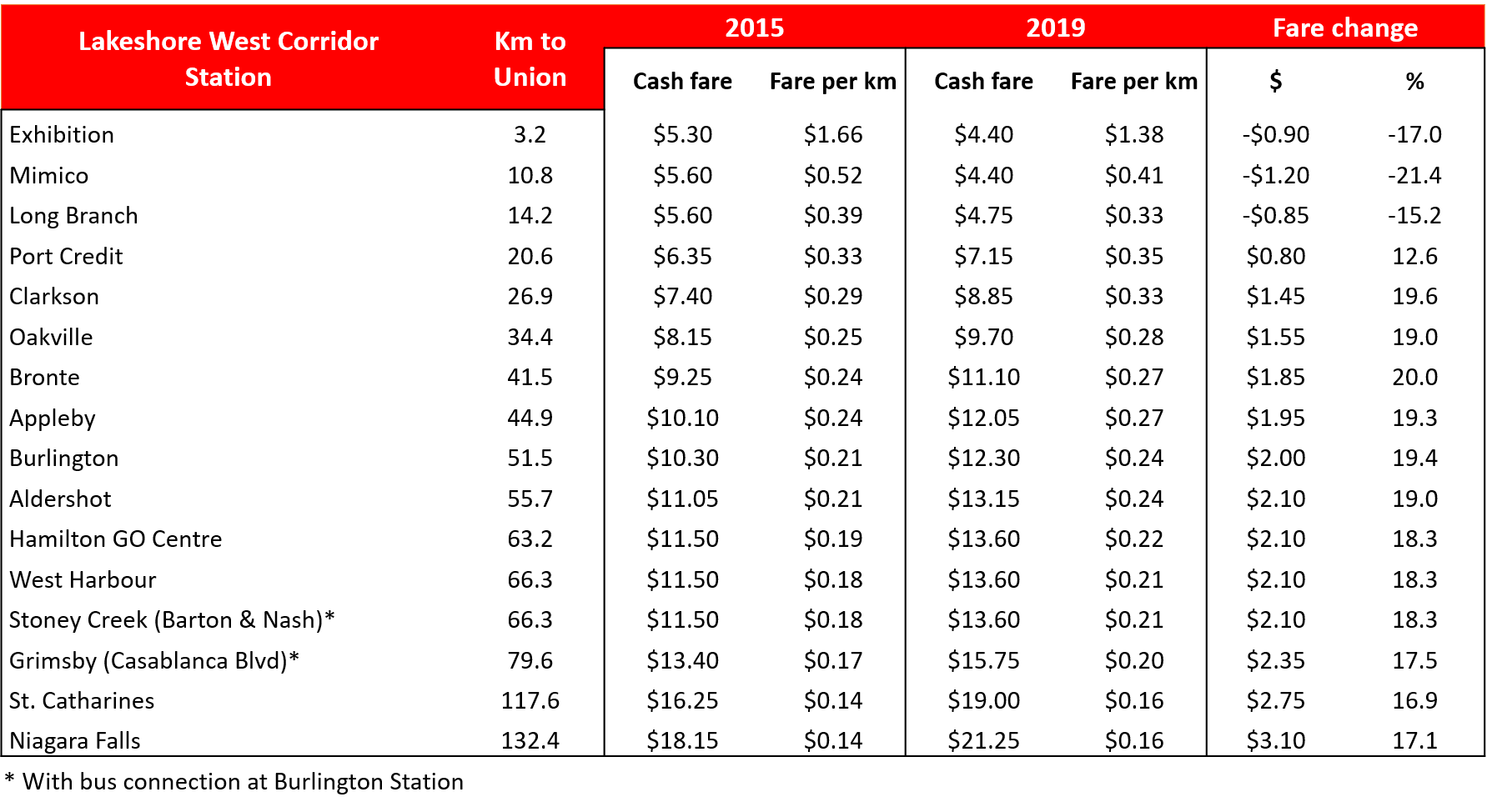
Four years ago, I did a fare analysis of GO Transit's tariff structure, which was a miserable mess. It's improved, with lower fares for short trips and the TTC/GO co-fare. but I still found several issues.

The "fare-by-distance" model still has a lot of discrepancies. The fares on the Barrie and Richmond Hill Corridors, especially outside of Toronto, are priced far lower than the other corridors. The Kitchener Corridor stations pay the highest fares per distance, with Malton Station being the biggest rip-off of all the 905 stations (it also had the highest % fare increase in the last 10 years).

GO fares have risen, on average, over 40% over the last ten years, twice the rate of inflation.

I discuss this in further detail (and include a map of all stations, with current and previous fares to Union Station, and the number of parking spots).

 
Four years ago, I did a fare analysis of GO Transit's tariff structure, which was a miserable mess. It's improved, with lower fares for short trips and the TTC/GO co-fare. but I still found several issues.

The "fare-by-distance" model still has a lot of discrepancies. The fares on the Barrie and Richmond Hill Corridors, especially outside of Toronto, are priced far lower than the other corridors. The Kitchener Corridor stations pay the highest fares per distance, with Malton Station being the biggest rip-off of all the 905 stations (it also had the highest % fare increase in the last 10 years).

GO fares have risen, on average, over 40% over the last ten years, twice the rate of inflation.

I discuss this in further detail (and include a map of all stations, with current and previous fares to Union Station, and the number of parking spots).


This is, simply, an excellent post!

Great research, great contribution to understanding what is; and insight in to how it might be better. Thank You.
 
There's a law of unintended consequences.

The move of the Hamilton stop of the #20 GO bus adds a lot of time to the average Niagara-Hamilton GO commute for bus users.

Massively better for car drivers, but massively worse for transit users.

This will change over time, but many think the imbalance needs to be addressed.

https://www.metrolinxengage.com/en/content/ask-metrolinx-november-14-2019


214539
 
Last edited:
Do you expect anything else from GO Transit? The Grimsby bus stop at Casablanca Blvd is good for drivers with a park and ride, but inaccessible to most Grimsby residents without a car.

The Milton Highway 25 park & ride is where GO buses 25 and 29 stop on their way to Guelph and Kitchener-Waterloo. But there's no sidewalk, and very limited Milton Transit service. It's only within walking distance from the Milton Hilton and McDonald's.

GO Transit doesn't think about these things. And sadly, local transit agencies don't either. The Centennial Station Park and Ride would be an ideal terminal for the B-Line bus, allowing transit riders to park there and ride into Downtown Hamilton and McMaster too.
 
There's a law of unintended consequences.

The move of the Hamilton stop of the #20 GO bus adds a lot of time to the average Niagara-Hamilton GO commute for bus users.

Massively better for car drivers, but massively worse for transit users.
FYI, it's GO route 12, not 20.
 
Still should have some dialogue spoken on this matter; it's been a longtime thorn on the side of many Hamiltonians.

It quickly skyrocketed to #2 question on MetrolinxEngage only 30 minutes after I tweeted. I tagged a lot of the complainers in the image attachment, which caused some retweets, so that probably helped.

I also noticed HSR has a new map-based suggester at https://myhsr.hamilton.ca ... Submitted to them that way.
 
Do you expect anything else from GO Transit? The Grimsby bus stop at Casablanca Blvd is good for drivers with a park and ride, but inaccessible to most Grimsby residents without a car.
Any location is Grimsby would be inaccessible to residence without a car because the city has no public transit... Until that changes, it makes way more sense to have the bus stop next to a parking lot, even if it's close to the edge of the city. The point is to take cars off of the highway.
 
Any location is Grimsby would be inaccessible to residence without a car because the city has no public transit... Until that changes, it makes way more sense to have the bus stop next to a parking lot, even if it's close to the edge of the city. The point is to take cars off of the highway.

I think what ShonTron was suggesting was that a stop closer to the middle of town - such as, for instance, the VIA station - would be accessible to more residents by walking or cycling, rather than waiting for a local bus service that doesn't exist. The Casablanca Blvd. stop is deally suited for capturing people heading to Hamilton and Toronto by auto, but is really only accessible without a car to a very small percentage of the community.

It is certainly symptomatic of a bigger problem inside of Metrolinx, and one that has been a concern for a long time. They simply are not able to disengage their thought processes from the automobile, and thus their stations are generally scaled and designed in that way. Huge parking lots, long walking distances from primary destinations or even just from the streets, and long, winding accesses for buses that add far too much time to effectively serve the stations properly.

Dan
 
I think what ShonTron was suggesting was that a stop closer to the middle of town - such as, for instance, the VIA station - would be accessible to more residents by walking or cycling, rather than waiting for a local bus service that doesn't exist. The Casablanca Blvd. stop is deally suited for capturing people heading to Hamilton and Toronto by auto, but is really only accessible without a car to a very small percentage of the community.

It is certainly symptomatic of a bigger problem inside of Metrolinx, and one that has been a concern for a long time. They simply are not able to disengage their thought processes from the automobile, and thus their stations are generally scaled and designed in that way. Huge parking lots, long walking distances from primary destinations or even just from the streets, and long, winding accesses for buses that add far too much time to effectively serve the stations properly.

Dan

This really is a huge problem. It feels like Metrolinx/GO has for decades tried to target a very narrow slice of the population: people who own cars but sometimes don't want to drive them (implicitly, into Toronto). What it does in practice is reinforce the Toronto-centric hub-and-spoke model with few lateral connections, depress potential local transit ridership (as you now need a car to get to the station anyway), and also selects for people who are wealthy enough that they can choose to pay for both car ownership and transit. Most people realistically can only afford one or the other, especially because of the price structure of both -- buying an occasional ticket isn't as cost-effective as owning a monthly pass, and buying a car creates a sunk cost fallacy that makes you more likely to drive it everywhere. The baseline demographics that underpin transit ridership are car-free people: students, seniors, people with disabilities, urban-dwelling professionals, low-income people who can't afford a car. Getting suburbs and smaller cities to switch to transit requires an investment in local networks that allow at least a limited number of people to make the switch, and that doesn't happen through park n rides, it happens through funding local transit. There's a reason why the relatively modest PTIF grants are having such a huge effect with a number of small, rural bus systems starting up, which in practice are just a successor to/replacement for the private bus lines that used to operate throughout Ontario until the 1980s and 1990s.

When you look at suburban GO stations (bus or train), these should really be minor hubs that take advantage of their often-ample station land to have local buses handle transfers, as well as at least some walkable proximity to amenities. Instead they are often total ghost towns that require a cab ride to get to or very careful timing with local transit, and are often pretty disconnected from local transit agencies' networks. The point being missed here is that strengthening transit anywhere strengthens transit everywhere, because the stronger someone's local transit is, the more likely they are to permanently go car-free, and car free people are what underpins transit, period. The goal of the next 20-30 years should be not so much trying to induce drivers to take single trips by transit instead of by car (because that's a niche case that selects for particular demographics), but pre-empting car ownership and driving amongst teens and students (already a process that's matured in many places) and providing enough incentives to take transit (and enough disincentives/discouragement to drive) that people give up their cars altogether and become full-time transit riders.
 

Back
Top