

News   Apr 02, 2026
 665     1 
News   Apr 02, 2026
 516     0 
News   Apr 02, 2026
 1.5K     2 

VIA Rail

I dont think you understand the scale.

I don't think you fully understand what I am saying.

Lets say the train has a range of 50KM's on battery and before it can get to the station to charge what would happen then?

A train with only a 50 km range would only work on the very shortest of dead zones, and I don't think anyone would expect it to be feasible for VIA.

That's different from a 2000km range and then being able to get diesel delivered to you almost anywhere there is road access. The buffer range is not even close to that of a battery train, and the battery train you need to get another train to tow it to the station to charge.

How often do VIA trains actually run out of fuel? Sure it happens to freight trains all the time, but the consequences of that are significantly smaller, and it becomes a financial decision based on cost vs. risk. With a VIA train, when you run out of fuel, you loose HEP, thus the HVAC systems stop working, and that affects not only passenger comfort, but passenger safety. VIA needs to be confident that they have enough fuel to get to their destination every time, regardless of eventualities.

As for the 2000km range, sure that is nice, but AFAIK, VIA only refuels their corridor locomotives once a day, and that is probably still double the range that they need (giving them plenty of reserve). If VIA can charge at every station and along every stretch of track that has catenary, you only need enough range to get to the next place you can recharge, though admittedly with an extraordinarily high level of confidence.

In the end, could VIA deploy battery powered trains today? No. The infrastructure isn't there and range isn't good enough, yet.

Could VIA deploy battery powered trains along the corridor in a decade? Maybe. If Metrolinx and EXO electrify the routes that they share with VIA, VIA electrifies much of the track they own, and the energy density of batteries continues to increase at the same pace as it has over the past decade, then it might be a feasible on certain routes.
 
That's different from a 2000km range and then being able to get diesel delivered to you almost anywhere there is road access.
Which car gives you 2,000 km? I've been not considering all-electric, because I didn't think anything had even a 1,000 km range.
 
I don't think you fully understand what I am saying.


A train with only a 50 km range would only work on the very shortest of dead zones, and I don't think anyone would expect it to be feasible for VIA.


How often do VIA trains actually run out of fuel? Sure it happens to freight trains all the time, but the consequences of that are significantly smaller, and it becomes a financial decision based on cost vs. risk. With a VIA train, when you run out of fuel, you loose HEP, thus the HVAC systems stop working, and that affects not only passenger comfort, but passenger safety. VIA needs to be confident that they have enough fuel to get to their destination every time, regardless of eventualities.

As for the 2000km range, sure that is nice, but AFAIK, VIA only refuels their corridor locomotives once a day, and that is probably still double the range that they need (giving them plenty of reserve). If VIA can charge at every station and along every stretch of track that has catenary, you only need enough range to get to the next place you can recharge, though admittedly with an extraordinarily high level of confidence.

In the end, could VIA deploy battery powered trains today? No. The infrastructure isn't there and range isn't good enough, yet.

Could VIA deploy battery powered trains along the corridor in a decade? Maybe. If Metrolinx and EXO electrify the routes that they share with VIA, VIA electrifies much of the track they own, and the energy density of batteries continues to increase at the same pace as it has over the past decade, then it might be a feasible on certain routes.
Okay so lets say the distance between Toronto and Ottawa is 400KM. This train has on intermediate stop at Kingston which is half way (200KM). This means that this battery operated train needs a 425-450 KM Range incase it cant charge at Kingston and to be confident to reach it's destination without an issue.

Now lets say that the train could not charge at Kingston because of some glitch. If the train didnt have that much range, the trip would need to be suspended until the train can be charged.
OR the train would need to be designed to be able to a one way trip to Ottawa from Toronto without the requirement to charge.

Also currently the amount of energy required to charge a locomotive at Kingston would likely be a 40 min lay over making the trip 40 minutes longer unless you plan to change locomotives half way, which also takes time and requires more capital expenditure.

So as of RIGHT NOW only trains in an urban environment with multiple stops are feasible. 100KM route with 10 stops along the way and a dwell time of 2-5 minutes per station. This way the train likely has 100KM of range but charges along the way "top up" 10% of the battery at each station.

Does that make sense?
 
I don't get the doctrinaire viewpoint that only one technology can win. VIA operations are all very different. And there will be different technologies for different applications in different timeframes. And all of this is far, far less important than VIA getting its own track.

I agree 100%! Catenary, batteries and hydrogen will all likely have a role to play as VIA electrifies its operations over the next 30 years. The exact mix is rather fuzzy at the moment though, and rather than be distracted by the details, it is more important to create an environment where VIA can get a larger modal share in the corridor.
 
I agree 100%! Catenary, batteries and hydrogen will all likely have a role to play as VIA electrifies its operations over the next 30 years. The exact mix is rather fuzzy at the moment though, and rather than be distracted by the details, it is more important to create an environment where VIA can get a larger modal share in the corridor.

I agree. There is no such thing as "one size fits all" when it comes to rail or any transport mode for that matter.

As we quickly decarbonize it is imperative that VIA is ahead of the game and not behind it if they want to increase ridership in the Corridor in the medium term. Trucks and buses will be the first major mode to transfer over to zero emissions whether that be battery or hydrogen all depending on such things as distance. It's very possible that nearly all inter-city Corridor bus services will be using zero emissions vehicles by the end of this decade.

Can you imagine VIA's ads in 2030-35,.............."Help kill the planet, take the train! "
 
^
Can you imagine VIA's ads in 2030-35,.............."Help kill the planet, take the train! "

If there are any gas autos left by 2030, and I think there will be, getting people out of cars and onto diesel trains will save more carbon than removing carbon from the rides of existing passengers. Getting people out of A-220‘s and B-737 Max’s ditto. Those aren’t being delivered with expectations of a 9 year service life.

It’s more important for VIA to spend whatever capital is available on extending the network and raising modal share. Sure, buy carbon free equipment for whatever niches come along, but running the Chargers til 2040 is quite appropriate.

- Paul
 
^


If there are any gas autos left by 2030, and I think there will be, getting people out of cars and onto diesel trains will save more carbon than removing carbon from the rides of existing passengers. Getting people out of A-220‘s and B-737 Max’s ditto. Those aren’t being delivered with expectations of a 9 year service life.

It’s more important for VIA to spend whatever capital is available on extending the network and raising modal share. Sure, buy carbon free equipment for whatever niches come along, but running the Chargers til 2040 is quite appropriate.

- Paul
If the feds would allow provinces and municipalities to pitch in and build stations and help pay for trains that would help them be more successful. Train stations used to be the hub of each city but with cars that has changed.

We need to make train stations a hub again.

Also phasing in new rolling stock in stages would make it less expensive.
 
Off topic by why do you need a car with 1000km range? Can you drive for 8-10 hours without stopping to pee?
Charging stations were very rare last time I bought a new car - and not quick to charge. I can't say I've seen a lot of them really, but they are starting to become a bit more common. 1000 km is rare, but I frequently do 750 km - occasionally up to 1,200 km.

Hence my curiosity on what gives a 2.000 km range? Charge times under 5 minutes would be a game changer too
 
Hence my curiosity on what gives a 2.000 km range?
A diesel locomotive (though in the case of VIA's non-Corridor services, the hours spent in sidings depress the range offered by the F40's fuel tanks).

Can we now get back on-topic, or even better: outsource the pointless "Overhead catenary vs. Hydrogen vs. Battery trains" discussion to the "General Railway discussions" thread, as (in absence of widespread infrastructure ownership) VIA can only adopt whichever electrification technology has been implemented by its host railroads?
 
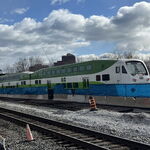
VIA seems to have brought back assigned seating and largely restored service between Ottawa and Montreal by reintroducing the Ren and Stainless Steel fleets. The departure schedule now appears to be mostly the same as the pre-pandemic service offerings but with without the occasional onwards service to Fallowfield or the departures from Ottawa and Montreal at ~11:20 and ~15:00 respectively.

I'm not 100% sure that the Ren trains are fully back into service but the I've been assigned a single seat for my trip back to Montreal and just saw one with passengers waiting on the approach into Montreal as the Stainless train I'm currently riding was also held up on departure due to some signal/switching drama.

1631381596617.png
 
Can you imagine VIA's ads in 2030-35,.............."Help kill the planet, take the train! "

The current federal target for auto electrification is 30% by 2030. The Liberals are pledging to raise that to 50% by 2030, to align with the Biden Administration. The Conservatives are pledging to keep the current 30% target. With half of sales being electric, easily 75-80% of cars on the road will still be burning gas. Even by 2035, when 100% of car sales are supposed to be electric, easily 40-50% of the cars on the road will be burning gas. VIA is going to the greener way for a long time to come.

Of course, the best argument for taking the train should never be environmental. It should be because the train is more comfortable, convenient and cheaper. We all know, very few people ever do anything solely for environmental good.
 

Back
Top