

News   Apr 01, 2026
 117     0 
News   Apr 01, 2026
 410     0 
News   Apr 01, 2026
 389     0 

VIA Rail

Time is money. If $20 gets you there 30 min faster, for some people it's worth it

I know. I am not against Via running service that can be used as commuter service. I am against anyone running service that will be used as commuter service, without taking into account the sprawl that will follow it. So, HSR will be used as commuter service. That is why Via, if they run it, should be talking with the communities they will stop in to ensure the city is prepared for the sprawl that will follow.
 
So, you are saying that if you know that your project will cause bad things, you are not going to mitigate them somehow? Via could go to the city and tell them they need a solid growth plan before they get HSR extended to it.

1) There's no HSR proposal from VIA to London. There's not even an HFR proposal from VIA to London. We're all speculating that VIA would pursue Toronto-Kitchener-London in a second phase. But that's easily half a decade or more off.

2) VIA has neither the ability nor role to assess impacts on housing from their infrastructure projects. All they can do is keep local municipal officials in the loop and let them determine the local impacts. From all that has come out, like say the Kingston hub from that city's mayor, they clearly do at least tell politicians in these cities and towns what they are planning years in advance.

3) All infrastructure that speeds up travel will bring in new residents. If local politicians don't know this or don't plan for this, that's on them. If suddenly aviation became cheaper and it was possible to commute by air from London, you would see the same impact. If we have self-driving cars in 10 years and special highways that allow 200 kph speeds, you'd see the same impact. It's up to local officials to stay aware of developments that impact their cities. You won't see Elon Musk briefing London City Councillors everytime he improve the autonomy of Teslas.

I'd think the city council would move heaven and earth to ensure the plan is great as they know what a HSR station would mean for the city.

They didn't do much for the Ontario HSR proposal. I don't expect different with the VIA HFR proposal when it eventually comes. London is a city filled with politicians who think public transport exists to move around students and retired people. Not a particular hit on London. Most smaller Ontario cities and towns have local politicians who think that way. So I wouldn't expect much.

Without a good solid plan, HSR could cause housing prices to become unaffordable. Growth is good, unafordable isn't.

HSR isn't going to make London suddenly cost the same as the GTA. It's still London. And it's still 200 km away. It also takes time for people with jobs and families to plan for and take advantage of such infrastructure. You won't suddenly see 50 000 lawyers, accountants and programmers move en masse from the GTA. What HSR or HFR might do is add to growth. Say an added 1% per year on top of existing growth trends. It will also grow the job market available to London professionals. Moving up won't have to mean moving out.

I have about 10 cousins who live in London. All are gainfully employed. They all have different education from barely high school to some college.

Good for your cousins. But that's not the type of people who usually leave these towns and cities. The folks my wife knows who left are all middle class professionals. Lawyers, doctors, accountants. One is a fashion designer. And another is a chef at a high end restaurant. If London was better connected and had a large base of upper income resident who could support more options (like a high end restaurant), more of those folks would still be in London. And that's the point. These are exactly the sort of people who would either stay in London or even move back, if the connectivity was better.
 
1) There's no HSR proposal from VIA to London. There's not even an HFR proposal from VIA to London. We're all speculating that VIA would pursue Toronto-Kitchener-London in a second phase. But that's easily half a decade or more off.

2) VIA has neither the ability nor role to assess impacts on housing from their infrastructure projects. All they can do is keep local municipal officials in the loop and let them determine the local impacts. From all that has come out, like say the Kingston hub from that city's mayor, they clearly do at least tell politicians in these cities and towns what they are planning years in advance.

3) All infrastructure that speeds up travel will bring in new residents. If local politicians don't know this or don't plan for this, that's on them. If suddenly aviation became cheaper and it was possible to commute by air from London, you would see the same impact. If we have self-driving cars in 10 years and special highways that allow 200 kph speeds, you'd see the same impact. It's up to local officials to stay aware of developments that impact their cities. You won't see Elon Musk briefing London City Councillors everytime he improve the autonomy of Teslas.

1) I know that, but when talking about it, we should also talk about doing it right. Ignoring the sprawl that will happen means we aren't doing it right.

2) That is what I am talking about. Others were thinking that I meant that they would bypass the city. No, I just mean good conversations about planning for the increase in passenger service.

3) Those won't have the same impact as a HSR will. Besides, those are private entities. Via is still public.

They didn't do much for the Ontario HSR proposal. I don't expect different with the VIA HFR proposal when it eventually comes. London is a city filled with politicians who think public transport exists to move around students and retired people. Not a particular hit on London. Most smaller Ontario cities and towns have local politicians who think that way. So I wouldn't expect much.

I know that. However, I'll bet that if HSR or GO were to be extended, those politicians would need to start thinking about it.

HSR isn't going to make London suddenly cost the same as the GTA. It's still London. And it's still 200 km away. It also takes time for people with jobs and families to plan for and take advantage of such infrastructure. You won't suddenly see 50 000 lawyers, accountants and programmers move en masse from the GTA. What HSR or HFR might do is add to growth. Say an added 1% per year on top of existing growth trends. It will also grow the job market available to London professionals. Moving up won't have to mean moving out.

Distance is not the key here, travel time is. That is why places like Hamilton, Kitchener, Barrie and Oshawa all are becoming bedroom communities for Toronto.

1% is fine. We were seeing closer to 10%-20% in Toronto and some parts of the GTA. That is not sustainable. When the bubble pops, which it might be doing, things will get bad and stay bad for a while. Let's learn from that and prevent other cities going through that.

Good for your cousins. But that's not the type of people who usually leave these towns and cities. The folks my wife knows who left are all middle class professionals. Lawyers, doctors, accountants. One is a fashion designer. And another is a chef at a high end restaurant. If London was better connected and had a large base of upper income resident who could support more options (like a high end restaurant), more of those folks would still be in London. And that's the point. These are exactly the sort of people who would either stay in London or even move back, if the connectivity was better.

Notice how I never said exactly what they do, just their education and sector. At least 4 of my cousins make 6 figures, and could easily do their work in Toronto. They choose not to because of how good London is for them. Toronto is not the be all and end all.
 
1) There's no HSR proposal from VIA to London. There's not even an HFR proposal from VIA to London. We're all speculating that VIA would pursue Toronto-Kitchener-London in a second phase. But that's easily half a decade or more off.
As fascinating as the discussion about the interplay between HSR development and the housing market and other social issues might be to certain posters here, it indeed hardly touches the topic of this thread, so can we please move it to a more relevant thread?

I would suggest the following one:

High Speed Rail: London - Kitchener-Waterloo - Pearson Airport - Toronto
 
I know that, but when talking about it, we should also talk about doing it right. Ignoring the sprawl that will happen means we aren't doing it right.

Start a thread for transit induced sprawl. Because this really isn't the place to "talk about doing it right". What happens locally with increased growth is a local problem. It's not a provincial or national concern. Nobody is going to stop building infrastructure because somebody is worried that people might actually use that infrastructure to move to their town.

That is what I am talking about.

Nope. You simply assumed (as you always do) that nobody else has a clue and that VIA just shows up with a construction crew and starts randomly building billion dollar rail infrastructure without telling anyone.

Those won't have the same impact as a HSR will.

I would bet money that if we had self-driving cars capable of high speed driving, or cheap commutes with electric airplanes, the impact would be substantially more than any rail infrastructure. Indeed, lots of planners are actually freaking out about the potential impacts of full autonomy electric vehicles. And that concern is actually part of why you're see cities (not in Canada of course....we aren't that forward thinking) push to severely restrict car use. They want to get ahead of cars becoming even cheaper and easier to operate.

Besides, those are private entities. Via is still public.

Doesn't make a difference. No entity is responsible for what happens in your local community but your local politicians. Those entities can (and do) share their plans. And warn about the need to plan for downstream impacts. But it's up to local communities to assess what those impacts will be and how they will handle them.

I'll bet that if HSR or GO were to be extended, those politicians would need to start thinking about it.

Again. They didn't show much interest when the Ontario HSR proposed. They didn't change any of their official plans. They didn't talk about how they might fix that decrepit area near the current station. Nothing. And since then, they've actually ditched the LRT proposal. So don't expect that warnings might make a difference.

On the other hand, I expect substantially different reactions from places like Kingston and Peterborough. They've been gearing up to take advantage of anything VIA does. It's clear they've been engaging VIA and are vocal about more and better service.

Like anything else you always have the A and C students in any pack.

Distance is not the key here, travel time is.

No. Cost is key. That travel time will come at a substantial cost. Which is why this won't be the average professional from Toronto moving.

Notice how I never said exactly what they do, just their education

You didn't have to same much. "Some college" doesn't usually lead to the types of middle class professions we were discussing.

At least 4 of my cousins make 6 figures, and could easily do their work in Toronto.

Nobody ever said you can't make 6 figures living in London. Your cousins could do their work in Toronto. But they don't NEED to do their work in Toronto. That's the difference.

What you can't do in London is climb the ladder at a top law or accounting or tech firm. Can't be a Bay St. trader from London. Not a lot of jobs in advertising, finance, environmental consulting. Etc. There are jobs that will never exist in London. And levels in certain professions that will never exist in London, even if the professions themselves are practised in London. This isn't a hit on London. This is just reality that certain opportunities comes with size. Just like at a certain level in the corporate world, Canada itself is too small, and people might have to move to the US or Europe to further their careers.

Toronto is not the be all and end all.

Nobody ever said it was.
 
As fascinating as the discussion about the interplay between HSR development and the housing market and other social issues might be to certain posters here, it indeed hardly touches the topic of this thread, so can we please move it to a more relevant thread?

I would suggest the following one:

High Speed Rail: London - Kitchener-Waterloo - Pearson Airport - Toronto


He can create a thread on transit induced sprawl if he wants.

The assertion that we need to consider and VIA is responsible for all second and third order effects of their rail line is patently ridiculous. Goes well with the fantasy world where VIA isn't telling municipal officials a thing while planning or building infrastructure. Does anyone seriously believe that if a $3B HFR West was planned, VIA's CEO wouldn't be having a few chats with the mayor of every city on that route? This is just the usual from a certain poster who believes that everyone else is incompetent and only he can see the issues....

I have actually long argued against transit induced sprawl. See the MOOSE Rail Thread. But it's a real stretch to think HFR and HSR would induce anywhere near the kind of growth that GO service does.
 
Last edited:
^^ I agree. I don't think Canada will see any true HSR in any of our life times. The political will simply isn't there and CN & CP have huge political sway in Ottawa. Service in The Corridor will certainly improve but again that says precious little as it couldn't get much worse.
 
Moving back to the question of whether or not trains 650 gets wyed (before returning as 651/655):
But there is no wayside power so they just left the train tied down idling all night? And the station is on the main line. Where did they WYE the train?
No idea about the wayside power, but I'd assume that the train (if non-push-pull) is wyed at the wye where I saw the trainset...

I was reminded in the meanwhile that VIA faced capacity issues on train 651 during the summer of 2017, which I had reported here:
Trains 650/651/655 already operate between Kingston and Toronto exclusively and this is what happens whenever the fourth (!) car is unavailable:
Tweet 1: "@VIA_Rail what's up with the shortened 651 train? One car short and people have to stand on the way in to TO."
Tweet 2: "@VIA_Rail 651 train absolutely needs another car on Monday mornings."
Tweet 3: "Hey Via, any news on where the fourth car went off 651 this morning? I know it's 70 yr old technology, but it was there last week"
Tweet 4: "@VIA_Rail Great stuffed Morning. End of long weekend and Via takes a car off 651. Make for a way too cozy trip. Just nutty planning!!"
Tweet 5: "@VIA_Rail please put an extra car on the 651 on a Monday morning. Tickets are sold out tomorrow and commuters need to be in work before 9am"

Back then, train 650 and 651/655 was a captive consist formed by one locomotive and 4 Economy coaches*, which was wyed after arrival in Kingston. However, due to some equipment availability issues (the Canada 150 Youth Pass madness on the Canadian certainly didn't help), the 4th coach was unavailable on a few trips, which caused major dissatisfaction amongst its users.

*Edit: actually, the first coach was a Business car, but deployed as an Economy car.

Later that year, VIA introduced the 10th frequency between Toronto and Ottawa with trains 53 and 54. Since 54 took the 17:40 slot, train 650 instead became a new evening departure. This later departure time of train 650 (19:35) allowed to have 651 cycle with train 40 (later: 42) and 47 with 650 (thanks to push-pull operations), thus freeing up the additional trainset required for increasing service between Toronto and Ottawa and adding Business Class service to trains 650 and 651, while obviating the need to wye trains in Kingston:
October 30, 2017
MORE DEPARTURES BETWEEN TORONTO AND OTTAWA

Toronto, October 30, 2017 - Starting November 5, VIA Rail will be offering 20 weekday departures between Toronto and Ottawa thanks tothe addition of a 10th round-trip, giving Canadians even more options for their travel. As well, a new evening departure from Toronto to Kingston will be added, along with additional stops in Trenton Junction and Guildwood.
“For the third time in three years, new departures will be added between Toronto and Ottawa, allowing more passengers to make the sensible choice to leave their cars at home. With each added frequency, VIA Rail sees a significant increase in ridership. On this popular segment, the number of travellers has increased by 40% since 2014. With this addition, we will be able to serve more Canadians, help reduce the carbon footprint of their journeys, and improve our financial performance,” said VIA Rail President and Chief Executive Officer Yves Desjardins-Siciliano.

NEW DAILY DEPARTURES

Toronto-Ottawa

Train #Toronto DepartureStopsOttawa Arrival
54
From Monday to Friday
17:40Guildwood, Oshawa, Port Hope, Cobourg, Trenton Jonction, Belleville, Napanee, Kingston and Fallowfield22:07
42
Saturday and Sunday
12:20Oshawa, Kingston and Fallowfield16:33

Ottawa-Toronto
Train #Ottawa DepartureStopsToronto Arrival
53
From Monday to Sunday
11:40Fallowfield, Kingston, Belleville and Oshawa16:03

TORONTO–KINGSTON
As of November 5, travellers departing from Toronto heading to Kingston will have more options for their travel, with a new round-trip departure between Toronto, Kingston and Ottawa, as well as a new evening departure from Toronto to Kingston.
Also new: VIA Rail will offer Business class service on trains Nos. 650 and 651 between Toronto and Kingston. Passengers can therefore enjoy access to Business lounges in Toronto and Kingston, superior comfort, delicious menu options* and priority access to ticket and check-in counters.
[...]
* Full meal service is offered on almost all routes. On short distances, such as between Toronto and Port Hope, Toronto and Cobourg, Oshawa and Belleville, as well as between Cobourg and Kingston, snacks and complimentary beverages are available.
 
Last edited:
^^ I agree. I don't think Canada will see any true HSR in any of our life times. The political will simply isn't there and CN & CP have huge political sway in Ottawa. Service in The Corridor will certainly improve but again that says precious little as it couldn't get much worse.
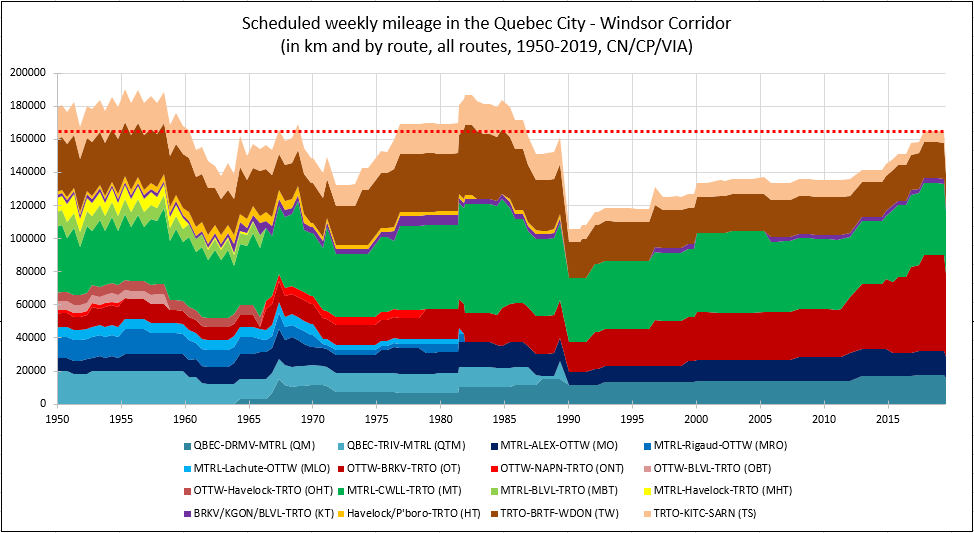
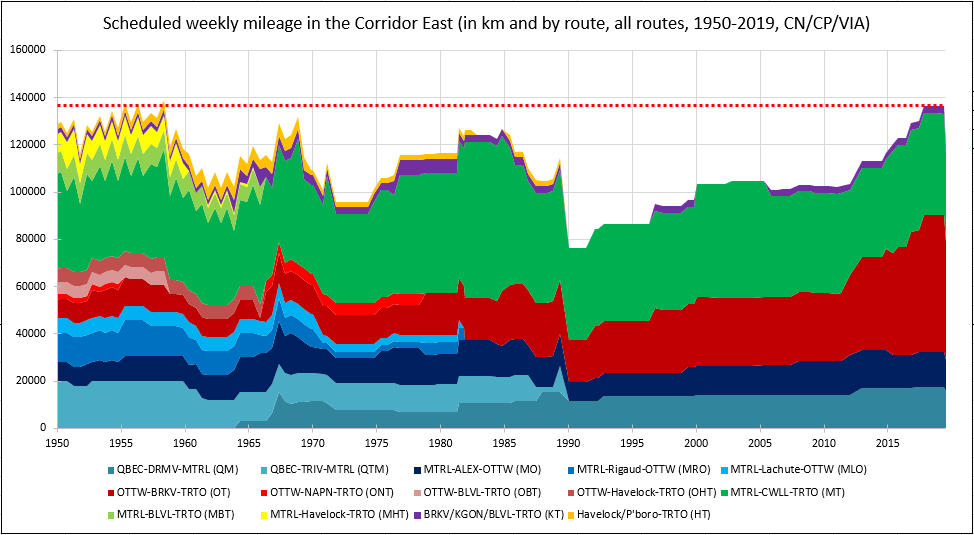
Your lack of motivation to follow this thread in-between your infrequent posts is quite apparent at this point, but looking at these diagrams I posted a mere 20 days ago, I would argue that the Corridor (at least East of Toronto) has seen a service which was for pretty much the entire period between January 1990 and at least December 2012 "much worse" than today:

Just to quantify where the Corridor stands in a historical comparison with the last 70 years, the scheduled timetable volume has caught up to the April 1989 timetable (i.e. the last timetable before the January 1990 cuts) in November 2017 (166,871 vs. 166,661 km per week) and remained (until CoVid-19 hit) higher than most of the 1960s and 1970s:
1607651838033-png.288086

Compiled from: official CN, CP and VIA timetables

If we look only at the "Corridor East" (i.e. east of Toronto), then the 136,627 km scheduled per week between November 2017 (when the 10th frequency was introduced between Toronto and Ottawa) and December 2019 (when train 69 was terminated already in Toronto instead of Aldershot) was only ever exceeded in April 1955 (137,660 km), April 1956 (137,120 km) and April 1958 (138,824 km):
1607651857061-png.288087

Compiled from: official CN, CP and VIA timetables
 
Last edited:
^^ I agree. I don't think Canada will see any true HSR in any of our life times. The political will simply isn't there and CN & CP have huge political sway in Ottawa. Service in The Corridor will certainly improve but again that says precious little as it couldn't get much worse.

Who cares? Seriously

I don't care whether something is "true HSR" or whatever other dick measuring stat/threshold/bar is to be employed by internet railfans who want to compare countries like baseball players. What I want is for Canada to set a trajectory where infrastructure is constantly improving. This is how all those great HSR networks you see in Japan or France or Germany were built.

We get way too wrapped up in random self-imposed expectations in this country and then don't build a thing when the task looks daunting. We need to learn to eat the elephant one bite at a time. Build that first stretch of HFR. Add to it in the East and West. Do a few straightenings and grade separations every year. Etc. The ideal outcome would be that the line gets a little bit longer and faster every year. Nobody should even notice as HFR transitions to full Quebec-Windsor HSR over the next 20 years.
 
No electrification? Just diesel service using an add-on procurement of the new fleet already being built (so just build 5 more trains of the already planned)? Possible.

While installing the catenary would slow things down a bit, the option to extend the fleet order can be diesel-electric, hybrid, or fully electric. Apparently Siemens claims to have locomotives they could substitute for the Chargers if needed, so VIA wouldn’t need a new RFQ.
 

Back
Top