News   Apr 02, 2026
 314     0 
News   Apr 02, 2026
 353     1 
News   Apr 01, 2026
 456     0 

Intercity Bus Services

^Which were then modified, and "refurbished" to an extent.

The Americans just tend to let their buses run down with grime in the interior and generally arent as clean as the Canadian buses were. That's something im not looking forward to at all.

The one "positive" thing in all this, is that it will actually be much easier to book trips to Canada from the U.S since it will all be done through Greyhound USA. Hopefully they allow passengers booking from Canada-->U.S to pay with Canadian currency though.
 
As an occasional user of Greyhound in the US, I can attest to the dirtiness of the buses. It also seems like buses that are nearing 25 years of age are still in service, but there are some newer ones around.
 
Holy crap! This is a big blow to many communities. So many car-less folks who are on fixed incomes will be stranded.
Yes, and unfortunately with this prolonged boiling-frog death, we already saw the loss of most routes and physical facilities that benefited underserved areas the most, such as in Western Canada or Northern Ontario, which are also places where you don't see governments stumbling over themselves to invest in transit.
 
The had stops where you would just give your printed ticket to the driver and they'd just hold onto it. The drivers didn't have any equipment to scan the tickets. Some of my friends would just buy one ticket, and print it 3 times and split it. I had an Unlimited VIA pass so I didn't participate.
So what you’re saying is... your friends are personally responsible for the downfall of Greyhound.

its like 2 kids in a trench-coat buying tickets for a movie.
 
Holy crap! This is a big blow to many communities. So many car-less folks who are on fixed incomes will be stranded.

Agreed.

I can't help but feel a new option will arise as we move out of the pandemic. There's still a demand for these trips.
 
Yes, and unfortunately with this prolonged boiling-frog death, we already saw the loss of most routes and physical facilities that benefited underserved areas the most, such as in Western Canada or Northern Ontario, which are also places where you don't see governments stumbling over themselves to invest in transit.
I wonder what we’ll see come out with the recent federal promise for rural transit investment.

 
Remember that in Ontario...

Once drivers reach 80 years of age, every two years they must:
  • Take a vision test
  • Undergo a driver record review
  • Participate in a 45-minute Group Education Session (GES)
  • During the GES, complete two, brief, non-computerized in-class screening assignments
  • If necessary, take a road test
If they fail, and they are still mobile over 80, how will they get around? They would be stuck in large parts of Ontario.

Then what about the people under 80 with suspended or revoked licenses? Will they have to beg and be at the mercy for rides from relatives or friends? Without a bus, will they have to pay big time for rides with taxis or ride-hailing?
 
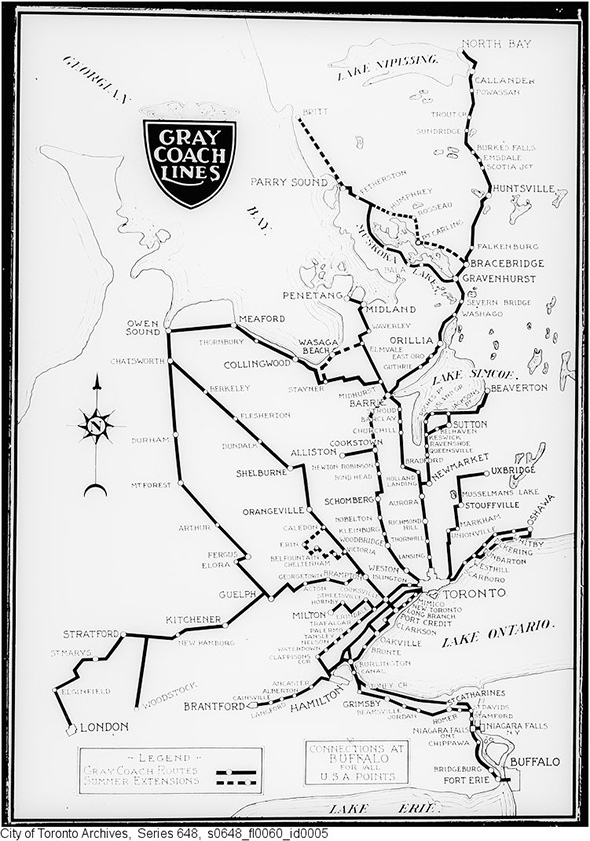
Grey Coach Lines was a subsidiary of the TTC. Parts were sold off, or taken over by GO Transit.

Sold 1990 to Stagecoach Holdings Ltd. of the UK. Stagecoach sold it in 1993 to Greyhound Lines of Canada and Ontario Northland Motor Coach Services.

GCL_map_1950%27s.jpg

From link.
 
Might be worth pointing out here that Greyhound's UK-based parent company FirstGroup is under significant pressure right now to reduce debt, recently agreeing to sell off its North American school bus and transit division. That buyer was apparently not interested in taking Greyhound off their hands, nor has any other buyer emerged for Greyhound.

From the April 23 press release re the school bus division sale (p. 7, emphasis mine):
Greyhound remains non-core and FirstGroup continues to pursue all exit options for the business in order to conclude the Group’s portfolio rationalisation strategy. Sale discussions are ongoing but the process has been affected by the pandemic’s impact on this passenger volume-based business. The impact on Greyhound’s financial performance and cash generation continues to be mitigated by tight cost control and recoveries of 5311(f) grants for operating key coach services under the US CARES Act. As noted above, c.$250m of the Net Disposal Proceeds will be utilised to buy out the legacy pension and substantially de-risk the self-insurance liabilities associated with Greyhound. The liability de-risking will result in Greyhound having a better capitalised balance sheet, which also includes its substantial property portfolio which the Group will continue to actively manage for value as part of Greyhound’s network transformation plans. For the purposes of the Retained Group pro forma net debt position, c.£15m of finance leases attributable to Greyhound have been excluded.
Those federal grants seem to have made up at least part of the difference in Greyhound US carrying on for now.
 
I'd think that they would be looking at some of the other routes as well. No one else is doing Montreal to Ottawa - so that would make sense for them, if they have enough vehicles.

I'd think extending the Hamilton-Kitchener buses to Guelph would make sense too, and wouldn't cost much.
 

An Open Letter to the Prime Minister and Ontario's Premier

From link.

To: Justin Trudeau, Prime Minister of Canada
Doug Ford, Premier of Ontario
Omar Alghabra, Minister of Transport, Canada
Caroline Mulroney, Ministry of Transportation of Ontario
Phil Verster, CEO Metrolinx
Cynthia Garneau, CEO VIA Rail


Re: The necessity of a strong train and bus network throughout Canada


I have read with grave concern about Greyhound Bus Lines’ decision to permanently end its operations throughout Canada, following its earlier decision to shut down its routes in western Canada. This, combined with service cutbacks to VIA Rail, have severely reduced public transit options for Canadians living in small towns and rural areas in this country.


In urban centres, it is easy for Canadians to take their mobility for granted. Many of us have cars, or access to good public transit networks to get them where they need to go. But outside of Canada’s big cities, people who cannot drive - either because they can’t afford it or are medically or for other reasons unable to - are effectively locked into their own homes. Services like Greyhound, or the now defunct Saskatchewan Transportation Company, gave people access to medical appointments or jobs they wouldn’t otherwise have had. Bus services like Greyhound have been important links for women fleeing abusive domestic partners.


Public transit is a public service, just like roads and highways. If private enterprise is unable to provide this necessity, it’s up to our governments to step in. A good step to take in the short term would be to contract Greyhound to continue operating its routes, covering its operating deficits. Going forward, a proper national network of connecting bus and train networks should be built so that people can travel across this country without having to rely on cars or planes.


In Canada, in addition to improving VIA service in the Quebec-Windsor corridor, Canada’s national train, the Canadian, should be improved to daily service, and freight railroads strongly encouraged to give this train priority over their tracks. In Ontario, the provincial government could improve service in southwestern Ontario by providing additional funds to VIA Rail for equipment and operations, such as how California provides service through Amtrak. Ontario Northland should receive the funds necessary not only to restore the Northlander, but to take over the Sudbury-White River train and extend it to Thunder Bay or Winnipeg. Bus lines should be set up connecting these train services to smaller towns further afield.


These steps would support Canada’s fight against climate change and support national tourism as that industry recovers from the pandemic. More than that, these steps would ensure that Canadians everywhere have equal access to this country, regardless of their ability to own and drive a car. Mobility rights in this nation have been overlooked for too long, and provincial and federal governments need to step up to address this long-neglected need.


Sincerely,
James Bow, Chief Content Editor, Transit Toronto
Robert Mackenzie, Senior News Correspondent, Transit Toronto
 

Back
Top