




reaperexpress
Senior Member
I finally got around to doing my annual Canadian Commuter Rail service summary. Because my benchmark is always the first week of January, my summary tables do not reflect the service reductions which were published in mid-January. Those fall into the scope of next year's (2022) summary.
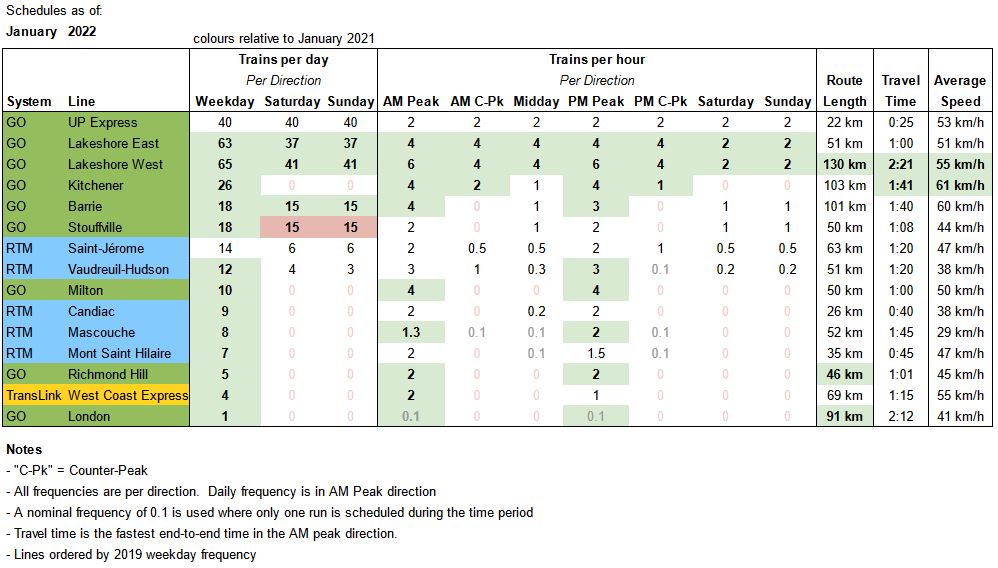
Coloured relative to last year's schedules (green = improvement, red = deterioration):
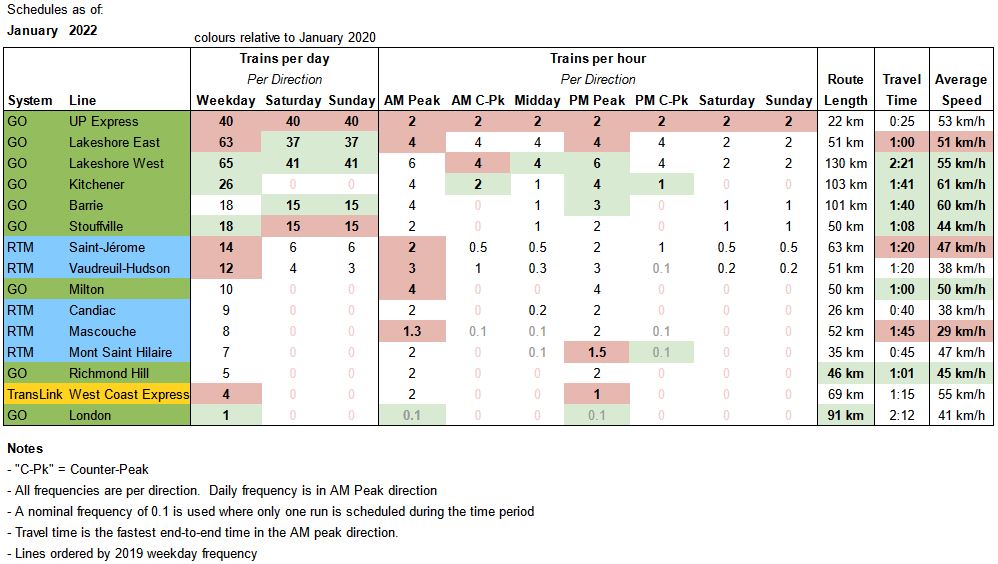
Coloured relative to two years ago (pre-pandemic):
https://ontariotrafficman.wordpress.com/2022/02/20/canadian-commuter-rail-summary-2021/
Coloured relative to last year's schedules (green = improvement, red = deterioration):
Coloured relative to two years ago (pre-pandemic):
https://ontariotrafficman.wordpress.com/2022/02/20/canadian-commuter-rail-summary-2021/
Following the annus horibilis that was 2020, I am pleased to report that commuter rail service in Canada is showing a promising rate of recovery.
The service scheduled at the beginning of January 2022 is better in every way than the schedules one year prior, with the sole exception of the Stouffville line, whose last train on weekend evenings has now been replaced by a bus trip.
Off-peak service on most lines has returned to pre-pandemic levels, though peak-period service frequencies continue to be a bit lower due to the lower commuter ridership.
I always make my summary tables based on the first week of January. But on the second week of January 2022, train service in Ontario was drastically reduced due to a spike in train operator absences (due to a spike in Covid cases and the start of mandatory vaccination). Those changes are not included in the table, but I think that’s okay because they are just temporary and service will be restored as operator availability improves.
Because I was late in making this summary, I don’t have the Mascouche Line timetable which was in effect at the beginning of January, but the release notes for the current timetable state the changes since January have been very minor.
Service Extensions
In June, the Richmond Hill line was extended one stop north to Bloomington station, which consists of a large parking garage in the middle of the greenbelt, completely inaccessible by foot, bike or local transit.
In August, all-day train service reached Hamilton for the first time, with one train per hour on the Lakeshore West line extended one stop west to Hamilton West Harbour Station, all day, every day.
Frequency
In September, service returned nearly to pre-pandemic levels across the country. But there were a couple services which surpassed their pre-pandemic service.
The Kitchener line was a big winner in many respects. The number of roundtrips reaching Kitchener reached 10 per day, up from 8 pre-pandemic. The line also received regular counter-peak service for the first time ever, with trains every half hour from Toronto to Bramalea during the AM Peak, and every hour from Bramalea to Toronto during the PM Peak. These trains cut the travel time in half compared to the previous bus trips which got stuck in rush hour traffic.
September also brought back express service on the Kitchener and Lakeshore West lines. The Kitchener line got 5 express trips per day, up from 2 two years ago. This came partly at the expense of local service, which now operates every 30 minutes during the AM Peak instead of every 15 minutes.
The rollout of regular 15-minute weekday local service continued on the Lakeshore West line. Pre-pandemic there were numerous 30-minute gaps in service in the midday period, and counter-peak service was consistently every 30 minutes. Service between Oakville and Toronto has now been filled out with 15-minute headways in both directions from the start of service until about 20:00. Two trains per hour continue beyond Oakville, and of those one continues beyond Aldershot to Hamilton West Harbour. For some reason, service then plummets to 1 train per hour on weekend evenings. In October a second train per hour was added between Union and Exhibition during the evening, but given that those trips are only shuttling between two stops I did not include them in the line’s frequency.
However, some of the increased local service came at the expense of express service. Instead of 4 express trains and 2 local trains per hour during peak periods, there are now 2 express trains and 4 local trains per hour.
The Lakeshore East line received a very simple weekday service pattern, with local trains every 15 minutes in both directions between Toronto and Oshawa from about 05:00 to 19:00, then every 30 minutes until the end of service. Peak-period express service was not restored, because the line between Toronto Union and Danforth will be temporarily narrowed from 3 tracks to 2 during construction on the Ontario Line subway, which widen the corridor to include 2 subway tracks and 4 mainline railway tracks. taken out of service . There will still be a 3-track segment between Danforth and Guildwood, but that express track is occupied by VIA in alternating directions as their intercity trains overtake GO local trains.
In October, one trip per day on the Kitchener line was extended 92 km westward to London, creating by far the longest commuter rail service in Canada, with a length of 194 km and a travel time of 3h53. This is far beyond a reasonable travel time for regular riders, so the Province reported that the purpose was primarily to connect London, St Marys and Stratford to Kitchener and Guelph, not to Toronto. Travellers between London and Toronto would continue to use VIA Rail’s intercity service, which connects the cities in just 2h10. Given the province’s statements, and to avoid messing up the statistics for the Kitchener line, I have included the London-Kitchener service as a separate line.
In BC service was partially restored on the West Coast Express, with service increasing to 4 trains per day, slightly short of the 5 trains per day two years ago.
The Union Pearson Express continues to stand out in the table, as it continues to operate every 30 minutes throughout the day, whereas it ran every 15 minutes prior to 2020.
Speed
With the return of express services in September, end-to-end travel times decreased on the Lakeshore West and Kitchener lines. And thanks to lower ridership and thus shorter station stops, they are also faster than pre-pandemic.
The biggest speed-related news this year was the completion of Metrolinx’s track upgrade project along the western Kitchener line, which finally eliminated the notorious 10 mph (16 km/h) slow zone through Guelph. On 16 December, the speed limit was increased to 45 mph (72 km/h) in December, cutting the Kitchener-Guelph travel time by several minutes. However, the time savings were not reflected in the timetables until mid-January 2022, so that improvement is not shown in the summary table. But even so, the previously-completed track improvements had already made the Kitchener line express the fastest AM peak service in Canada, with an average speed of 61 km/h.
The speed of new London-Kitchener service is remarkable, but not in a good way. The London line has the second-longest travel time of any line, despite only being the fourth-longest line by distance. Its travel time is 31 minutes longer than the Kitchener line express service, while covering 12 fewer kilometres and making a third as many intermediate stops. The poor track conditions on the CN-owned railway between London and Kitchener limit trains to 30 mph (48 km/h) for most of the route, even though the line has supported 70 mph (112 km/h) operations in the past. In April 1976, trains covered London to Kitchener in 1h13, compared to 2h12 in January 2022, while making the same two intermediate stops.
Last edited:


