

News   Apr 02, 2026
 131     0 
News   Apr 01, 2026
 359     0 
News   Apr 01, 2026
 559     0 

VIA Rail

AMTRAK already has the data for Long distance chargers. Why do we need to duplicate the data?

Amtrak has only just started receiving their ALC-42 locomotives (the long distance version of the Charger) according to this media release from last August. Granted, by the time VIA gets approval to purchase replacements, there should be some good data.

EDIT: According to this article from March of this year, the first ALC-42s were expected in April and Amtrak would begin testing them, so it sounds like they still aren't in revenue service.
 
Last edited:

It would make sense to retain some of the LRC's that are in good condition and use them in areas outside of the corridor. I mean if they are more reliable than the rebuilt HEP Fleet that should tell you something.
You can forget that, according to Jason Shron:
The LRC cars will not be permitted to carry passengers for any carrier. Transport Canada has given them a reprieve until the new fleet arrives, but they have made it very clear to VIA that the LRC fleet cannot be sold for private use in Canada.

We're hoping to get a set for the VHA - VIA Historical Asssociation - but we will never be able to run them with people on board.
 
You can forget that, according to Jason Shron:


Thanks for the link. I wonder if there are real safety concerns with the LRCs as implied, or if it is a matter of the government not wanting the potential embarrassment of after spending money to replace the fleet, because it is at the end of its life, to then have VIA (or someone else) getting many more years of service out of the equipment? While there might be practical ways they could be used elsewhere, the media could latch onto it and twist the facts to question the necessity of the corridor fleet replacement. Since the LRCs are only used on the corridor, they are easy to identify. The HEP and Renaissance cars look the same as cars used elsewhere and it would be less obvious using them without tracking car numbers.

It is kind of like in hockey when a player flails on the ice in pain to draw a penalty and then is on the ice for the first shift of the ensuing power play. There might be good reasons for it to happen, but it is an embarrassment to the referee.
 
Last edited:
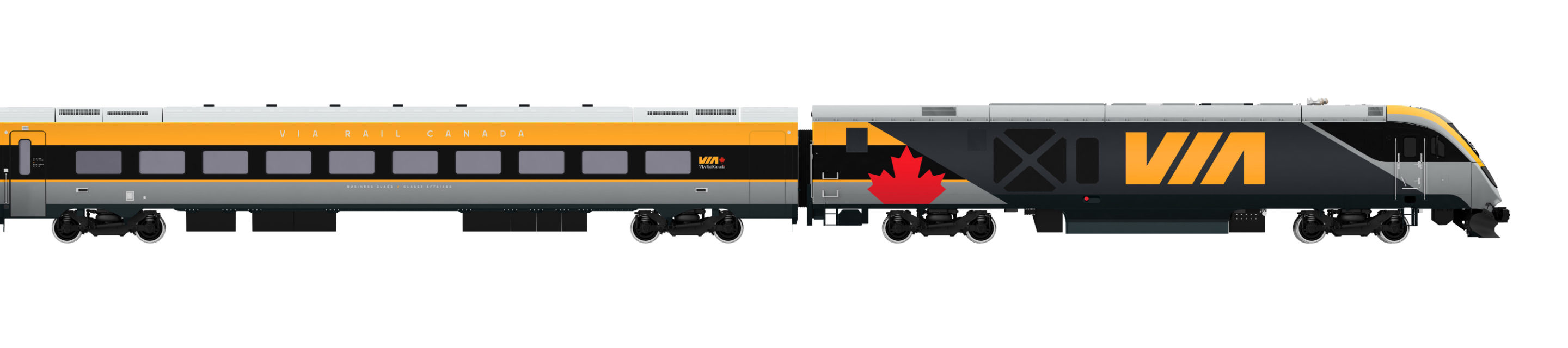
^^^Looks nice! And from VIA's Website:


EDIT: Also from their website for those concerned about how it will transition to the rest of the train:
train_illustration@2x.jpg
Honestly, kudos to the VIA Rail team on this design. They could've gone the easy route and just paint it with some generic livery like Amtrak that has zero creative elements.

To your average passenger, most people would almost mistaken this for "high speed rail" rolling stock, which will undoubtedly help boost VIA Rail's public image.
 
I seem to recall that VIA intended to retain some of the existing fleet, shifting it around a bit to northern services and retiring some older cars there, and using a few trainsets to increase service in Southern Ontario with the new fleet being focused on the London-Quebec City corridor. They wanted to increase Windsor, Stratford, and Sarnia service a few years ago but that never came to be. Retaining a few trainsets (3-4) would likely allow for some frequency improvements for those lines.

I would love to see a return of regular service to Niagara as well if possible to supplement the Maple Leaf and GO service, which is more or less useless for non-cross border traffic. With the rumblings coming out of the Biden Administration the Maple Leaf may see some frequency improvements anyway, but still.
 
It depends on how you define "the corridor". The new order replaced the old fleet seat-for-seat. The new fleet will be more reliable, so there will be some margin of growth possible. The question is how long it will take to "max out" that capacity.

A lot depends on the HFR decision. That decision is said to include a further order for more trainsets. If HFR proceeds, the fleet will grow. If it doesn't, well, the outcome is better than status quo.

The P42's are at end of life in terms of maintainability - parts supply etc. Maybe someone will buy them, but don't count on it.


The time to ask that question is after the Siemens order has arrived and been in service for long enough to give data on its reliability and performance capability. If the results are positive, one might look to Siemens to provide a loco that has parts commonality in whatever body shell works best for long distance trains. If the results are less impressive, one would explore what the market can offer. The F40's are young enough still that there's no need to rush that decision.

- Paul

Why are the P42's at end of life and the F40's not when the F40 is an older loco? Im guessing it just was a more popular unit and therefore theres more parts etc for it?
 
Last edited:
Why are the P42's at end of life and the F40's not when the F40 is an older loco? Im guessing it just was a more popular unit and therefore theres more parts etc for it?

According to VIA's 2018 Corporate Plan, pg. 62, under "Corridor Fleet Renewal:"

Of VIA Rail’s 40 locomotives, neither, the 19 F40s or the 21 P42s, currently comply with Canada’s minimum environmental regulatory requirements or the industry Best Practice exhaust emission standards. Furthermore, neither complies with the newly proposed crashworthiness standards. It has been identified that the F40 locomotives represent an opportunity to be overhauled such that they can satisfy both of the aforementioned requirements. Unfortunately, the monocoque design of the P42 implies that this model can be made environmentally compliant though not crashworthy.

I gather they can be grandfathered under the old regulations during regular operation and maintenance, but during an overhaul (which they are due for), they would be required to be brought up to the new standards.
 
Last edited:
Thanks for the link. I wonder if there are real safety concerns with the LRCs as implied, or if it is a matter of the government not wanting the potential embarrassment of after spending money to replace the fleet, because it is at the end of its life, to then have VIA (or someone else) getting many more years of service out of the equipment? [...]
Getting the LRCs off the (rail)road with as little delay as possible is way too urgent to waste precious time with pondering about the other possible motivations you volunteered...

From the linked Railway Technology article:

Siemens Mobility Canada CEO Yves Desjardins-Siciliano said: …​

I can't remember the timing. Was YDS still CEO of VIA when Siemens was selected for the new fleet? I liked him as CEO, but … 🤔
Not sure I follow: what exactly is the ethical issue with one of VIA's suppliers (led by a former VIA CEO) acquiring another?
 
The Q&A to which a few UT'ers submitted questions is linked here: https://corpo.viarail.ca/sites/default/files/media/pdf/speeches/2021 Annual Public Meeting_VIA Rail_Q&A_EN.pdf

I will repost some of the questions/answers here that I know or believe originated w/forumers here. For the full set, please follow the link above.

View attachment 323198
View attachment 323199
View attachment 323200

View attachment 323206

View attachment 323201
View attachment 323202
Has Via ever given any indication of what "regional hub" might mean for a place like Kingston?
 
Has Via ever given any indication of what "regional hub" might mean for a place like Kingston?

^VIA has definitely suggested that trains could arrive at Kingston in the late evening and lay over, permitting new early morning services originating there.

There is also a suggestion that trains would turn back, or at least cease a continuous journey, in Kingston. I have ‘t actually seen a VIA source for this, it seems to be assumed.

- Paul
 
^VIA has definitely suggested that trains could arrive at Kingston in the late evening and lay over, permitting new early morning services originating there.
When did they stop doing that? It was pretty routine for the late train from Toronto to Kingston, to lay-over on a siding somewhere near Kingston, before leaving first thing in the morning.
 

Back
Top