News   Apr 02, 2026
 2.5K     3 
News   Apr 02, 2026
 1.1K     0 
News   Apr 02, 2026
 2.8K     2 

VIA Rail

It's an interesting take. But again, if that is true, why not a big official launch?

I can buy that they put in some allocation in the budget and would work to make the announcement later. But now you have Catherine McKenna and Omar Alghabra going on Twitter and insinuating that they are investing in HFR. I'm not sure if they are just trying to score political points with their $491M investment, or there will be an HFR announcement, in which case why front run it with random tweets from two ministers?

One other interesting aspect of this is that the Minister's tweets and the budget reference using the project name of "high frequency rail" continues to build awareness for that plan. Also, they've achieved a situation where the pro-HSR folks are disappointed (see the HSR Canada twitter feed) and those who wanted faster action and the full $6-8B HFR budget requirement (and full JPO release) are also disappointed. So both sides can equally claim disappointment, but for those who are pro-HFR, I assume there's some relief it's at least still being discussed.

On the whole topic of HSR vs HFR, I'm reminded of this article from a few years ago by Sean Marshall, in case people here haven't seen it. It was about a different corridor of course, but there are some relevant points.

 
^ I'm not as familiar with the Ottawa-Montreal stretch as I am with the Toronto-Ottawa stretch.

What types of projects between Ottawa-Montreal could the $491 million be spent on?
I agree with the others that Ottawa-Montreal (and Smiths Falls-Ottawa) would be a good non-controversial target for improvements.

Here's where I would spend some of the money along the Smiths Falls and Alexandria subdivisions:

Track Speed Upgrades​

Both railways currently have 100 mph (160 km/h) speed limits. Upgrading the lines to 110 mph (177 km/h) would bring them up to the promised top speed of HFR – bringing some good publicity for the railway and politicians. This would involve upgrading level crossings and probably replacing some track.

There is also a particularly slow segment of track within the City of Ottawa, between Ottawa and Fallowfield stations. This also needs to be addressed to cut down travel times between Toronto and Ottawa.

Curve Realignments

Both railways have some curves which appear to be relatively easy to realign and would noticeably reduce travel times and fuel consumption.

Along the Smiths Falls subdivision there is an 85 mph (137 km/h) speed restriction due to a curve right in the middle of an otherwise 100 mph (161 km/h) segment.

Existing speed limits in mph
Capture1.JPG


Since the curve is only a few degrees, relatively little property would be required to widen the curve radius to allow trains to maintain a steady 110 mph (177 km/h).

Black line: current alignment; Green line: new alignment
Capture2.JPG


Along the Alexandria subdivision there is a collection of 3 sharp curves in a segment which is otherwise quite straight. Together, these 3 major curve realignments, as well as three more slight realignments, would create a 26 km (16 mile) segment of continuous 110 mph running at quite a modest cost.

Capture3.JPG


Capture4.JPG

Capture5.JPG

Capture6.JPG

Siding Adjustments​

The two lines are single-tracked, and trains cross each other using short sidings located roughly every 16 kilometres (10 miles). These represent a considerable source of delay. Each time a train encounters another train in the opposite direction, at least one of the trains incurs several minutes of delay as it slows down for the switches, sits around waiting for the train in the other direction, and eventually accelerates back up to speed.

Two very low-hanging fruit are the siding configurations at Casselman and Alexandria stations.

In Casselman, there is a siding just east of the station. Trains often serve the station, then roll forward a few hundred metres, and stop again to wait for the train in the opposite direction. Extending the siding west to the station itself would allow the opposing train to approach while the train is sitting in the station, which would save a couple minutes. Less than half of the trains between Ottawa and Montréal stop at the station, so it is not a problem that only one of the two tracks would have a platform.
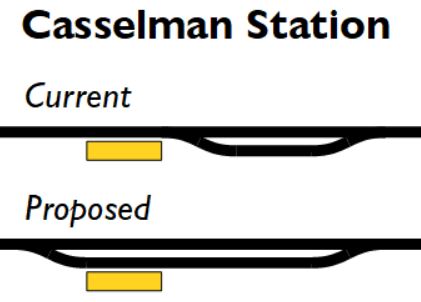
Capture9.JPG


At Alexandria station, there is an even lower-hanging fruit. Currently the mainline track passes by the platform, and a siding bypasses it to the north. But this means that when trains meet at the station, the train bypassing the station needs to slow down order to switch tracks. Realigning the switches so that the mainline bypasses the station would allow the train skipping the station to pass through at full speed. It wouldn’t make a difference to the train serving the station since it already needs to slow down regardless of the switches.
Capture10.JPG

Double Track Segments​

In addition to the above adjustments at stations, some double-track segments could be built to allow trains to meet at full speed between stations. A cost-effective option would be to build double-track segments roughly 16 km long, so that they can replace two sidings each. One of the double track segments on the map below is the segment including the curve realigments above. I figure it’s cheaper to do both realignment and double tracking at once, than to realign one segment and double track another.

Existing sidings in green, proposed double track in purple
Capture7.JPG

Using the double track segments to reduce the number of sidings helps keep maintenance costs low by minimizing the number of switches, which are a disproportionately high-maintenance component of a railway line.
Capture11.JPG
 
Also, they've achieved a situation where the pro-HSR folks are disappointed (see the HSR Canada twitter feed) and those who wanted faster action and the full $6-8B HFR budget requirement (and full JPO release) are also disappointed.

Actually, Paul Lanagan is crowing that the lack of HFR funding is evidence of its inadequacy. He's not disappointed at all. Go look at as HSRCanada's Twitter feed.

So both sides can equally claim disappointment, but for those who are pro-HFR, I assume there's some relief it's at least still being discussed.

I really wouldn't put it this way. I'm relieved they haven't cancelled the thing entirely. I'm pissed they don't yet have a plan to actually build it.
 
In addition to the above adjustments at stations, some double-track segments could be built to allow trains to meet at full speed between stations. A cost-effective option would be to build double-track segments roughly 16 km long, so that they can replace two sidings each.

Could a case be made to double track the whole line from Ottawa to Coteau?
 
Could a case be made to double track the whole line from Ottawa to Coteau?
Not at this stage. HFR still only envisions about 1-2 trains per hour, which is totally doable on single track.

Full double-tracking could be part of a later upgrade, if we decide to run more than 2 trains per hour. It would need to be accompanied by some capacity improvements such as a new railway from the Alexandria Sub to the west edge of Montreal's built-up area, and a rail-to-rail grade separation across the CP mainline (just north of Coteau). It could also be bundled with some additional curve realignments and road-to-rail grade separations.

Actually, now that I think of it, the rail-to-rail grade separation might even be included in the $491M as a negotiating chip with CP.

New ROWs in blue
Capture.JPG
 
Last edited:
Actually, Paul Lanagan is crowing that the lack of HFR funding is evidence of its inadequacy. He's not disappointed at all. Go look at as HSRCanada's Twitter feed.


I really wouldn't put it this way. I'm relieved they haven't cancelled the thing entirely. I'm pissed they don't yet have a plan to actually build it.

I guess I just meant his overall disappointment that there's a lack of movement on HSR (aka the below), and he's annoyed by the current government and VIA keep talking about the HFR plan.

 
Last edited:
Not at this stage. HFR still only envisions about 1-2 trains per hour, which is totally doable on single track.

Full double-tracking could be part of a later upgrade, if we decide to run more than 2 trains per hour.

A very good point, and one that anyone proposing GO service towards Peterboro should keep in mind. HFR 1.0 will have ample capacity for HFR trains, and that will serve Peterboro just fine....but adding GO trains that serve intermediate stations on top of HFR would necessitate adding more track.

- Paul
 
A very good point, and one that anyone proposing GO service towards Peterboro should keep in mind. HFR 1.0 will have ample capacity for HFR trains, and that will serve Peterboro just fine....but adding GO trains that serve intermediate stations on top of HFR would necessitate adding more track.

- Paul

Very true, but I don't think that's a problem. If a project is created to bring GO service to Peterborough, then that project would be responsible for funding the remainder of the double track. With the extra train volumes, full double track would indeed be justified, especially given the speed differentials between GO and VIA.
 
A very good point, and one that anyone proposing GO service towards Peterboro should keep in mind. HFR 1.0 will have ample capacity for HFR trains, and that will serve Peterboro just fine....but adding GO trains that serve intermediate stations on top of HFR would necessitate adding more track.

- Paul

This is why I am asking about double tracking. One could argue that Toronto-Peterborough and Ottawa-Montreal should be double tracked at launch to enable local service that is sure to be required in short order.
 
This is why I am asking about double tracking. One could argue that Toronto-Peterborough and Ottawa-Montreal should be double tracked at launch to enable local service that is sure to be required in short order.

I wonder if these enhancements are even covered by the JPO/EA work. I'm betting not, just because it's added scope and cost ,when the intent is lowest possible initial cost. I'm hopeful that the initial envelope will fund sufficient sidings, but as noted above even sidings are not cheap.Let's hope that the initial product hasn't been value-engineered too far.

And, while everything seems rosy on the surface, I have to wonder what pass-the-hat discussions happen between ML and VIA. One should not expect VIA to build a second track for ML, any more than one should expect VIA to have free use of all ML's expanded corridors without chipping in for the capital cost of those. I'm sure the CIB would be asking pointed questions about who is paying for what.

- Paul
 
Just a reminder that the Chargers come prepared for dual mode operation. That was a condition of the contract. It's not hard to electrify this fleet.

Do they? AFAIK, the contract was that there needed to be an upgrade path for electrification. IIRC (and please prove me wrong if you have evidence to the contrary), Siemens plan was that should electrification be necessary, the Chargers could be replaced with electric locomotives.

This is why I am asking about double tracking. One could argue that Toronto-Peterborough and Ottawa-Montreal should be double tracked at launch to enable local service that is sure to be required in short order.

Do you really think that we will see more than 2 trains an hour along the Alexandria Sub any time soon? IMHO, we are more likely to see an upgrade to HSR before that. Long sidings can be converted to double track relatively easily when it becomes necessary. With single track and long sidings, the expensive bits (like bridges) can be done later.

I would actually have more concern about the Smiths Falls Sub as it will likely be shared by both HFR and the Kingston regional service.
 

Back
Top