

News   Mar 31, 2026
 1.2K     2 
News   Mar 31, 2026
 214     3 
News   Mar 31, 2026
 1.1K     0 

VIA Rail

I suspect he means multiple-locomotives, like this one on the Narvik-Lulea line in Sweden/Norway I mentioned recently:
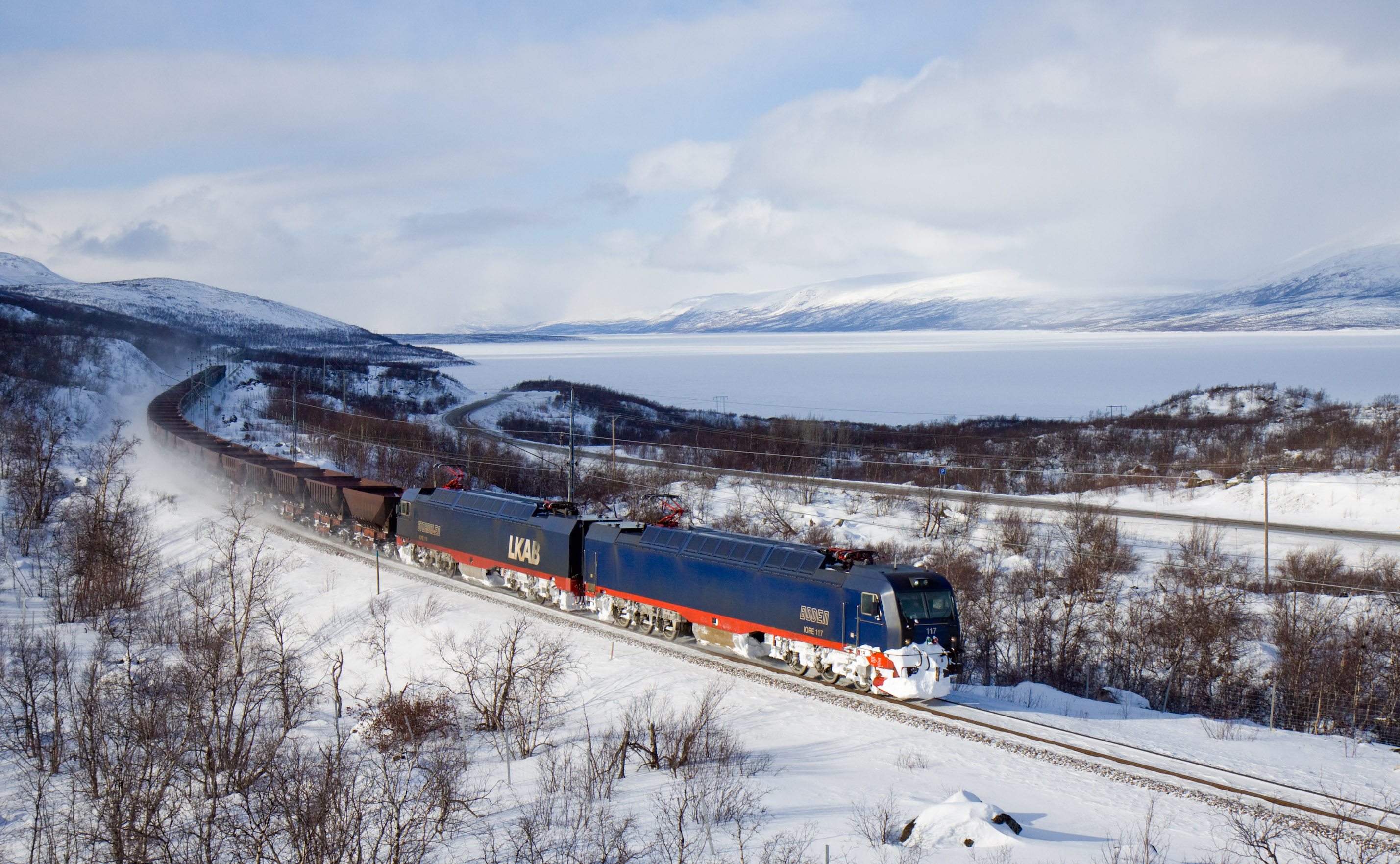
IORE_beim_Torneträsk.jpg

Source: David Gubler via Wikimedia

As you said, that is an example of electrified freight, but it certainly isn't an EMU. The locomotives will have a significant amount of weight added to gain traction, which was my point.
https://commons.m.wikimedia.org/wiki/File:IORE_beim_Torneträsk.jpg

Interesting, though I don't see any catenary, so I assume it is a DMU not an EMU. Regardless an interesting vehicle and would be useful for certain applications, especially with severe restrictions on train lengths Europe. I see it working well for running containers back and forth between a port with limited space to a nearby intermodal yard, especially if it could operate autonomously.

Back to talking about VIA Rail
 
For something like double stack well cars, there is space at either side of the car where you could put batteries, and then connect all of those batteries in tandem. You could charge the batteries in the cars while braking and then use the power in the batteries to power the locomotive.

The issue would be, maintenance cycling, and crash management. How about a non revenue car like an APU with just batteries or DPU but without the cab?
 
Not even close.

1) There's no mandate to decarbonize rail in Canada. This is entirely dependent on technology and economics.

2) VIA doesn't control most of its track. So it can't make policies on decarbonization until the track owners do.

3) With the vast majority of passenger miles being generated in the Corridor, realistically, this is the only portion that will matter for a while. Maybe if Calgary-Edmonton gets built....

4) Time is on VIA's side. Technology is only getting better and cheaper. And the carbon tax is only going to make driving and flying more expensive. VIA can wait for a more appropriate tipping point. Be that in 10, 20 or 30 years.

Right now, all of this is correct. However, with the USA back in the Paris Accord, and no real chance a party in Canada will get in without a climate policy, there is the real possibility that we start decarbonizing the rail industry. If Via is smart, when Amtrak has an order, they order a few too.

EMU freight trains? I have never seen such a beast. Freight trains with an electric locomotive sure, but not freight trains without a locomotive but instead each car has an electric motor. Can you provide a picture?
I misunderstood you. I thought you meant replacing the existing diesel electric with full electric. Those exist. Having each car with it's own motor would be problematic, and costly.
 
Right now, all of this is correct. However, with the USA back in the Paris Accord, and no real chance a party in Canada will get in without a climate policy, there is the real possibility that we start decarbonizing the rail industry.

1) US policy on climate change is largely irrelevant to Canada. We've been ahead of them the entire time. And we're still ahead of them. You'll note they have neither a national plan to cut emissions or any plans to price carbon. This is not the situation Canada is in.

2) Rail emissions are negligible in both countries. And substantially lower per pax-mile or ton-mile than road or aviation alternatives. So governments will not be focusing on rail first. The primary focus is on cutting road and aviation emissions and miles traveled.

3) Canada has chosen a carbon tax to specifically avoid sectoral mandates. Set the price. Industry and consumers will decide what is the cheapest way to cut emissions. In some cases, shifting to diesel rail would cut emissions and costs.


If Via is smart, when Amtrak has an order, they order a few too.

Amtrak already orders for their electrified corridor. VIA just doesn't because it has no electrified order. Heck, it has no full substantial corridor of its own to even electrify.
 
For something like double stack well cars, there is space at either side of the car where you could put batteries, and then connect all of those batteries in tandem. You could charge the batteries in the cars while braking and then use the power in the batteries to power the locomotive.

The issue would be, maintenance cycling, and crash management. How about a non revenue car like an APU with just batteries or DPU but without the cab?

I can't comment on whether or not there would be sufficient space on well cars, one problem with distributing power throughout the consist is that the bulk of rolling stock is not owned by the carriers. It would be quite an effort to achieve commonality across a fleet that gets bashed around all sorts of roads across NA and sometimes sits idle for extended periods in obscure locations (although no doubt that carriers would love it as it would shift a lot of the cost away from them).
 
1) US policy on climate change is largely irrelevant to Canada. We've been ahead of them the entire time.

2) Rail emissions are negligible in both countries. And substantially lower per pax-mil or ton-mile than road or aviation alternatives. So governments will not be focusing on rail first.

3) Canada has chosen a carbon tax to specifically avoid sectoral mandates. Set the price. Industry and consumers will decide what is the cheapest way to cut emissions. In stone cases, shifting to diesel rail would cut emissions and costs.

1) For now. However, if they get going in a big way, this could force us to try to keep up.

2) Rail would be easier than trucks. Think of it another way - low hanging fruit. What could the government mandate to decarbon that would be easier for the industry, trucks or trains? The amount may be low but the optics would be high.

Amtrak already orders for their electrified corridor. VIA just doesn't because it has no electrified order. Heck, it has no full substantial corridor of its own to even electrify.

So, there will never be another order? I know they have ordered various things as they needed to in the past. I am talking about a future order that eventually will happen.
 
The issue would be, maintenance cycling, and crash management. How about a non revenue car like an APU with just batteries or DPU but without the cab?
I think this is what it would look like. You don't want to worry about maintaining thousands of such cars, and you want to be able to swap the batteries for charging without having to reload the train.
 
I misunderstood you. I thought you meant replacing the existing diesel electric with full electric. Those exist. Having each car with it's own motor would be problematic, and costly.

The confusion makes sense. While a train with multiple locomotives might sound like it has multiple units, in reality an EMU (or sister DMU) has multiple self propelled carriages instead of one or more locomotives.
 
1) For now. However, if they get going in a big way, this could force us to try to keep up.

First, they are not going to "get going in a big way", simply because their political process doesn't allow for that. Republicans would have to agree to passing a carbon tax in Congress. And they'd have to agree to raising it by $10 per year through 2030 to even come near the ballpark to what Canada is doing. And then all of this would have to survive a whole bunch of lawsuits from the states in a Supreme Court dominated by Republicans, a third of whom are Trump appointees. In short, not happening. Rejoining Paris was somewhat symbolic. And all their emissions cuts are mostly going to come from carrots (incentives and infrastructure dollars) than sticks, which means there's a real limit to what can be done.

So yes we'll always be ahead of them. And that's a good thing. It's a way to develop our cleantech sector and sell to them. See GM's recent investment in Ingersoll as an example.

2) Rail would be easier than trucks. Think of it another way - low hanging fruit. What could the government mandate to decarbon that would be easier for the industry, trucks or trains? The amount may be low but the optics would be high.

Why would you think rail is easier? There's zero evidence of that. Battery and hydrogen tech will electrify most last mile logistics and substantial portions of trucking in 10-15 years. The tech is still substantially further out on doing that to freight rail. The passenger rail networks that can be electrified in 10-15 years are well on their way to being done.

So, there will never be another order? I know they have ordered various things as they needed to in the past. I am talking about a future order that eventually will happen

If you're talking about a future in 2-3 decades? Sure. Right now though, it's hard to see any of this in the next 10-15 years. We don't even have an announcement on HFR yet. And when announced, it'll be unelectrified single track for just Toronto-Ottawa-Montreal and Montreal-Quebec. We're a long ways away from doing joint orders with Amtrak on electrified rolling stock. Maybe in the 2040s, when our Chargers and their Avelia Libertys are going on two decades, we will have something to talk about.
 
Finally, 2nd class will be tolerable....saves me some money too.

Yeah, I think I'm going to roll the dice on this one/flip a coin. I'm not sure I can stand wearing my home-made cloth mask for 5 hours. :/
I do prefer the train though.
I've been on VIA a bunch of times since the pandemic started for school-work reasons. They've gotten far better since the beginning of the pandemic in terms of service and safety. I am on 71 today in Business Class, there are 5 people in the car total. Meanwhile looking at the trains to Montreal and Ottawa over on the other track, business class was similarity empty. However, they packed all the economy passengers into one car and left two cars empty so that they can have all cars staffed. There was also an unrenovated HEP2 which are the worst since they're old and difficult to properly clean with the cloth seats (don't know why they put that in there when they had renovated ones sitting in the TMC). Nonetheless, there was still empty enough room for Solo travellers to have an empty seat.

Travelling in economy, they were a lot more strict with masks just because there were more people in the car (based on my previous trips). They're a lot looser in business just because you're essentially eating and drinking the entire trip, and there's less people. If you can get a Business "M" fare (lowest and second lowest fare), I'd definitely upgrade to business if you choose VIA.

IMG_20210122_091102.jpgIMG_20210122_082137.jpg
Also, I was the only one in the lounge.

PS, if you have a hoodie with strings on the hood, you could pull on the strings all the way, tie a bow knot, and make a mask out of that. Cheers. 🎉

Evening Update

Train 78

IMG_20210122_190856.jpg
Water only in the London lounge, no news papers or magazines. Toronto lounge was cold drinks only.
IMG_20210122_194816.jpg
^Dinner
 
Last edited:
The impact on VIA is, it's just another aspect of being a tenant on the freight railways. And more broadly, one would expect that passenger motive power technology would be an offshoot of whatever freight technology is pursued.... because the economics will be driven by the much larger market for freight locomotives.

Yes and no. Installing catenary would be difficult for VIA. That's true. Fielding BEMUs or maybe even installing battery packs on coaches to feed an electric loco? Not so much of a challenge.
 
Yes and no. Installing catenary would be difficult for VIA. That's true. Fielding BEMUs or maybe even installing battery packs on coaches to feed an electric loco? Not so much of a challenge.

What time frame are you talking about? AFAIK, there aren't currently any BEMUs approved for mainline use in North America. VIA is a small player and unless someone bigger orders some, I don't think any of the manufactures would be willing to make a custom design for such a small order. Also, AFIK, most BEMUs need at least part of the route to be electrified to recharge the batteries.

As for installing battery packs on coaches, unless the coaches were designed to have battery packs installed (which I don't think the Siemen's Venture coaches were designed for), I don't see that as being an easy solution.
 
Travelling in economy, they were a lot more strict with masks just because there were more people in the car (based on my previous trips). They're a lot looser in business just because you're essentially eating and drinking the entire trip, and there's less people. If you can get a Business "M" fare (lowest and second lowest fare), I'd definitely upgrade to business if you choose VIA.
Thank you so much for your response! ^THIS is what I was hoping for. I normally take 1st when travelling with VIA so I may as well keep that going just so I don't have to have this stupid piece of cloth (which I am burning in a fire as soon as this plague is over) on my face for hours.

You've made my mind up for me. ;)

PS, if you have a hoodie with strings on the hood, you could pull on the strings all the way, tie a bow knot, and make a mask out of that. Cheers. 🎉
Sounds appropriately street. Shall do! :D
 
Yes and no. Installing catenary would be difficult for VIA. That's true. Fielding BEMUs or maybe even installing battery packs on coaches to feed an electric loco? Not so much of a challenge.
Hypothetically, yes.... but the freight railroads will not tolerate any new technology on their rails until it has been through a testing process under conditions they can accept.

The event that traditionally makes a train or locomotive credible in the context of North American railroading is 10,000 laps or so around the industry's test track in Colorado.

I would expect that test track and/or in-field testing (similar to the BNSF test underway at the moment) will lead to freight locomotive e-technology which will lead to passenger motive power e-technology.

It's possible that some passenger agency (Amtrak? NJT? ML?) will demonstrate a technology on their own rails, and that test will prove compelling. But until that happens, BEMU is a fantasy technology in the context of CN and CP and VIA.

- Paul
 

Back
Top