
News   Jan 20, 2026
 440     0 
News   Jan 20, 2026
 1.5K     9 
News   Jan 20, 2026
 940     1 

TTC: Other Items (catch all)

It just occurred to me that as of right now, 5(ish) years away from 3 subway lines and extensions opening virtually simultaneously, the City of Toronto and the TTC still don't have a way to fund their operating costs. I'm wondering if the significant transfer of ridership from buses and streetcars to subway will see an improvement in fare evasion recovery — a $124M problem. Fewer people will be boarding through the current POP (mostly) honour system and more of them will be going through turnstiles. Will that be enough to offset the cost of operating the Ontario Line and the Yonge and Scarborough extensions?
 
The H6s are the ones that got a light refurb, only to be retired a short 7 years later. The H5s were rebuilt in the 1990s (saved them from getting replaced with more T1s), and 50% of the H4s were rebuilt in the very early 2000s (iirc) to keep running another decade (rush hour only).
The H5s in particular went through a couple of courses of rather intensive work to keep them running reliably. The one that APTA-2048 refers to in the 1990s specifically was a rather major structural rebuild, to deal with structural corrosion issues.


Note that the name "Metropolis" is a marketing catch-all, and really does not mean much at all in the grand scheme of things. It does not mean that the equipment will share some or any common features.

In some cases, there is absolutely no parts commonality between members of the "family". The only thing that they have in common is that Alstom has decided to name the rolling stock that.
Indeed, the ones in Warsaw or Budapest have essentially nothing in common with, for example, REM, so it's hard to even see the logic of grouping them into the same family. I assume the same is true of the Movia family, which the TR is part of, even though the TR has nothing in common with the Bucharest metro, or the C20 & C30 in Stockholm (and again, the C20 & C30 don't really have much in common with each other).
 
I'm not so sure yet that I would give the Alstom cars on line 6 a free pass just yet.

Yes, they are still quite young, but some of the failures being shown in the reports that Steve Munro has been dutifully sharing with us are quite concerning. That some repeating failures have occurred consistently on certain cars on subsequent days (or within a limited number of days) makes me concerned that (1) either the components are not being built robust enough, (2) the design of the cars lends themselves to difficult maintenance processes or (3) the maintenance forces just don't understand the cars yet and aren't able to solve the root cause of the problems.

I didn't mean to imply in my post that Alstom gets a free pass ( I believe I explicitly said they do not).

I was meaning to convey that the vehicles were not a primary factor in people's negative perceptions of the line.

Meaning, primarily the slowness of travel; but also the weather related problems.
 
Note that the name "Metropolis" is a marketing catch-all, and really does not mean much at all in the grand scheme of things. It does not mean that the equipment will share some or any common features.
You are correct. But the Metropolis name isn't entirely useless in other contexts. It helps us differentiate it from Alstom (Bombardier) Innovia which has LIM, or recently, rotary motors, and from smaller-sized competition like Hitachi Rail Italy Driverless Metro. Metropolis rolling stock is heavy / high capacity metro in all its applications to date, as opposed to light metro-y Innovia and Hitachi.
 
You are correct. But the Metropolis name isn't entirely useless in other contexts. It helps us differentiate it from Alstom (Bombardier) Innovia which has LIM, or recently, rotary motors, and from smaller-sized competition like Hitachi Rail Italy Driverless Metro. Metropolis rolling stock is heavy / high capacity metro in all its applications to date, as opposed to light metro-y Innovia and Hitachi.
Metropolis is running 2-cars as a light metro on REM. The Metropolis "family" is flexible enough to run 2-9 cars according to their wesbite.
 
Metropolis is running 2-cars as a light metro on REM. The Metropolis "family" is flexible enough to run 2-9 cars according to their wesbite.
That's what the CDPQ marketing says, but a real argument can be made that the REM rolling stock is heavy metro due to its width and overall length. The example I've given before is Paris Metro which runs 45 metre trains that are ~2.4 metres wide on two stub lines, 3bis and 7bis. Other lines like 3, 10, and 12 run 75 metre long trains ~2.4 metres wide in Paris. Contrast that with the REM that usually runs 76 metre trains that are 2.94 metres wide. Despite the narrow trains, most people would not call Paris' system a light metro. CDPQ also used to call the REM, 'light rail transit' and 'LRT'. Doesn't make it true: https://rem.info/en/communiques/construction-rem-officially-started

IMO to be considered light metro, the rolling stock must at least be ≤2.8 metres, with some non-light metros like Montreal and Paris running even narrower rolling stock.

What you'll find in many cities is that 130+ metre trains over 3 metres wide like the Toronto Rockets are the exception rather than the norm.
 
Last edited:
Note that the name "Metropolis" is a marketing catch-all, and really does not mean much at all in the grand scheme of things. It does not mean that the equipment will share some or any common features.

In some cases, there is absolutely no parts commonality between members of the "family". The only thing that they have in common is that Alstom has decided to name the rolling stock that.

Dan
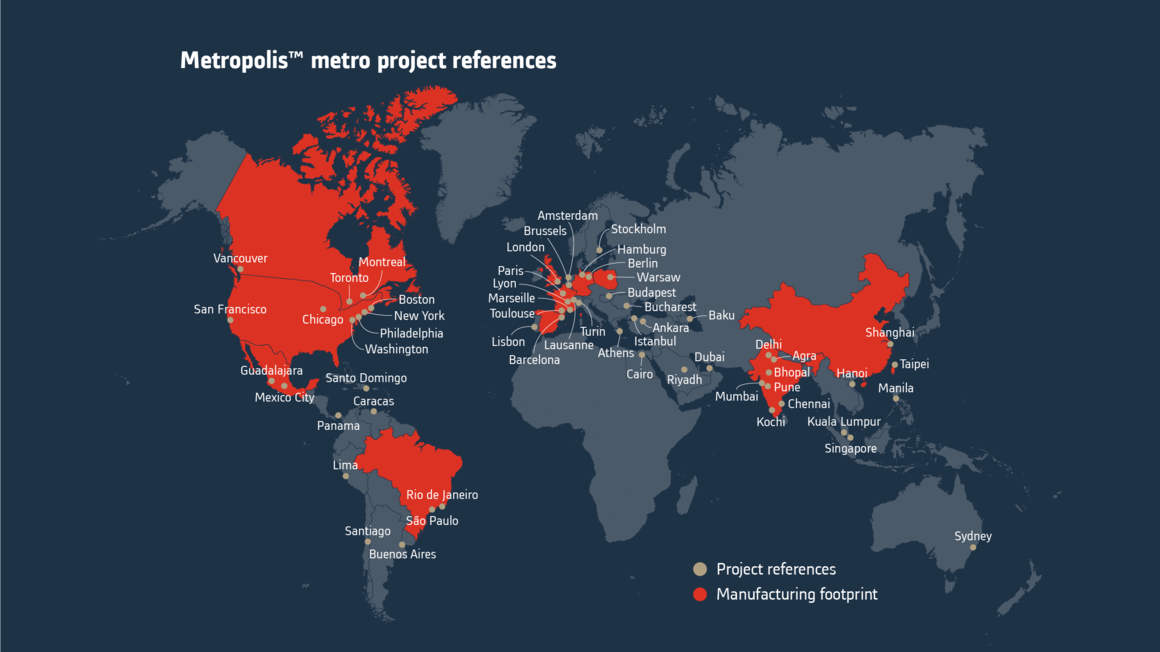
Just want to highlight this (and maybe add to the confusion), since I just noticed this project map from 2023 appears to consider the Toronto Rocket and Vancouver SkyTrain Metropolis projects.

Map_1200x690px_web_product_Metropolis.png
 
With the T1 and TR orders, the new cars went to Line 1 and the older cars were shifted to Line 2. Why will the new cars go to Line 2 this time?
 
With the T1 and TR orders, the new cars went to Line 1 and the older cars were shifted to Line 2. Why will the new cars go to Line 2 this time?

Likely for compatibility with existing equipment.

The TR's were brought online in 2011 and since then tech has changed. It stands to reason they would want newer and more compatible trains on the line.

I do see your point though. Line 2 always got hand me downs.
 
Likely for compatibility with existing equipment.

The TR's were brought online in 2011 and since then tech has changed. It stands to reason they would want newer and more compatible trains on the line.

I do see your point though. Line 2 always got hand me downs.
The electronics and software might be different but similar mechanical systems would ease maintenance and training to maintain them.

With the T1 and TR orders, the new cars went to Line 1 and the older cars were shifted to Line 2. Why will the new cars go to Line 2 this time?
The TRs were designed for line 1 to improve capacity however their coupled designed makes it very difficult to maintain at Greenwood yard so these new trains are designed to be easily decoupled. The TRs can’t to handed down to line 2 unless they build a new yard. They wanted to do that but they got no money. The older T1s stared in line 1 but are spread onto all 3 lines for accessibility. They aren’t bad trains at all.
 
Likely for compatibility with existing equipment.

The TR's were brought online in 2011 and since then tech has changed. It stands to reason they would want newer and more compatible trains on the line.
It is not clear as yet just what is going to change on these new trains. There may be a lot of carry-over from the TRs for all we know.

I do see your point though. Line 2 always got hand me downs.
This is absolutely not true. The H5s were split between the two lines, and the H6s were all delivered to the B-D. While the YUS got the base order for the T1s, the option order was allocated to B-D.

Dan
 
It is not clear as yet just what is going to change on these new trains. There may be a lot of carry-over from the TRs for all we know.


This is absolutely not true. The H5s were split between the two lines, and the H6s were all delivered to the B-D. While the YUS got the base order for the T1s, the option order was allocated to B-D.

Dan
Likely the electronics on the new trains should be smaller, tighter, and more compact. The last TR train was completed in 2015.

For comparison, cell phones in 2015 offered storage options ranging from 16 GB to 128 GB. Today's cell phones offer 1TB or more of storage. By the time the new trains arrive, will we actually make use of their new options, however? Or will the TTC stick to punched cards because of cost?
 
With the T1 and TR orders, the new cars went to Line 1 and the older cars were shifted to Line 2. Why will the new cars go to Line 2 this time?
Because why not?
I do see your point though. Line 2 always got hand me downs.
Just because that was usually the case before doesn't make it right (or wrong), and certainly doesn't mean it should always be the case going forward.
This is absolutely not true. The H5s were split between the two lines, and the H6s were all delivered to the B-D. While the YUS got the base order for the T1s, the option order was allocated to B-D.
It's mostly because of the T1 & TR orders that line 2 is known for "handmedowns". And again, when the T1s were being delivered I really fail to see the logic of the newest T1s going on line 1 and displacing the older T1s to line 2, rather than leaving the older T1s on line 1 where they already were to begin with, and putting the newest T1s directly on line 2.
It is not clear as yet just what is going to change on these new trains. There may be a lot of carry-over from the TRs for all we know.
Which would hopefully accelerate the design/build stage. While it's not yet known whether the new trains will have the same propulsion as the TRs (which themselves have similar propulsion to the C20, which came out in the late 1990s), other aspects of the TRs are already seen as outdated (such as the TR maps vs. LCD screens on newer cars like the R211). Even the original TR-inspired proposed exterior of the new trains is seen as outdated by many, who find the new rendering more modern.
The last TR train was completed in 2015.
Wasn't the last one delivered as late as 2017?
 
With the T1 and TR orders, the new cars went to Line 1 and the older cars were shifted to Line 2. Why will the new cars go to Line 2 this time?
Simply put, Wilson Yard (where the main heavy maintenance is done to the TR) has been retrofitted to handle the TRs maintenance requirements.

Greenwood Yard (where heavy maintenance is done for T1s) has not been retrofitted to handle TR maintenance requirement. If the TTC's new train order went to Wilson, the TRs would have to be moved to Greenwood and that yard isnt built/retrofitted to handle that.

So in order to avoid all that train movement/incompatibility, the new trains are being built in such a way where sets can be broken apart, which would then allow Greenwood to perform maintenance to the trains.

That's just a general synopsis of the reasoning.
 

Back
Top