




Monarch Butterfly
Superstar
Too bad Doug Ford vetoed "ranked balloting" at the municipal level. (And at the provincial level.)
|
|
|

Though I agree that the idea of the "Province of Toronto is not going to happen, the fact that it would not have an airport (or a major one) inside its boundaries is not significant. There is no 'law' saying a Province must have an airport and, of course, many people who live in Province A often use an airport in Province B.Agreed. And besides, most of the 6.8 million people who reside in the GTA do not live within Toronto anyway. And even if we looked at a province of the GTA, what about the nearly 2 million additional people who reside in the GTHA? Where do we draw the line?

Agreed. Washington, D.C., Las Vegas, Seattle, Pittsburgh and New Orleans are all examples of US airports that are not located within their city limits. No one cares. In fact, having grown up in pre-aircon 1970-80s Mississauga and having to hear the roar of jets, I felt that moving to the Toronto Beaches area was upscale because it did NOT have a major airport nearby. In my young adult mind, major airports, railway freight terminals and landfill sites were necessities of any city, but best placed in the outer suburbs. I wonder if we'd built the train from Union to Pearson first if Porter would have got off the ground, so to speak at the Toronto Islands.Though I agree that the idea of the "Province of Toronto is not going to happen, the fact that it would not have an airport (or a major one) inside its boundaries is not significant. There is no 'law' saying a Province must have an airport and, of course, many people who live in Province A often use an airport in Province B.
More to the "province of Toronto" point, DC's airport isn't within *DC* limits (National/Reagan Airport is across the river in Arlington). And you can also point out other "cross-state" cases (Cincinnati's airport being in Kentucky, for one)Agreed. Washington, D.C., Las Vegas, Seattle, Pittsburgh and New Orleans are all examples of US airports that are not located within their city limits. No one cares.

Kansas City's airport isn't in Kansas either. Though it is in Kansas City.
Milwaukee roof has "Welcome to Cleveland" on it.Uh... but... ah... never mind.
Cincinnati would have been a much better example.
 ca.mar.medallia.com
#2 over #1 please. I’m frustrated that road and sidewalk design is dictated by oversized emergency vehicles. We often can’t have separated bike lanes, sidewalk barriers, or other safe infrastructure because emergency vehicles can’t fit. Whenever I stand at the NW corner of Parliament and Carlton waiting to cross I note how narrow the sidewalk is, and how southbound trucks ride over the corner as they turn right onto Carlton - and I think we need a deeper sidewalk and a barrier here. But of course firetrucks seemingly cannot make the turn if a streetcar is there. Another example, in the suburbs, residential streets are built wide enough for six cars across, while in older city areas like Cabbagetown or Parkdale, streets may be only two cars wide - which would never be allowed today to serve the firetrucks. The solution isn’t to force infrastructure to accommodate massive vehicles, but to procure emergency vehicles that can navigate the streets we actually have. For example here is a firetruck in Paris.The City of Toronto AND the Province of Ontario needs to change its transportation policy ratings.
Should be…#1 priority—emergency vehicles#2 priority—pedestrians

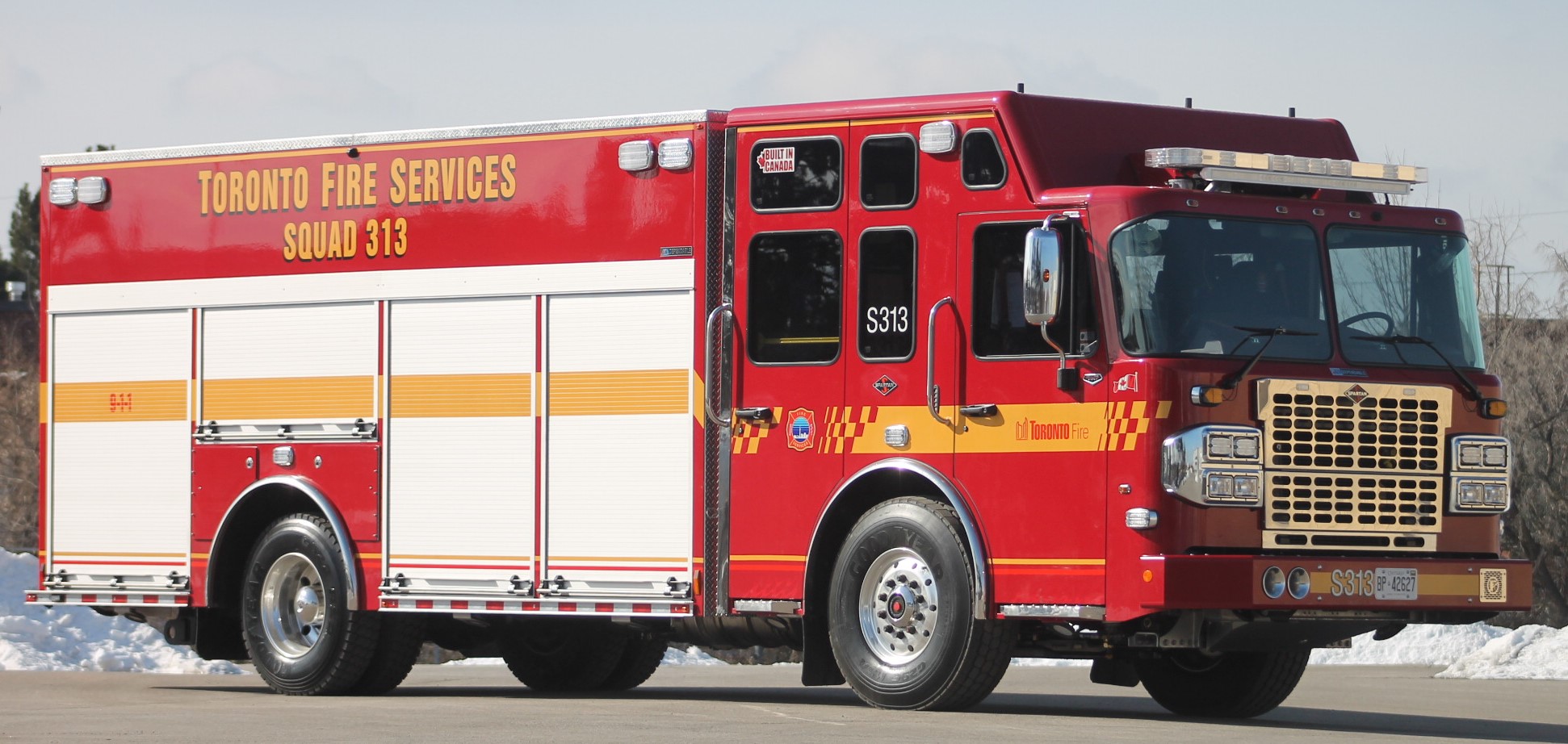
Instead of separate directional bike lanes, have dual-directional bike lanes. One lane for both cycling directions.#2 over #1 please. I’m frustrated that road and sidewalk design is dictated by oversized emergency vehicles. We often can’t have separated bike lanes, sidewalk barriers, or other safe infrastructure because emergency vehicles can’t fit. Whenever I stand at the NW corner of Parliament and Carlton waiting to cross I note how narrow the sidewalk is, and how southbound trucks ride over the corner as they turn right onto Carlton - and I think we need a deeper sidewalk and a barrier here. But of course firetrucks seemingly cannot make the turn if a streetcar is there. Another example, in the suburbs, residential streets are built wide enough for six cars across, while in older city areas like Cabbagetown or Parkdale, streets may be only two cars wide - which would never be allowed today to serve the firetrucks. The solution isn’t to force infrastructure to accommodate massive vehicles, but to procure emergency vehicles that can navigate the streets we actually have. For example here is a firetruck in Paris.
If you make separated bike lanes that are wide enough for a vehicle they will be used by cars. I see this every day on eastbound Dundas, Parliament to River. Maybe some sort of automated bollard would help - though I can see cellphone distracted cyclists crashing into it.Instead of separate directional bike lanes, have dual-directional bike lanes. One lane for both cycling directions.
Maybe create "Emergency Vehicle Lanes", that can be used by cyclists when the ambulances or fire trucks are not using them.

#2 over #1 please. I’m frustrated that road and sidewalk design is dictated by oversized emergency vehicles. We often can’t have separated bike lanes, sidewalk barriers, or other safe infrastructure because emergency vehicles can’t fit.
I think it might just be about availability and cost. The Cummins L9 models the city ordered last year are built in Brampton, on Spartan chassis.I see no reason that we need these enormous beasts dictating our infrastructure if Paris can make do with the above. Especially since most FD trips are ambulance calls.