News   Apr 02, 2026
 2.4K     3 
News   Apr 02, 2026
 1.1K     0 
News   Apr 02, 2026
 2.6K     2 

GO Transit: Construction Projects (Metrolinx, various)

^ Wasn't that for all the works in that section?

"GO Expansion: Lakeshore East – Central
Corridor (works west of Beechgrove Road
to west of Scarborough Golf Club Road)"
 
April 14
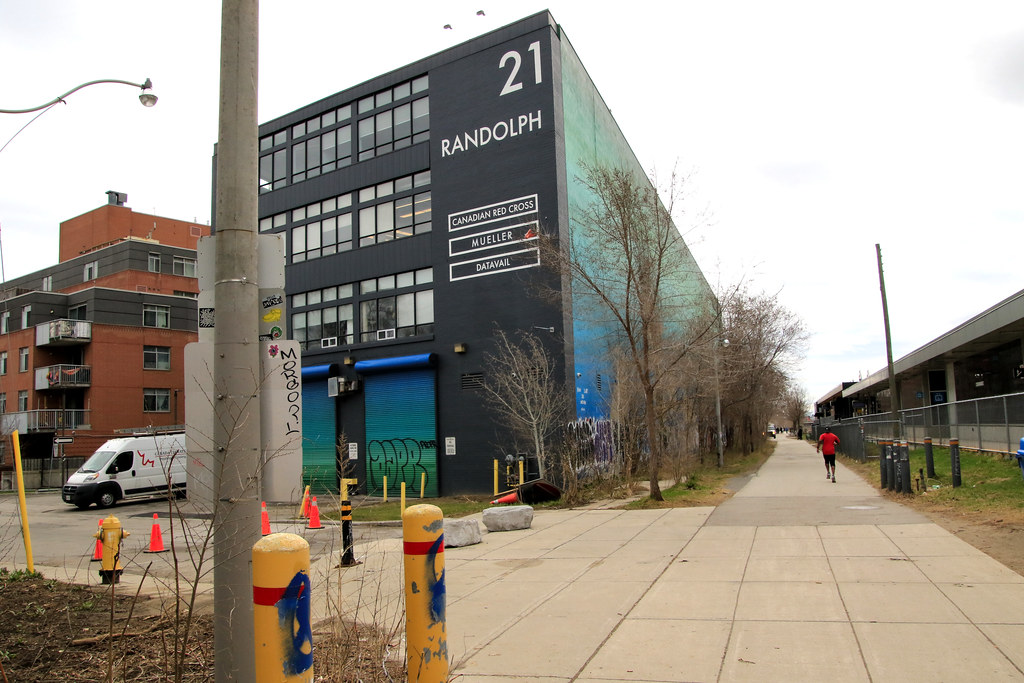
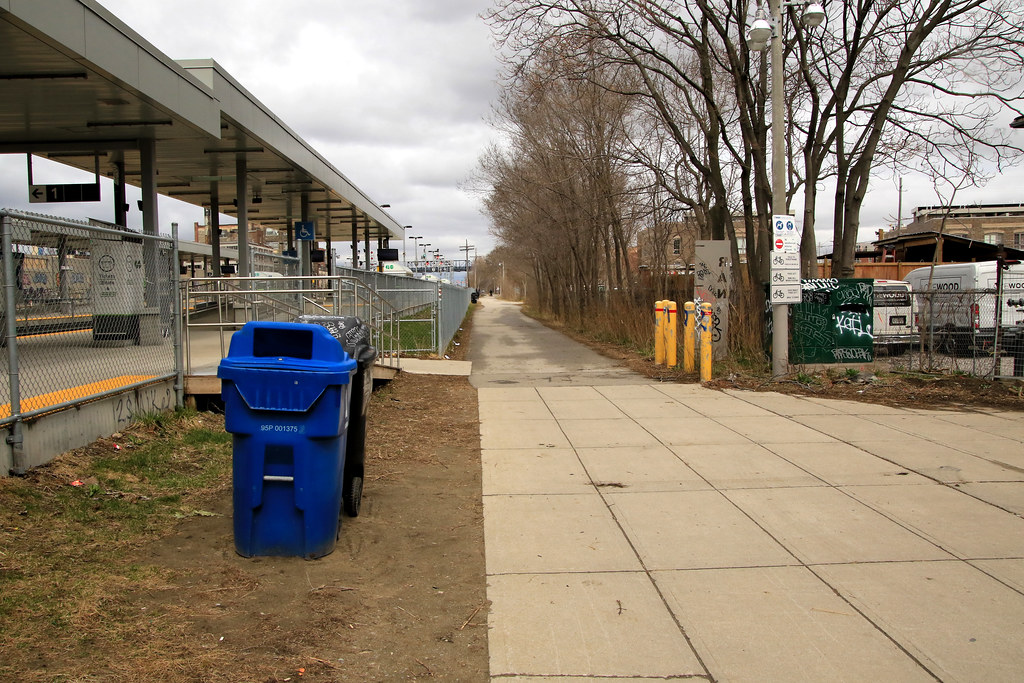
While waiting to try to get shots of the new VIA train at Bloor Station, decided to refresh what I knew of it as well take some update shots.

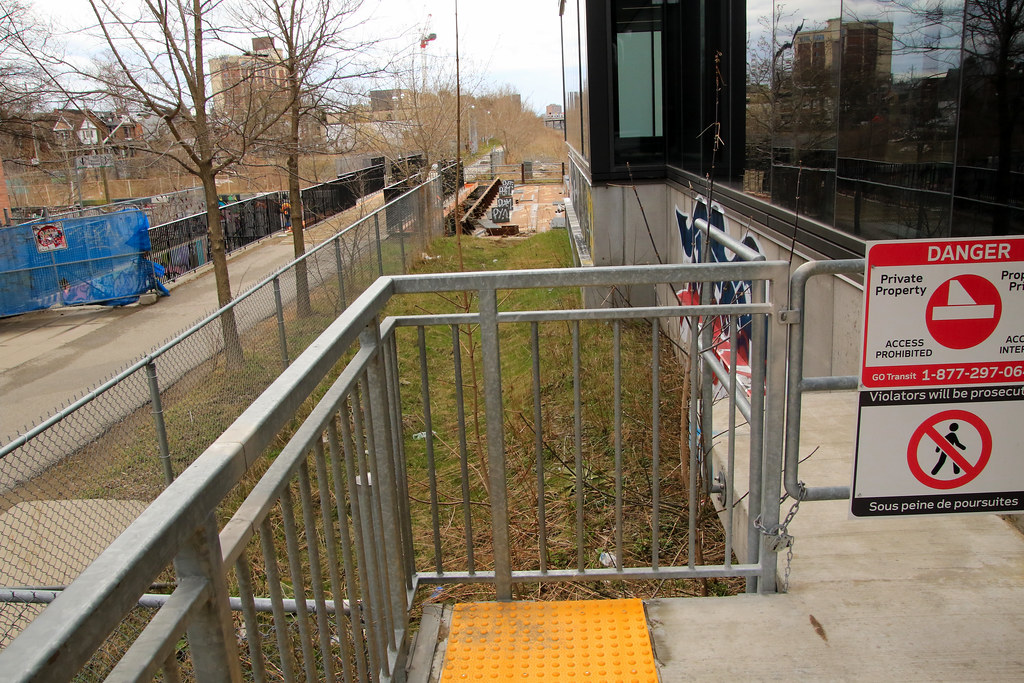
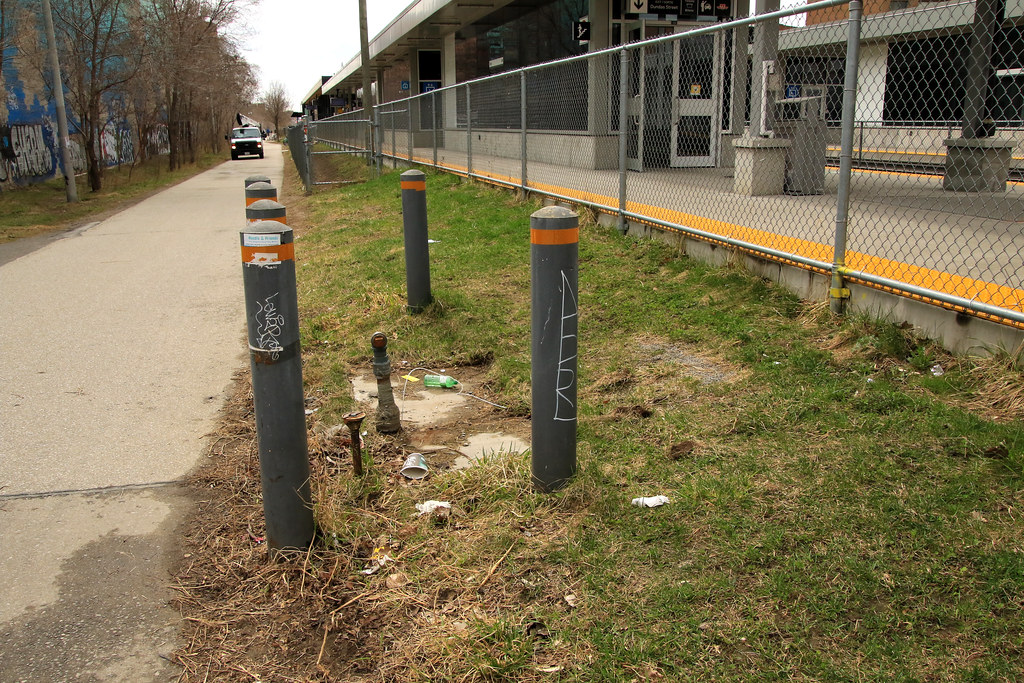
Unless all the trees are remove on the eastside of the Railpath, only 40% of it will remain once the track 1 install as well the sound barrier wall. The waterline and other utility lines will have to be relocated. 5 trees will have to be remove on the westside at Bloor as they are in the way. Bike rental will have to be relocated.

The big issue for the Railpath during construction is building a new angle tunnel from the centre tunnel to Randolph where there is area for a new stair well and elevator. This may see the Railpath close during the construction of the tunnel.

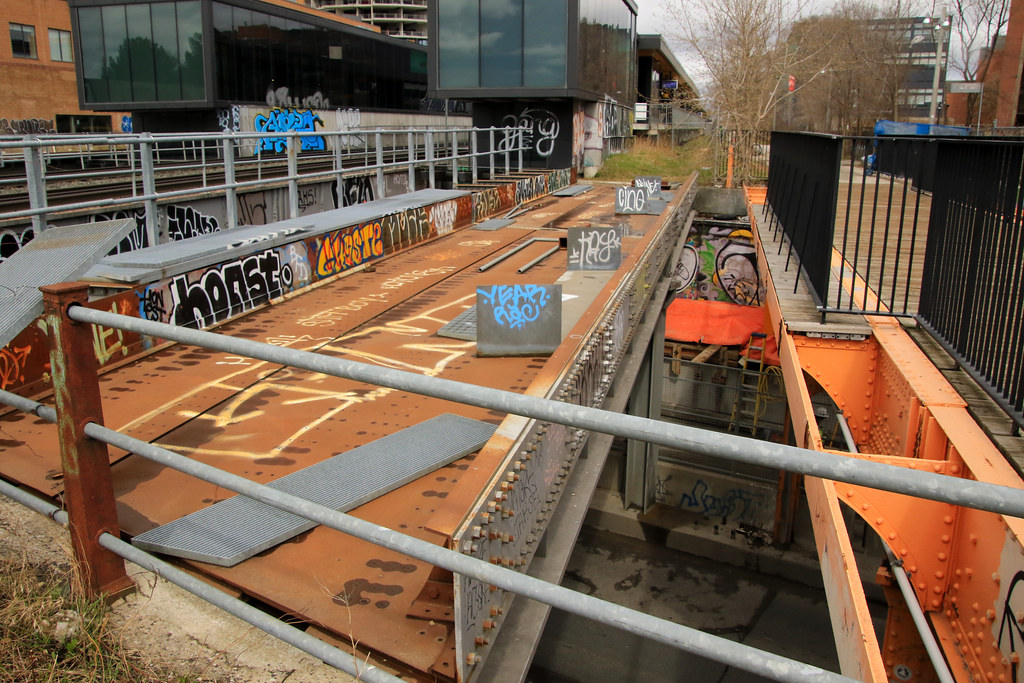
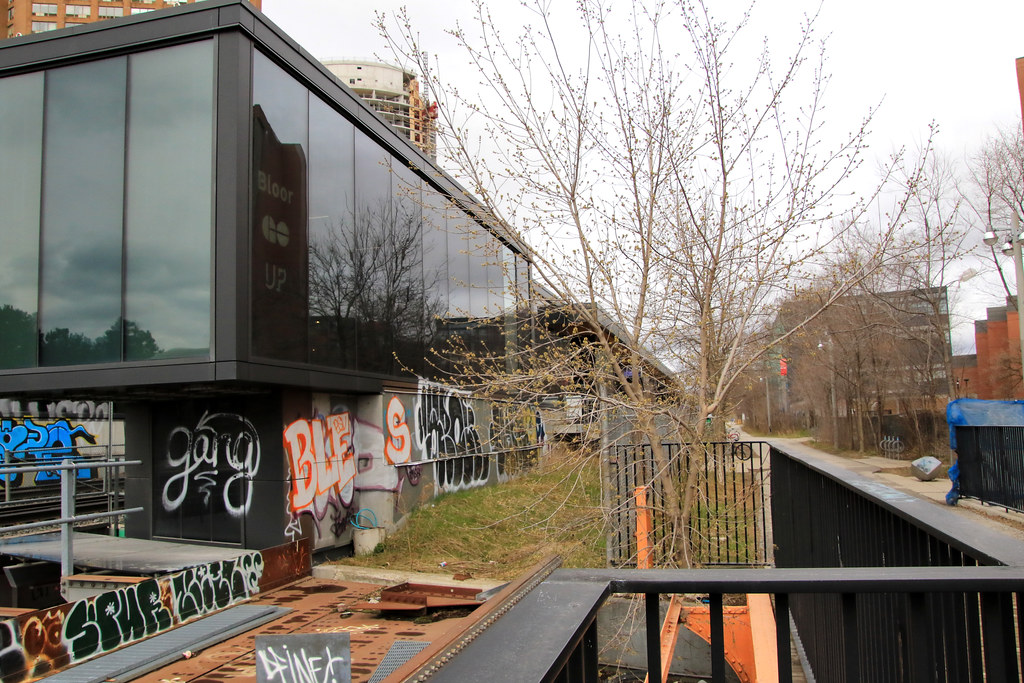
When the station was rebuilt, the centre support for track 1 bridge was rebuild with huge columns and support beam that will require it to be beef up and extended it to shift the bridge to line up correctly with the new track unless left as is with a small kink to the platform slowing trains Entering/Exiting the station. Best to rebuilt the bridge with no centre support.
52006317144_c0cd46a88d_b.jpg

52006582045_07854abf67_b.jpg

52006316864_0e49bb6c73_b.jpg

52006062046_53cefb8315_b.jpg

52005041457_d720ecc9f8_b.jpg

52006062321_aafe670ec2_b.jpg

52006123638_a4a8b00502_b.jpg

52006582685_9d21f54c8f_b.jpg

52006123398_3edc2b6c30_b.jpg

52006123143_77c049443e_b.jpg

52005040622_dd018c9490_b.jpg
 
When the station was rebuilt, the centre support for track 1 bridge was rebuild with huge columns and support beam that will require it to be beef up and extended it to shift the bridge to line up correctly with the new track unless left as is with a small kink to the platform slowing trains Entering/Exiting the station. Best to rebuilt the bridge with no centre support.

That 'kink' has always looked impossible to me. Way, way back in this thread we discussed this, and I recall someone knowledgeable stating that the reconditioned span had just been plunked down in a temporary manner and it was always intended that it would be realigned when/if the 4th track was added. I have always wondered if that were true, or if the placement was an "oops" during the GTS project.

- Paul
 
^ Brief reference to it here:

Post in thread 'Cycling: West Toronto Railpath (City of Toronto, Phase II Proposed)' https://urbantoronto.ca/forum/threa...f-toronto-phase-ii-proposed.2969/post-1301930

I think I remember asking someone about it at the meeting and was told that because they didn't have the final design of the Railpath or maybe the 4th track, it made sense just to place the span and adjust it later. So I'm going with temporary instead of 'oops'.
 
Last edited:
That 'kink' has always looked impossible to me. Way, way back in this thread we discussed this, and I recall someone knowledgeable stating that the reconditioned span had just been plunked down in a temporary manner and it was always intended that it would be realigned when/if the 4th track was added. I have always wondered if that were true, or if the placement was an "oops" during the GTS project.

- Paul
I always thought it was an oops' especially with the support of the bridge. Its not a simple task to move the new support as it replaced the existing one and more beef up. You would have to place shoring on both side of the support to remove it and move it to where it should be after new footing are built for it as one option.

The other option for shifting the bridge a foot or so will require an new support bean as well dealing with a cantilever overhang to the east. You could do a full moment stub connection for the support beam as well a tee column with a support footing anchor to the concrete base. Lots of field welding and full moment welds require more work.

Given the age of the bridges, wise go to a clear new span like ML has being doing on a number of bridges these days. Only have to look to the east a few block to see the real benefits of clear span. You may gain more height clearance doing so as well.

The area between Bloor and Ernest is the narrowest area as there is more room at each end to deal with track 1 and the wall. I would go with the grass wall as all other walls are a failure on ML part dealing with tagging.
 
That 'kink' has always looked impossible to me. Way, way back in this thread we discussed this, and I recall someone knowledgeable stating that the reconditioned span had just been plunked down in a temporary manner and it was always intended that it would be realigned when/if the 4th track was added. I have always wondered if that were true, or if the placement was an "oops" during the GTS project.

- Paul
One of our mutual friends worked on the cleanup from GTS and confirmed that it's current location was intentional, but temporary.

Dan
 
That 'kink' has always looked impossible to me. Way, way back in this thread we discussed this, and I recall someone knowledgeable stating that the reconditioned span had just been plunked down in a temporary manner and it was always intended that it would be realigned when/if the 4th track was added. I have always wondered if that were true, or if the placement was an "oops" during the GTS project.

- Paul
I was at a meeting about the Railpath realignment for the 4th track, which would use that bridge. the Metrolinx rep was asked. At that meeting the questioner was wondering how they could have blundered so when placing the bridge but the rep claimed it wasn't a problem, and made it seem as if it was more trouble to try and get the bridge in the exact spot when it was being worked on than it would be to fix later. As I recall, he claimed a night and a crane are all that is needed to align it.
 
Last edited:
I was at a meeting about the Railpath realignment for the 4th track, which would use that bridge. the Metrolinx rep was asked. At that meeting the questioner was wondering how they could have blundered so when placing the bridge but the rep claimed it wasn't a problem, and made it seem as if it was more trouble to try and get the bridge in the exact spot when it was being worked on than it would be to fix later. As I recall, he claimed a night and a crane are all that is needed to align it.

I was told same thing at the meeting.

Post in thread 'Cycling: West Toronto Railpath (City of Toronto, Phase II Proposed)' https://urbantoronto.ca/forum/threa...f-toronto-phase-ii-proposed.2969/post-1301930
 
I was at a meeting about the Railpath realignment for the 4th track, which would use that bridge. the Metrolinx rep was asked. At that meeting the questioner was wondering how they could have blundered so when placing the bridge but the rep claimed it wasn't a problem, and made it seem as if it was more trouble to try and get the bridge in the exact spot when it was being worked on than it would be to fix later. As I recall, he claimed a night and a crane are all that is needed to align it.

The supporting concrete on each end of the bridge span was renewed during GTS for the full 4-track width, so the span can certainly be shifted easily with a simple lift.
As @drum118 notes, the center support might need to be rebuilt, but that's not a lot of work. I expect the footing was built with that eventuality in mind.
The span itself is effectively a like-new bridge with a long life expectancy. It has fewer supports underneath than the other spans, but retains the center support. Going to a new design with a single full-width design would waste that investment, and since the other spans retain their center support there's nothing gained by eliminating it for just this one track.
Hopefully there is clearance without shifting the Railpath bridge - there is a stairwell on the east side so it can't move more than a foot or two. It's a bit rustier, not a problem given its lighter load but sure is messy underneath. One would hope the whole underpass ends up with a neater finish.

- Paul

Screen Shot 2022-04-16 at 10.25.56 AM.png
 
Contract Awarded


Update on the Don Valley Layover.


Key passage from the report:

Summary

To achieve service-level targets that support Metrolinx's GO Expansion Program ("GOE Program"), track improvements, infrastructure modifications and new facilities are planned across the rail network. On-Corridor ("OnCorr"), the GOE Program's largest package of work, is focused on corridor electrification and includes any outstanding infrastructure not constructed as part of earlier work packages, such as new track, facilities and a number of grade separations throughout the rail network. The Don Valley Layover Facility ("Facility") is one of three new layover facilities planned through the Metrolinx GOE Program's OnCorr package of work.

Metrolinx plans to locate the Facility north of the Prince Edward Viaduct at Bloor Street East, between the Don Valley Parkway and Lower Don Trail, along the Don Branch Rail Corridor (currently not operational), and within Toronto's park network with a variety of informal names, including Lower Don Parklands, Don River Valley Park, or "Wonscotonach Parklands". Through stakeholder engagement and outreach, the name Wonscotonach Parklands has emerged as a potential official name that could be used moving forward. Wonscotonach is understood to be the Anishinaabe place name for the Don River and likely translates to "burning bright point".

Metrolinx has noted it requires a new Facility at this particular location to reduce the congestion currently experienced at Union Station and to provide a location for storage and light maintenance of trains during day-time off-peak periods. Earlier designs identified a three-track electrified facility south of the Bloor Viaduct within a City of Toronto-designated Environmentally Sensitive Area (ESA). However, following significant feedback from the City of Toronto, Toronto and Region Conservation Authority (TRCA), and local stakeholders, Metrolinx proposed several modifications to the Facility to minimize the impacts on Toronto's park network.

The purpose of this joint staff report is to respond to direction from EX29.3 Update on the Metrolinx GO Expansion Program – First Quarter 20221considered by City Council. To begin, this report will provide an update on the current proposal for Metrolinx's Facility, including the size and location of the land needed, including City-owned land, and details on any land-use changes since the last report on this matter. This report will subsequently detail the Facility's anticipated impacts to Toronto's park network and will provide updates on Wonscotonach Parklands consultations to date.

Current Status & Next Steps

In early fall 2021, Metrolinx initiated a procurement process for a technical advisor (TA) to undertake engineering services that will advance the Facility's design. The Request to Qualify and Quote (RQQ) was subsequently published on December 17, 2021, providing a brief scope overview and details concerning associated project components. Metrolinx has advised City staff that a detailed scope of work, as well as the Facility's design, footprint and configuration will be further advanced, clarified and confirmed by the TA, who is anticipated to begin work in mid-2022.

At present, there is no further information on the total footprint or proposed configuration of the Facility as previously reported to City Council. As Metrolinx proceeds with refining the Facility's design and requirements in consultation with the TA, the property requirements and overall impacts may be adjusted.

In late 2021, Metrolinx also initiated work to inform studies that will further evaluate and consider the impacts of the Facility on the Lower Don Valley, including heritage impact assessments of heritage features in the area, such as the Prince Edward Viaduct. In early 2022, work including biological assessments of the habitat features in the adjacent area; arborist evaluations of trees in the vicinity of the proposed layover; and, engineering analyses of the current infrastructure began to further inform Metrolinx's studies. At present, City staff have not received a tree inventory and/or arborist report; therefore the full scope of tree and vegetation impacts are currently unknown. These reports are required to allow City and TRCA staff the opportunity to assess impacts to the ravine area as a whole. Lastly, Metrolinx has proposed to also undertake a planning study to examine the infrastructure requirements in the Don Valley, which is also anticipated to take into consideration community inquiries with respect to trail creation (e.g. East Toronto Railpath).

Metrolinx has committed to continued community and stakeholder engagement through this refinement of project requirements stage, and through to detailed design and construction. Metrolinx has also communicated that it will continue to address stakeholder comments with the aim to further minimize impacts and enhance the ecological function of the Don Valley. In addition, as part of the EPR process, Metrolinx Metrolinx's Proposed Don Valley Layover Facility and the Wonscotonach Parklands Page 10 of 19 documented Indigenous Communities Consultation10 and has also committed to undertake additional community and stakeholder engagement as detailed design progresses.

City staff are committed to providing updates on the Facility as it develops through future reports on the Metrolinx GOE Program.
 

Back
Top