News   Apr 17, 2026
 268     0 
News   Apr 17, 2026
 687     1 
News   Apr 17, 2026
 368     0 

Waterloo Region Transit Developments (ION LRT, new terminal, GRT buses)

I've lived here all my life and am convinced that he's wrong. Reusing hydro and rail corridors was key to keeping phase 1 affordable enough to actually happen. Hate on the route all you want, but any other routing would have cost significantly more and failed to pass the many so-called 'transit referendum' elections that it got through.

My only regret with the phase 1 route was that they couldn't keep it in the rail corridor between Hayward and the hydro corridor, ducking under Block Line and crossing Courtland with straight track at higher speeds, with an Ottawa/Pimisi style station at Block Line. The current route absolutely crawls along beside Courtland between Block Line and Hayward, then tip toes its way through the Hayward s-bends. Rumour has it that CN/CP blocked any use of the space alongside their interchange yard though, so it was simply not to be. :(
If affordability was a concern when building this line or not (and accepted) then I am a bit confused why some are shocked that affordability is leading to service changes.
 
If affordability was a concern when building this line or not (and accepted) then I am a bit confused why some are shocked that affordability is leading to service changes.

The problem when the line was getting built is completely different than it is now. When it was getting built so many things got VE because if it cost anymore than it did it would not have gotten built and we still wouldn't have a LRT line. The service changes that the region wants to do is really a situation of suffering from success, the amount of people using the LRT now compared to when it opened is substantial, in the fall term of 2019 there were still seats available during rush hour, both morning and evening, now 4 years later many trains are shoulder to shoulder. The service changes the Region wants to make allow them to stay within the contract between Keolis/Grandlinq and the Region where there is a set amount of service hours per year. They could always break the contract with Keolis/Grandlinq but they are trying to avoid that since it would inevitably mean a significant increase in cost, ultimately if ridership continues the way it has they're going to break the contract anyways they're just trying to push that off as far as they can while still maintain adequate frequencies.
 
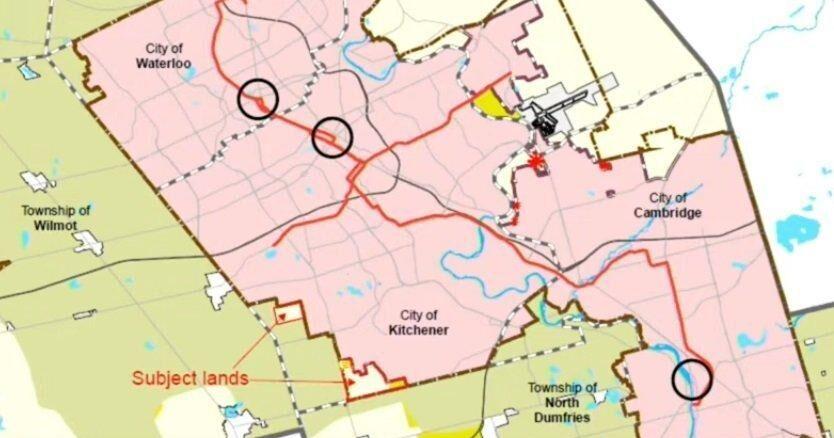
Saw this map in this article

1701278084035.png


I see the ION LRT with Cambridge extension, but what is the other red line? Going east/west?
 
Saw this map in this article

View attachment 523588

I see the ION LRT with Cambridge extension, but what is the other red line? Going east/west?

It's from ROPA 6 (Regional Official Plan Amendment 6). When you go reading it says the following in section 2.D.3.5,

As part of the next update to the Region’s Transportation Master Plan, the Region, in collaboration with the area municipalities, will examine the potential for establishing a new ION rapid transit route along the east-west Regional Intensification Corridor shown on Map 2 that would:

(i) provide a direct link from the Region’s transit system to the Region of Waterloo International Airport; and

(ii) serve as a key transit corridor connecting the west side of the City of Kitchener to the East Side Lands Employment Area in the Township of Woolwich, and City of Cambridge via the Fountain Street corridor

So the region is considering Ottawa as a phase 3 LRT line instead of other potential routes like University or Victoria.
 
Last edited:
It's from ROPA 6 (Regional Official Plan Amendment 6). When you go reading it says the following in section 2.D.3.5,

As part of the next update to the Region’s Transportation Master Plan, the Region, in collaboration with the area municipalities, will examine the potential for establishing a new ION rapid transit route along the east-west Regional Intensification Corridor shown on Map 2 that would:

(i) provide a direct link from the Region’s transit system to the Region of Waterloo International Airport; and

(ii) serve as a key transit corridor connecting the west side of the City of Kitchener to the East Side Lands Employment Area in the Township of Woolwich, and City of Cambridge via the Fountain Street corridor

So the region is considering Ottawa as a phase 3 LRT line instead of other potential routes like University or Victoria.
I'll add that it's also one of the real bits of strangeness in ROPA 6 after the minister got his claws into it. The Regional Intensification Corridors as the Region talked about them were in more places and looked more like the Stage 3 concepts that have popped up before.
 
I'll add that it's also one of the real bits of strangeness in ROPA 6 after the minister got his claws into it. The Regional Intensification Corridors as the Region talked about them were in more places and looked more like the Stage 3 concepts that have popped up before.

The Region had settled on Ottawa St as the next Regional Intensification Corridor before the province even got to review it. In the August 2020 Technical Brief on the Intensification Strategy Ottawa St, Victoria St, University Ave/Erb St/Ira Needles Blvd were marked as potential Regional Intensification Corridors, in the August 2021 Technical Brief on the Intensification Strategy Ottawa, Victoria/Highland, Erb/University/Seagram were all marked as potential Region Intensification Corridors, then in the draft ROPA 6 from June 29 2022 Ottawa St was marked as a Regional Intensification Corridor with Victoria/Highland, Erb/University/Seagram, and King St (Uptown to Conestoga Mall) all marked as "Local Intensification Corridors".

In terms of the differences between a Regional Intensification Corridor and a Local Intensification Corridor it is explained in ROPA 6 sections 2.D.3 and then 2.D.4. The difference primarily relates to densities, along Regional Corridors the Region wants high density, along Local Corridors the Region wants missing middle/midrise. Both are very "15 minute city" focused but the Regional Corridor elaborates significantly more on Active and Public Transit focus compared to Local Corridors (It also mentions a future ION phase).

Appendix E of the 2021 Technical document goes through an analysis of all the Corridors that were put forward to get to the final 4 but I can't find anything on why Ottawa was ultimately picked, looking at the fall 2019 boarding map does show significantly more boardings along the Ottawa Corridor then Victoria however. It was ultimately the Region who picked it not the province, the province meddled with ROPA 6 after the Ottawa St decision.
 
Given the projected cost, I am really curious if this will come to fruition. (There will soon be two new LRT projects vying for provincial and federal money: Brampton and KW).
Four projects total now - Brampton, KW, Toronto (Eglinton East, Waterfront East). With ballooning costs I cannot see how these all get funded in a timely manner.
 
Not to mention the funded Hamilton LRT, the proposed Ottawa stage 3 LRT, and the Gatineau and Quebec city trams. All of which are at least in the 4 billion range. Just last week Quebec paused work on their tramway after costs were projected to reach $8 billion ! ION's cost of $868 million/19 km in 2014 now seems like a bargain. Its probably better to spend that money on purchasing new buses and training additional operators than on any higher order transit. Alas we now risk falling back into the transit expansion stagnation of the 2000s (at least for trams).
 
Given the projected cost, I am really curious if this will come to fruition. (There will soon be two new LRT projects vying for provincial and federal money: Brampton and KW).

I will note that the 4.5 billion price tag is the high end of the current estimate. It was said in one of the council meetings or a report to council I do not remember which one that the 4.5 billion amount was the upper bound of the range and that it really ranged from 2.25 billion (-25) to 4.5 billion (+50). A more accurate cost will be determined when the Region makes the business case which they expect to be done by the end of 2025.

Another interesting thing that was mentioned at one of the council meetings was that of all the recent LRT projects KW and Ottawa are the only municipalities that have had to pay a substantial portion of the capital costs, with Finch, Eglinton, Hurontario and Hamilton being completed funded by the province and feds. So the Region is definitely going to be asking for more money from the province/feds this time around compared to last time. Especially since they can show the success of Phase 1.
 

Back
Top