
News   Apr 02, 2026
 128     0 
News   Apr 01, 2026
 356     0 
News   Apr 01, 2026
 559     0 

VIA Rail

We can marble at Brightline all we want, but in the end, the passenger and freight operations along the Florida East Coast corridor are owned by the same investor, who also happened to own the adjacent lands required for its downtown terminals,

There's a lot of people who don't get that many of these private rail enterprises only work with substantial real estate plays. It's the same for a lot of Asia's supposedly private subway systems.

Also, it's hilarious to see the folks that think privatization will somehow improve service. They've apparently not heard of the fiasco in the UK. If VIA was privatized, the only service left could well be Quebec-Windsor, and even that might be down to London-Quebec with fewer intermediate stops.
 
Privatization does not necessarily mean without subsidy or service standards. Most certainly what privatization would do is lay bare what subsidies exist (including cross subsidies) and force the government to justify them, or the lack of them.

Like why is VIA funding critical links for community survival in some places, but provinces do in others? Is that VIA’s job? Is it VIA’s duty to provide service where provinces have refused to build roads? Is VIA’s job to run any service where a subsidy below a certain $/pax/mile would make it viable? Is VIA’s job to provide the illusion of usefulness while fuelling nostalgia and inbound visitation?
 
Admittedly, the consistency of the VIA mandate seems as clear as mud, but I'm not sure turning it into a federally-funded bus service is a viable answer. Constitutional jurisdiction aside, I'm not sure how bus service between two communities within a given province should be dependent on whether one of them happens to have a train station.

Trying to compare any transportation service to the Rocky Mountaineer services is ludicrous. The RM routes are tourism packages, period. The Canadian and Ocean do have significant tourist ridership, but they do provide station and flag stop service at basic fare rates.
 
Admittedly, the consistency of the VIA mandate seems as clear as mud, but I'm not sure turning it into a federally-funded bus service is a viable answer. Constitutional jurisdiction aside, I'm not sure how bus service between two communities within a given province should be dependent on whether one of them happens to have a train station.

Trying to compare any transportation service to the Rocky Mountaineer services is ludicrous. The RM routes are tourism packages, period. The Canadian and Ocean do have significant tourist ridership, but they do provide station and flag stop service at basic fare rates.
So then the RMR should be mandated to pickup passengers along their route with a "coach" class, or allow VIA to be allowed to provide transportation on the same route. There should be enough market for both.
 
I think the most interesting information in the HFR material that is out there is mention that the HFR service would operate under a new brand and the service being part of a build-operate model. I think these steps really break this new service away from the VIA that exists today if this effort crosses the finish line. When people associate VIA with tourist trains and Peregrine (making up the name) with HFR and decent corridor services, then the discussion with politicians and the goals of taxpayers becomes different.

VIA needs to become a transport-focused agency rather than a rail-based company. If buses are more effective at creating transport links than trains (which would be in smaller areas, hopefully/mostly), do that instead.
Agreed. This is something VIA would likely already do if their mandate was cross-canada land based public transportation.
 
So then the RMR should be mandated to pickup passengers along their route with a "coach" class, or allow VIA to be allowed to provide transportation on the same route. There should be enough market for both.
Seriously? It's a privately owned tour company operating on a privately owned right-of-way providing what I understand is a profitable and popular service. Yes, let's grind that down with wayside stops.

Perhaps freight carriers should be mandated to tack on a passenger car or two, or GO rail should start doing flag stops along its routes.
 
Seriously? It's a privately owned tour company operating on a privately owned right-of-way providing what I understand is a profitable and popular service. Yes, let's grind that down with wayside stops.

Perhaps freight carriers should be mandated to tack on a passenger car or two, or GO rail should start doing flag stops along its routes.
If there is no "public" transportation on that route and they are the only carrier that provides services they should be mandated to. OR VIA should be allowed to operate the same route as a form of public transportation.
 
By giving the new carrier the rolling stock and VIA owned track, Ottawa, as I stated, would be able to set and maintain prices,, would dictate frequency standards, require transit integration, and set minimum on-time performance levels lest they lose their GST exemption and other tax breaks. Basically, Ottawa would set the standards and control prices just like they do with telecom companies.............private enterprise but federally regulated.

They would only build lines where the need can be financially justified and yet would not have to run under VIA's antiquated and highly politized mandate. For the vast majority of the country which will no longer have rail service, VIA would be the bus carrier. I'm sure most people in Western Canada would rather have 2 reliable and fast buses rolling into town than a 2 day/week train that is always late and sometimes over 15 hours late.

Having a rail line to your town is not a right of passage. If one believes that all citizens have to right to a RELIABLE and EFFECTIVE form of public transport then VIA would be gone tomorrow and be replaced by buses that would serve millions of more people with vastly superior service. The job of VIA is not to be yet another government agency but to provide effect rail transport in the country and in this regard it has been an absolute failure so why bother keeping it when there are alternatives?
 
By giving the new carrier the rolling stock and VIA owned track, Ottawa, as I stated, would be able to set and maintain prices,, would dictate frequency standards, require transit integration, and set minimum on-time performance levels lest they lose their GST exemption and other tax breaks. Basically, Ottawa would set the standards and control prices just like they do with telecom companies.............private enterprise but federally regulated.

They would only build lines where the need can be financially justified and yet would number have to run under VIA's antiquated and highly politized mandate. For the vast majority of the country which will no longer have rail service, VIA would be the bus carrier. I'm sure most people in Western Canada would rather have 2 reliable and fast buses rolling into town than a 2 day/week train that is always late and sometimes over 15 hours late.

Having a rail line to your town is not a right of passage. If one believes that all citizens have to right to a RELIABLE and EFFECTIVE form of public transport then VIA would be gone tomorrow and be replaced by buses that would serve millions of more people with vastly superior service. The job of VIA is not to be yet another government agency but to provide effect rail transport in the country and in this regard it has been an absolute failure so why bother keeping it when there are alternatives?
Since when do we have a national bus or airline service for the public to use?
 
So Rocky Mountaineer was a VIA train, a daylight tourist train. The franchise to operate it was sold or leased or somesuch with the goal of not providing a subsidy to an explicitly tourist service. My understanding is that soon afterwards, the Montreal-Vancouver via Edmonton route was shutdown, and the Toronto-Vancouver route via Calgary was shifted to via Edmonton.
 
So Rocky Mountaineer was a VIA train, a daylight tourist train. The franchise to operate it was sold or leased or somesuch with the goal of not providing a subsidy to an explicitly tourist service. My understanding is that soon afterwards, the Montreal-Vancouver via Edmonton route was shutdown, and the Toronto-Vancouver route via Calgary was shifted to via Edmonton.
VIA Rail‘s “Rocky Mountains by Daylight” service was privatized the same year (1990) as half of VIA’s network was cut. Interestingly, it already recovered 96% of its direct operating costs in its first year of operation (1988), which strongly suggests that it would have become a net contributor to VIA‘s fixed costs, had VIA been allowed to keep it:
A4D32E2C-F4E5-4B49-9411-48E85819C549.jpeg

Downloaded via: High Speed Rail Canada
 
VIA Rail‘s “Rocky Mountains by Daylight” service was privatized the same year (1990) as half of VIA’s network was cut. Interestingly, it already recovered 96% of its direct operating costs in its first year of operation (1988), which strongly suggests that it would have become a net contributor to VIA‘s fixed costs, had VIA been allowed to keep it:
The rocky Montaner is a tourist train it has no sleeping cars and makes a stop during the night for the people on the train to go to a hotel, the service is not comparable to a via train. Via gave up using that section of the line a d the Rocky mounter took it over


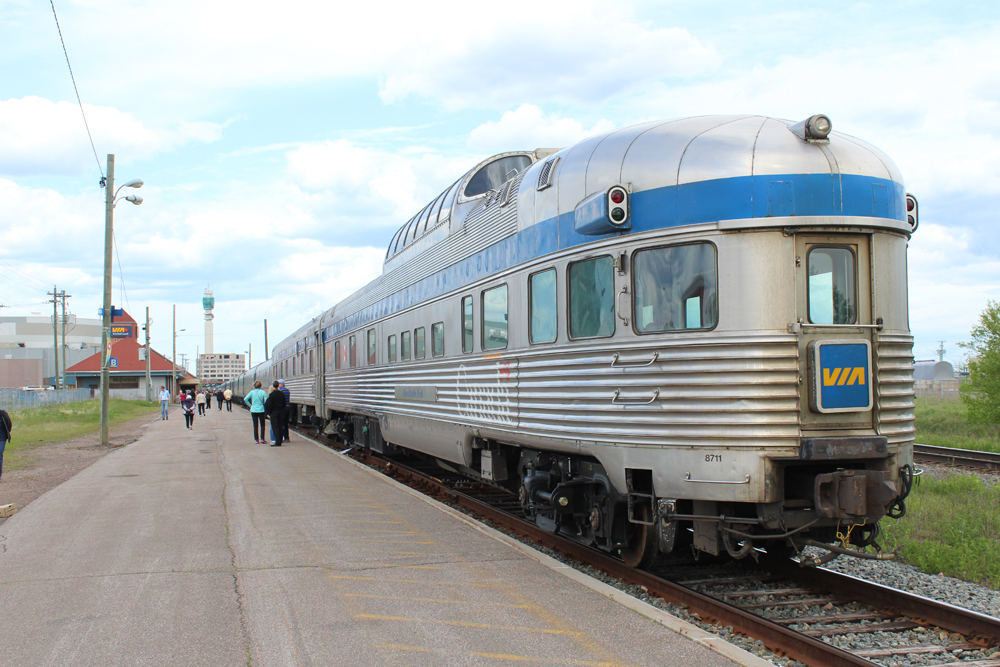
VIA’s struggle for relevance at the root of CEO’s resignation: Analysis​


MONTREAL — When a passenger operator is forced to survive on a budget insufficient to provide service capable of satisfying its country’s travel needs, while on-time reliability remains hamstrung by host railroads, it is almost impossible for the person in charge to make a difference.

The abrupt departure of VIA Rail Canada CEO Cynthia Garneau after three years is seen by many Canadian observers as recognition of that reality [see “VIA Rail Canada CEO Garneau resigns,” News Wire May 21, 2022]. But the move was likely set in motion in March when Transport Minister Omar Alghabra announced at a VIA facility, without Garneau in attendance, that his department would essentially usurp her role as “High Frequency Rail’s” primary overseer.
 
Thats a bit of a gloomy picture. Maybe this is a good thing? Who knows who the next CEO will bring.
 
Thats a bit of a gloomy picture. Maybe this is a good thing? Who knows who the next CEO will bring.
Whenever you see an article which asks Crazy Greg for his opinion, you can safely ignore and forget what you just read and go to the next article, as the sole purpose of his opinions (and the other expert opinions - like David Gunn’s - he volunteers to the authors) is to promote the narrative that VIA is in perpetual decline and that only his (almost as perpetually forthcoming book) knows the answers of how to solve it…
 

Back
Top