News   Apr 02, 2026
 140     0 
News   Apr 01, 2026
 362     0 
News   Apr 01, 2026
 564     0 

VIA Rail

There's room on the Winchester Sub - CP pulled out the second track this past summer, leaving only a few long sidings. They installed CTC to manage it, and sent the CWR out to improve the MMA/CMQ. If a bypass was needed badly enough, there is room to re-lay that second track, sidings might not be necessary.

I don’t understand the interest in the Winchester Sub.... once one gets to Smiths Falls, might as well carry on to Ottawa on the existing line. Not much longer and hugely cheaper than having two routes in parallel so close together. Taking a short cut through Winchester would save a few minutes of trip time, but at a significant construction and operating cost. That idea seems like the least justifiable of any of the options that have been floated.

Where things get interesting is between De Beaujeu and Dorion. One could make a case for VIA cutting the corner and using the Winchester Sub (which remains double track that far east) to Ste Annes. That would keep HFR off CN through Coteau (a pinch point) and could use the CP bridges to cross the Ottawa River. CP is a bit less busy than CN, and the result would be less conflict with freight.

- Paul
 
While using the Winchester Sub would technically be an option, I don't think it is a very likely one given that I don't think CP would be willing to have their network disconnected from the Atlantic ports.

Besides, you are totally missing my point. I was trying to say that having completely separate and isolated ROWs for Montreal-Toronto and Ottawa-Toronto (like some people seem to be promoting), is not only expensive, but unnecessary since the shortest possible route for Montreal-Toronto could have branches to Ottawa and Kingston with the bulk of the ROW being shared.


If you go back to my original post, you will see that I said,:


In other words, this would only happen once when demand has increased to a point where HFR is exceeding its capacity and upgrades are needed anyway. The thing about intercity rail is once you have hourly service, increasing frequency beyond that doesn't provide significant benefit, so rather than having 30 minute service through Ottawa, it would make more sense to keep it at the (post HFR) hourly frequency and add hourly express trains from Montreal to Toronto. As I said:


I still remain unconvinced that a zig-zag Toronto-Kingston-Ottawa-Montreal route is the best one for a future HSR plan. I would rather see a route that goes down the middle with branches to Kingston and Ottawa.
I never understood the compulsion among people on forums like these to relegate Ottawa to a branch line. I don't think a lot of people are really getting how much ridership Ottawa generates and how connected it is to Toronto. It's a critical source of ridership and having it on the same line as Montreal and Toronto brings significant operating efficiencies. Building another line to by-pass Ottawa (on a freight mainline no less) would have a huge cost for very little distance saved and negligible benefit. Every train using it would miss out on a lot of ridership and revenue in Ottawa. Bypassing Ottawa to save some time getting to Montreal makes about as much sense as by-passing Montreal to speed up trains to Quebec City.

Just about every HSR line zig-zags to hit major cities along the route. The line from Rome to Milan doesn't by-pass Bologna. The line from Brussels to Frankfurt doesn't by-pass Cologne. You get the point.
 
I don’t understand the interest in the Winchester Sub.... once one gets to Smiths Falls, might as well carry on to Ottawa on the existing line.
Another one of the benefits of the HFR approach. Start with the rail beds that exist as much as possible, create a connection between the two lines 2km north of Smith Falls for now, but maybe have a more direct line from Glen Tay to near the 416 near McKenna Casey Dr in the future. Personally I would like to see all the Toronto - Montreal traffic stop in Ottawa... because it means the traffic that pays for the line and political will to improve the line is greater than if you have multiple lines, and the amount of track you pay to maintain in total is less.

I would start with the route from Toronto to Ottawa via Peterborough, start service with that, and then divide the route into operating segments that would be upgraded over time based on benefit:
  1. Union to Rail Corridor at Lake Ridge Rd in Whitby - Solve the long term route out of Toronto (Don Valley, Stouffville with a new connection north of Major Mackenzie heading west, other options?)
  2. Rail Corridor at Lake Ridge Rd in Whitby to Rail Corridor and Peterborough County Rd 10
  3. Rail Corridor and Peterborough County Rd 10 to Rail Corridor and Jermyn Line in Indian River - Solve the route through Peterborough (grade separations, station downtown vs outskirts, etc)
  4. Rail Corridor and Jermyn Line in Indian River to Rail Corridor and Tiffen Rd in Marmora - Solve by-passing Norwood and Havelock
  5. Rail Corridor and Tiffen Rd in Marmora to Rail Corridor and Sulphide Rd in Tweed north of Bogart - Solve the big dip and Tweed by-pass
  6. Rail Corridor and Sulphide Rd in Tweed to Rail Corridor and Clark Rd in Central Frontenac east of Cardinal Heights Drive - Solve the curves around Arden and the Kaladar by-pass.
  7. Rail Corridor and Clark Rd in Central Frontenac to Rail Corridor and Hydro Corridor east of Fall River Road in Sharbot Lake - Solve the Sharbot Lake by-pass
  8. Rail Corridor and Hydro Corridor east of Fall River Road in Sharbot Lake to Rail Corridor and Brooke Valley Rd in Perth - Solve for the many curves getting in/out of the Canadian Shield.
  9. Rail Corridor and Brooke Valley Rd in Perth to Rail Corridor and Highway 416 - Solve the Perth and Smith Falls by-pass.
You upgrade each segment based on prioritization of benefit, it can take as long as it needs to in order to get the funding required to finish it, with each segment completed there is immediate overall benefit, and at the end you have a modern HSR. It is the same approach that has led to the 400 almost being fully built to North Bay... you have a route and you slowly improve segments over time.
 
Last edited:
Just about every HSR line zig-zags to hit major cities along the route. The line from Rome to Milan doesn't by-pass Bologna. The line from Brussels to Frankfurt doesn't by-pass Cologne. You get the point.

In the end it boils down to whether the end trip time Toronto- Ottawa- Montreal will be acceptable to the riding public or not. We may have different opinions on that, and I won’t re-cycle through all that. But one can’t overcome the reality that a three-sided T-O-M network will be much more expensive proposition to build, regardless of what route one prefers, than a single line connecting all three points.

The HFR strategy is, build the simplest line, at the most affordable price, to break the logjam of public and bureaucratic apathy for investment in a better rail passenger network. I do think that strategy will work. It may not be optimal, but it’s not a “blank sheet” design exercise....it’s the most direct route to getting things moving.

- Paul
 
In the end it boils down to whether the end trip time Toronto- Ottawa- Montreal will be acceptable to the riding public or not.

- Paul
Exactly! If the trip between Toronto to Montreal takes too long because it goes via Ottawa most travelers will take alternatives. One can argue what 'too long' is but some of us remember the (supposed) 4 hour Montreal-Toronto schedules and I for one would expect a "new train' to be faster than that!
 
Exactly! If the trip between Toronto to Montreal takes too long because it goes via Ottawa most travelers will take alternatives. One can argue what 'too long' is but some of us remember the (supposed) 4 hour Montreal-Toronto schedules and I for one would expect a "new train' to be faster than that!
Measuring it on a map, the shortest possible distance T-M is less than 40 km shorter than the HFR route through Ottawa. Using the Winchester Sub from Smith Falls to St. Polycarpe is a savings of 30 km.
 
Exactly! If the trip between Toronto to Montreal takes too long because it goes via Ottawa most travelers will take alternatives. One can argue what 'too long' is but some of us remember the (supposed) 4 hour Montreal-Toronto schedules and I for one would expect a "new train' to be faster than that!
The problem with this way of thinking is that while Toronto-Montreal passengers would have a slight benefit to bypassing Ottawa (in theory but probably not in practice, but I'll get to that), that comes at the expense of Ottawa-Toronto and Ottawa-Montreal passengers. So two of the three city pairs end up with worse service to make make one of the three slightly better. It hurts the majority to benefit the minority. Not to mention they'd still have exactly the same issues with CP that they currently have with CN, so we'd end up with the same scheduling and reliability problems we have now, and probably worse travel times to Montreal because of that. So in reality this Winchester sub idea would get worse rail service for every route, cost more money to build, and cost more money to operate.

According to Wikipedia, Ottawa station gets more ridership than Montreal Central. 800,000 per year for Ottawa vs 593,000 for Central (those are 2012-2016 numbers). And it's not just train traffic, it's car traffic too. Highway 401 traffic literally drops in half at the 416. Ottawa is critical to the Corridor.

Besides, the proposed HFR will still make Toronto-Montreal trains faster than even the fastest trips today. Every route benefits.
 
Last edited:
The problem with this way of thinking is that while Toronto-Montreal passengers would have a slight benefit to bypassing Ottawa (in theory but probably not in practice, but I'll get to that), that comes at the expense of Ottawa-Toronto and Ottawa-Montreal passengers. So two of the three city pairs end up with worse service to make make one of the three slightly better. It hurts the majority to benefit the minority. Not to mention they'd still have exactly the same issues with CP that they currently have with CN, so we'd end up with the same scheduling and reliability problems we have now, and probably worse travel times to Montreal because of that. So in reality this Winchester sub idea would get worse rail service for every route, cost more money to build, and cost more money to operate.

According to Wikipedia, Ottawa station gets more ridership than Montreal Central. 800,000 per year for Ottawa vs 593,000 for Central (those are 2012-2016 numbers). And it's not just train traffic, it's car traffic too. Highway 401 traffic literally drops in half at the 416. Ottawa is critical to the Corridor.

Besides, the proposed HFR will still make Toronto-Montreal trains faster than even the fastest trips today. Every route benefits.

Yes and shaving 30-40km really is not going to benefit much compared to the ridership that will happen from stopping at Ottawa.
 
One problem with major funding announcements, particularly when it involves procurement and other large capital expenditures, is that Treasury Board tends to include lifetime costs over sometimes decades, such as operating costs, maintenance and inflation, without adequately explaining it, so the media, opponents, the Opposition, etc. see this massive number and it scares the pants off everybody. This is a particular problem with large military acquisitions. It is largely poor communications and marketing. If you and I did that type of accounting, we'd never buy anything.

Get the thing going and fund steady, incremental improvements. The perfect is the enemy of the good.
 
Besides, the proposed HFR will still make Toronto-Montreal trains faster than even the fastest trips today. Every route benefits.
That's rather an unfair comparison. With only 2 trains a day during the pandemic, the fastest train makes 7 stops in between Montreal and Toronto, taking 5:10 hours. What's the HFR time ... almost 5 hours according to Global. Ominously, VIA seems to have removed that information from their website.

Just before the pandemic VIA was doing Toronto to Montreal in 4:49, and for most of the last 40 years has been hitting 4:30 - and even as fast as 3:59.

I just don't see them achieving 4:30 on the HFR line through Ottawa - let alone beating it, with only $4 billion available - which barely seems enough to put in the single track, some sidings, rebuild the viaduct down the Don, and do the required grade separations.
 
^ Just a quick note on the rebuilding of the viaduct/Don piece. There's speculation that HFR may actually use the LSE-Stouffville line to get to the CP Belleville and then Havelock Sub.
 
That's rather an unfair comparison. With only 2 trains a day during the pandemic, the fastest train makes 7 stops in between Montreal and Toronto, taking 5:10 hours. What's the HFR time ... almost 5 hours according to Global. Ominously, VIA seems to have removed that information from their website.

Just before the pandemic VIA was doing Toronto to Montreal in 4:49, and for most of the last 40 years has been hitting 4:30 - and even as fast as 3:59.

I just don't see them achieving 4:30 on the HFR line through Ottawa - let alone beating it, with only $4 billion available - which barely seems enough to put in the single track, some sidings, rebuild the viaduct down the Don, and do the required grade separations.

You seem to have missed the gap between timetable schedule and reality. You also seem to be ignoring how many trains were scheduled in less than 5 hrs or less. And while talking about what has been happening over the last four decades, you also missed the trend here. Slower and slower service.

HFR's actual performance should beat out actual performance pre-Covid. Sure, it may only be by a few minutes. But HFR should basically turn every train into a pre-Covid sub 5 hr express with >90% on-time performance. That is better than anything pre-Covid.

And hopefully after it's built, we can start discussing upgrades that we cut travel times further.
 
I honestly don’t know what the business case for having any Montreal-Toronto Express trains bypass Ottawa via the Winchester Sub is supposed to be, as it would significantly increase capital (25% more route-km to upgrade) and operating costs (94% more train-miles) for an insignificant increase of ridership (3.3%, according to my GJT model)...

Besides, you are totally missing my point. I was trying to say that having completely separate and isolated ROWs for Montreal-Toronto and Ottawa-Toronto (like some people seem to be promoting), is not only expensive, but unnecessary since the shortest possible route for Montreal-Toronto could have branches to Ottawa and Kingston with the bulk of the ROW being shared.

If you go back to my original post, you will see that I said,:
No, you are "totally missing" my point: I'm not saying that there is no economic case to build the Ottawa bypass from the outset, I'm saying that it's not worth building at all.

To explain this, let's look at an actual real-world example of the Bremen Freight Bypass:
Bremen Freight Bypass [...]

When the Hamburg-Venlo railway was built, the Hanseatic city of Bremen (like Hamburg) was still not a member of the German Customs Union (Zollverein); in fact this did not happen until 1888.

In order to be able to transport goods from the Rhenish-Westphalian industrial region to Harburg [Note: Harburg is a suburb of Hamburg] without incurring taxes in the German customs area a treaty-approved goods line was built due east past Bremen which also reduced the journey time considerably because it was almost 13 km [Note: more like 34 km, the bypass itself is just short of 13 km] shorter than the main route which ran in a loop through Bremen state territory.

[...] The shortcut was worked for several years by the Hamburg–Cologne Metropolitan line. Currently an ICE Sprinter pair of trains uses the line to circumvent Bremen Hbf. Tracks pass over the Friedenstunnel in Bremen.

Basically, an 11.7 km long bypass (from Sagehorn to Bremen-Gabelung) avoids a 45.6 km long trip through Bremen (Germany's 11th-largest city and smallest city-State with just over 500k people), thus shaving 33.9 km off the route or 2.9 km for every km bypass built:

1614793562350.png

Adapted from: DB Netz Register of Inftastructure

Note that out of 21 intercity (IC/EC/ICE) trains running daily between Cologne and Hamburg, only 6 make use of this bypass, whereas 15 trains (i.e. one per hour) use the regular (longer) line to serve Bremen Central Station:

1614793572662.png

Source: Fernbahn.de

Consequently, the Bypass line is unlikely to be upgraded beyond its current speed limit of 100 km/h (even though the regular line is capable of 120-200 km/h), as even at an assumed average speed of 160 km/h on the regular line (a unrealistically high estimate!), an average speed of 100 km/h on the bypass route would save exactly 10 minutes, whereas even an upgrade to 300 km/h (the fastest speed of any train reached in Germany while in revenue service) would fail to save another 5 minutes):

1614794819505.png

Note: speed figures highlighted in red means that the average speed required to achieve the desired travel time saving exceeds the average speed assumed for the regular route.

Now, let's look at the Ottawa bypass and assume an average speed of 120 km/h (i.e. roughly the average speed implied by the latest travel times we've seen for HFR) for the segment you want to bypass (i.e. De Beaujeu to Smiths Falls): This time, the regular route is 214 km and the bypass route is 146 km, meaning that the bypass would save 68 km or about 450 meter for every kilometer of Bypass built. Note that the bypass is 12 times longer than the Bremen Freight Bypass, but shaves only twice as much of distance off the route. Note also that upgrading the Winchester subdivision to HFR standards means building new tracks and passing loops, whereas the existing route via Ottawa is already mostly straight and requires very minor upgrades for HFR. Anyways, let's still assume we would build that bypass and chose an average speed so that it saved 30 minutes of travel time (i.e. at 113.8 km/h, see table below), every subsequent upgrade on the Ottawa route would reduce that travel time advantage and would eventually make the whole bypass redundant once the average speed on the "regular route" exceeds 160 km/h (i.e. an increase of only one-third compared to HFR speeds).
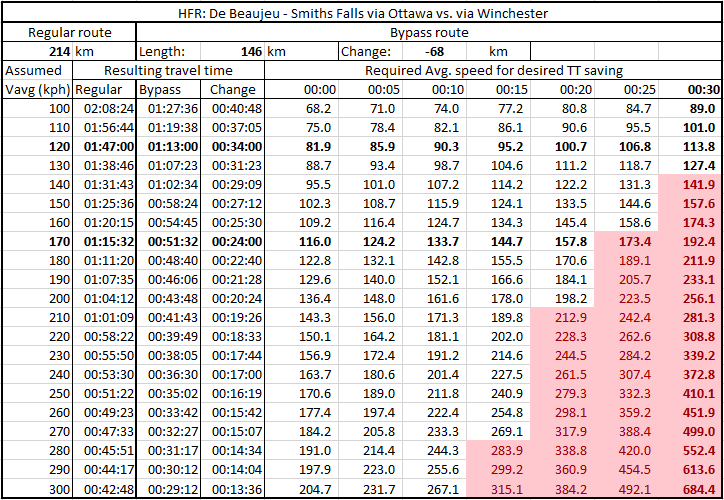
1614795533930.png

Note: as in the last table, the speed figures highlighted in red means that the average speed required to achieve the desired travel time saving exceeds the average speed assumed for the regular route.


In the end, the fact that the incremental costs to upgrade an alignment raise exponentially with the design speed, it is clear that the bypass would never be upgraded to HSR standards and that's the point where even you should realize that it would be a costly mistake to ever build it...


In other words, this would only happen once when demand has increased to a point where HFR is exceeding its capacity and upgrades are needed anyway. The thing about intercity rail is once you have hourly service, increasing frequency beyond that doesn't provide significant benefit, so rather than having 30 minute service through Ottawa, it would make more sense to keep it at the (post HFR) hourly frequency and add hourly express trains from Montreal to Toronto.
This is complete nonsense: the GJT model shows that a decrease in headway from 60 to 30 is equivalent to a reduction of travel time by 13 minutes (i.e. the perceived penalty decreases from 39 to 26 minutes). Therefore, having that second hourly train stop in Ottawa has the same effect to demand for Ottawa-Montreal and Ottawa-Toronto than upgrading the lines to shave off 13 minutes on both sides of Ottawa. This extra demand might not matter for stations like Kingston or Peterborough, but in the case of Ottawa, it would be huge...


I'm always happy to lay down why bypassing Ottawa would be extremely wasteful in terms of capital and operating costs, but I do start to wonder what still remains to be explained...

 
Last edited:
^ Just a quick note on the rebuilding of the viaduct/Don piece. There's speculation that HFR may actually use the LSE-Stouffville line to get to the CP Belleville and then Havelock Sub.
There was talk of that 2-3 years ago, but with the Ontario Line plans, it reduces the ultimate capacity on the Kingston Sub to only 4 tracks - which GO needs just with the current VIA operations - let alone increased operations.

You seem to have missed the gap between timetable schedule and reality. You also seem to be ignoring how many trains were scheduled in less than 5 hrs or less. And while talking about what has been happening over the last four decades, you also missed the trend here. Slower and slower service.

HFR's actual performance should beat out actual performance pre-Covid. Sure, it may only be by a few minutes. But HFR should basically turn every train into a pre-Covid sub 5 hr express with >90% on-time performance. That is better than anything pre-Covid.
I've certainly taken Montreal to Toronto trains that achieved the 4:30 during that era. And even were close to 3:59 in that era. The theoretical minimum is about 3:45 (though rarely achieved).

If you are going to drop $4 billion you can readily achieve 4.5 ... or better on some runs.
 
I'm always happy to lay down why bypassing Ottawa would be extremely wasteful in terms of capital and operating costs, but I do start to wonder what still remains to be explained...

Your explanation is quite compelling.

I would come at it from another angle: Suppose we can find whatever amount of capital the incremental Ottawa bypass would rquire, using the CP line as the straw man. Now remember that VIA is planning to also retain the Lakeshore service, with reportedly 12 trains per day west of Brockville and 6 east of there. Now remember that the whole issue with the Lakeshore line is the conflict with CN freight. 12 trains is still a lot of conflict.
I would expect that the business case for spending that available capital on the CN line to assure the performance of that Lakeshore service would exceed the business case for spending the same amount to extract a small gain in travel time on through Montreal-Toronto business.

Relaying the Winchester, at minimum, would be roughly 60 miles of new rail and ties. If the vision is to lay a new line end to end, not encroaching on CP's freight infrastructure, that's an even bigger bit of capital....25 miles of new grading plus the track itself to sidestep the remaining double track sections. All, with a huge presumption that CP will be amenable.

Spend that money on the Kingston line, and, even with a "hub" at Kingston, the performance and marketability of that service would likely deliver equal or better return. Who knows - one might even find that a couple of those 6 local trains would run right through, on a total Montreal-Toronto time as good or better than through Ottawa.

I'm not saying that will ever happen, just making the point about the return on the simplest bypass versus other uses of the money. And there are other things I can think of that would also be better uses.

- Paul
 

Back
Top