News   Mar 31, 2026
 1.1K     2 
News   Mar 31, 2026
 201     3 
News   Mar 31, 2026
 1.1K     0 

VIA Rail

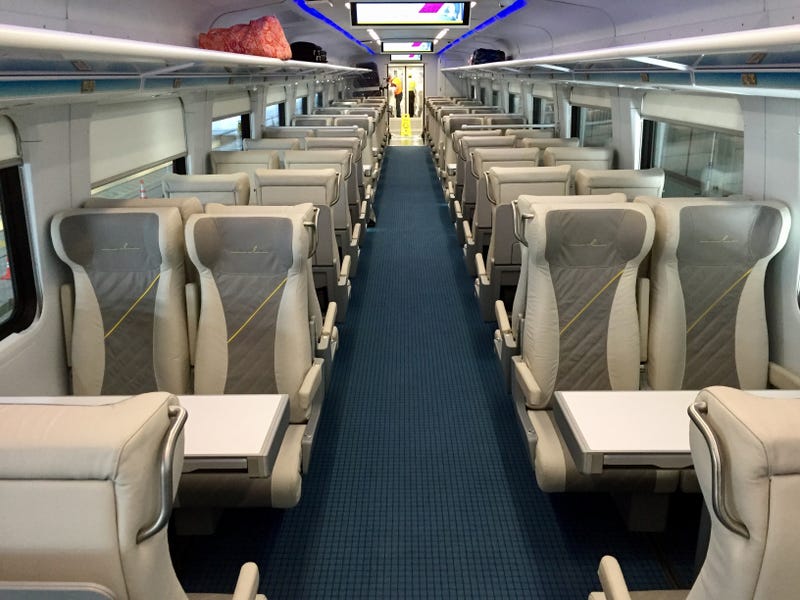
Brightline interior looks totally different. https://images.app.goo.gl/rbDM8HVznwB6rY1c7

Totally different? To my eyes, most of the differences seem to be in upholstery.

EtqSx1xXcAkqB0A

Amtrak

636197396865867888-5.jpg

Brightline

04_benefits.jpg

VIA Rail

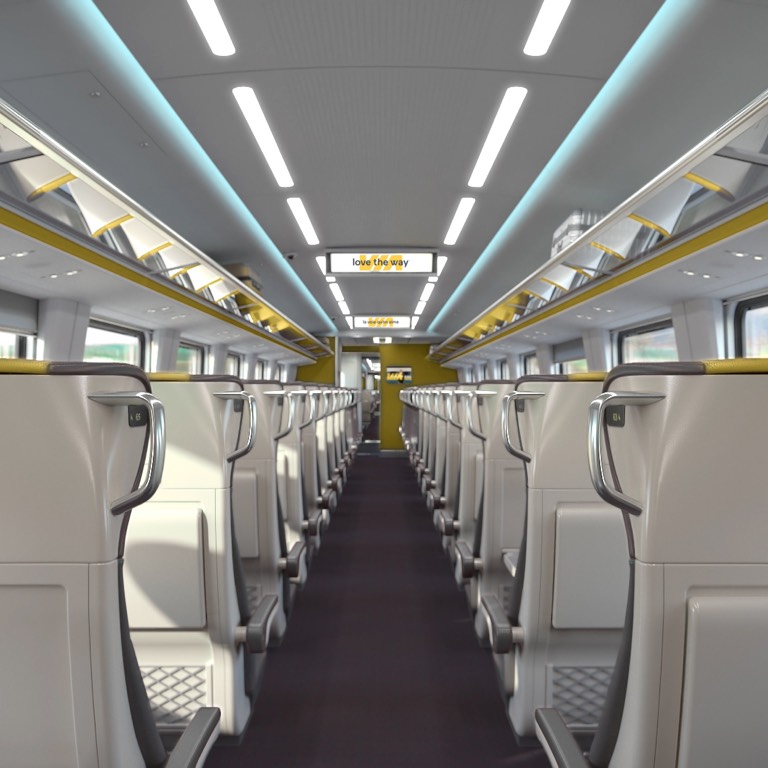
This render makes the bike and luggage racks look quite different than either Brightline's or Amtrak's.

Capture-via-bike-storage.jpg

VIA Rail
 
Last edited:
Optimally you want both. While it is better to avoid the crash in the first place, you can't avoid all crashes so it is good to mitigate the consequences of those.
Europe does both. The main difference is that mainline derailments make national news whereas they are seen here in Canada with the same shoulder-shrugging as mass shootings south of the border:
 
Europe does both. The main difference is that mainline derailments make national news whereas they are seen here in Canada with the same shoulder-shrugging as mass shootings south of the border:
Passenger derailments make national news here though too, it's freight derailments that result in no injuries that don't. Not good, but when the consequences are significant, the response generally is.
 
Am I reading those renders correctly? Looks to me like open luggage racks for Canada.
I know of no other jurisdiction where falling luggage is such a safety obsession. Sure, Canadian passengers have been injured by flying luggage in past incidents - but that’s hardly a world class view of safety. Somehow our safety investigators seem happy worrying about luggage while leaving bigger issues alone lest they offend the railways. Lots of bark over squirrels, not much bite over intruders.

- Paul
 
Am I reading those renders correctly? Looks to me like open luggage racks for Canada.
I know of no other jurisdiction where falling luggage is such a safety obsession. Sure, Canadian passengers have been injured by flying luggage in past incidents - but that’s hardly a world class view of safety. Somehow our safety investigators seem happy worrying about luggage while leaving bigger issues alone lest they offend the railways. Lots of bark over squirrels, not much bite over intruders.

- Paul

I agree that it looks like that, but it could be an early rendering and the final product might be different. To be honest, I don't see what all the fuss is about. If having doors on the overhead compartments makes things safer, why not have them? Do people find it inconvenient to open the doors?
 
I agree that it looks like that, but it could be an early rendering and the final product might be different. To be honest, I don't see what all the fuss is about. If having doors on the overhead compartments makes things safer, why not have them? Do people find it inconvenient to open the doors?

For the passenger, the issue is a real inconvenience, yes. Mostly in the dilemma one faces on boarding.... is there enough luggage rack space in the rack at the door? If I take my luggage to my seat, will there be space for it overhead, or will I have to go hunting for same? Will my bag fit?

VIA's heritage/LRC fleet has pretty ample storage space at the end of the car. Looking for space is far less of a hassle than on an airplane, and on a train one can easily access one's bag during the trip. So it's perhaps as small thing and a bit hypothetical as yet. However, we don't know if the new cars will be as generous with luggage space.... especially with more space allocated to bicycle storage, etc.

My last trip to the UK involved a Virgin railcar which had absurdly little end of car luggage space, with the result that many passengers had bags in the aisle... hardly any safer. I would much prefer being able to spot the availability and dimensions of luggage space when I board.

For us armchair riders, it's perhaps a trigger - a constant reminder that we have this oddball regulatory environment with a very tunnel focus. Another example - on the long distance trains, all the small enclosed compartments are a safety concern as egress can be difficult in a derailment. VIA's solution is to ask someone in the car to be the volunteer safety monitor. You get a tag on the door to your bedroom identifying you as such, presumably so people will look to your leadership in a crisis. I have been put in this role, and I will confess I spent most of my waking hours in the dome car. So much for my contribution to my fellow passengers' safety.

Another example is all the cameras that sprang up at level crossings in the Fallowfield area after the Ottawa Transpo incident. Cameras don't enhance safety, but they make sure that no one will be in the same position of arguing over liability afterwards. The bureaucrats and lawyers have done a damn good job of closing the barn door on that one.

VIa is a sitting duck for regulatory nitpicking. Meanwhile, requirements for running and terminal inspections for freight trains have been loosened, trains run down hills with inoperative brakes, etc.

So while the luggage doors may be a small thing in the big picture, it does give us grounds to vent a little ;-)

- Paul
 
For the passenger, the issue is a real inconvenience, yes. Mostly in the dilemma one faces on boarding.... is there enough luggage rack space in the rack at the door? If I take my luggage to my seat, will there be space for it overhead, or will I have to go hunting for same? Will my bag fit?

VIA's heritage/LRC fleet has pretty ample storage space at the end of the car. Looking for space is far less of a hassle than on an airplane, and on a train one can easily access one's bag during the trip. So it's perhaps as small thing and a bit hypothetical as yet. However, we don't know if the new cars will be as generous with luggage space.... especially with more space allocated to bicycle storage, etc.

My last trip to the UK involved a Virgin railcar which had absurdly little end of car luggage space, with the result that many passengers had bags in the aisle... hardly any safer. I would much prefer being able to spot the availability and dimensions of luggage space when I board.

For us armchair riders, it's perhaps a trigger - a constant reminder that we have this oddball regulatory environment with a very tunnel focus. Another example - on the long distance trains, all the small enclosed compartments are a safety concern as egress can be difficult in a derailment. VIA's solution is to ask someone in the car to be the volunteer safety monitor. You get a tag on the door to your bedroom identifying you as such, presumably so people will look to your leadership in a crisis. I have been put in this role, and I will confess I spent most of my waking hours in the dome car. So much for my contribution to my fellow passengers' safety.

Another example is all the cameras that sprang up at level crossings in the Fallowfield area after the Ottawa Transpo incident. Cameras don't enhance safety, but they make sure that no one will be in the same position of arguing over liability afterwards. The bureaucrats and lawyers have done a damn good job of closing the barn door on that one.

VIa is a sitting duck for regulatory nitpicking. Meanwhile, requirements for running and terminal inspections for freight trains have been loosened, trains run down hills with inoperative brakes, etc.

So while the luggage doors may be a small thing in the big picture, it does give us grounds to vent a little ;-)

- Paul

While I can see how having enough luggage space is a concern, I would hope that VIA has learnt from using the Renaissance cars (which don't have any luggage racks at the end of the car or overhead bins (just space for a small-medium sized bag under your seat and a cubby for a very small hand bag)) that having sufficient luggage space is important. As for the bike racks, if I had to guess, I would suspect that only one type of car will have them. One hint is the new cars are about the same size as the LRC cars yet have slightly fewer seats, so that should be a good sign. At this point though, things are as clear as mud and we are only speculating.

Regardless, large suitcases should not be placed in the overhead bins, whether they have doors or not. It always surprises me how many people have a poor understanding of the force of gravity. They expect their mammoth, 80 lb suitcase that is half sticking out of the rack to somehow levitate in midair, and not fall on the head of the person sitting below it mid voyage. From that perspective, doors help tell people what bags will fit and what bags won't.
 
Nearly all the trains I used for my 2012 trip had luggage at the ends of the car that required you to move other people luggage to get to yours regardless if you are going end to end or X stops.

A number of trains had luggage sitting in the aisle as there was no more room to place luggage in the luggage area. Some passengers had their luggage beside their seat in the aisle as they refused to place it in the luggage area. a few trains had no storage area and had to be place either in the aisle or overhead. It was a bitch trying to get your suitcase up to the overhead storage area.

The size of luggage as well how many you have play a large part if there is space for everyone or not, let lone for yourself.

Overhead should be for small items, but have seem some oversize items on airplanes that force passengers to look elsewhere or have it under their feet for their carry on. My carry on is my laptop and backpack that has my camera equipment in it. Been times trying to find space for the backpack is zero in the overhead bin that I don't try looking for space anymore.

Can't recall the last time I used a train in NA.
 
I agree that it looks like that, but it could be an early rendering and the final product might be different. To be honest, I don't see what all the fuss is about. If having doors on the overhead compartments makes things safer, why not have them? Do people find it inconvenient to open the doors?
more moving parts = more maintenance costs and time required to service/clean. over the lifespan of the vehicle a large portion will be spent towards maintenance and cleanliness. Things like this add up. imagine 32 trainsets worth of doors AND the insides to clean and keep servicable.
Its these small things that normal riders done care about but affects the profits of the service provider. Also for trains what are the chances that bags will recieve so much lateral force it would fall sideways off the rack? If that were to happen there is much more serious issues at hand.
Every other passenger train in the world that ive seen on youtube with the exception of acela has uncovered overheads. I seriously doubt that we have encountered some silver bullet in safety. Its just one of those overly OCD type of rules that arent much use but costs that much more money to implement
 
Passenger derailments make national news here though too, it's freight derailments that result in no injuries that don't. Not good, but when the consequences are significant, the response generally is.
The point was that derailments are a very rare occurrence (I recall consultants from Deutsche Bahn estimating the number of derailments on their network at "maybe five per year" and that of mainline derailments at "maybe once every five years"), whereas they are seen here as an unavoidable side effect of railroading.

Just to highlight some of the events I recall from the just over five years since I joined VIA:

  • March 3, 2018: Mainline derailment of CN freight train just east of Kingston (i.e. on a segment which sees 30 passenger trains per day)
  • February 2, 2019: VIA train 52/62 damaged by loose track material stored within the tracks
  • March 20, 2019: exactly the same happened with train 15
    • TSB report (same as for above incident, mentioned in Section 1.12, together with 3 further incidents of VIA trains strucking debris causing damage)
  • September 5, 2019: "a Via Rail passenger train collided two tank cars that had derailed and were leaning into the Via Rail line in Ernestown, Ont."
  • December 31, 2019: VIA train 692 derails due to a broken rail
Thankfully, nobody was killed in any of these accidents, but that's about the only thing positive which can be said about these incidents and how they reflect on the rail safety culture in this country.

Oh, and then, there is of course the Hinton train collision, which killed 23 people yesterday exactly 35 years ago:

Hinton train collision​

From Wikipedia, the free encyclopedia

The Hinton train collision was a railway accident that occurred on 8 February 1986. Twenty-three people were killed in a collision between a Canadian National Railway freight train and a Via Rail passenger train called the Super Continental, including the engine crews of both trains. It was the deadliest rail disaster in Canada at this time, since the Dugald accident of 1947 which had thirty-one fatalities, and was not surpassed until the Lac-Mégantic rail disaster in 2013, which resulted in 47 deaths.

After 56 days of testimony at a public inquiry, a commission concluded that the collision was caused by the freight crew failing to stop their train because of incapacitation or other unknown factors. The report also highlighted serious flaws in the culture and safety practices at Canadian National Railway.

[...]

The inquiry concluded that no one individual was to blame, instead it condemned what Foisy described as a "railroader culture" that prized loyalty and productivity at the expense of safety. As an example of lax attitudes to safety, Foisy noted that engineering crews that took over trains at Edson did so "on the fly". While the locomotive was moving slowly through the yard, the new crew would jump on and the previous crew would jump off. While this method saved time and fuel, it was a flagrant violation of safety regulations which required stationary brake tests after a crew change. Management claimed to be unaware of this practice, even though it was quite common. In regards to engineer John Hudson, the Foisy Commission concluded it was a possibility that the collision happened because he had either fallen asleep at the controls or had suffered a heart attack or stroke due his extremely poor health.

The report highlighted that there was no evidence that either train made any attempt to brake prior to the collision. Analysis of the line showed both trains would have only been visible to each other for the final 19 seconds before the collision. No conclusive reason could be found for the failure of the passenger train crew to react, neither was there any evidence that the Super Continental crew had made any errors before the accident. No evidence could be found to explain why the freight train failed to stop at the absolute signal at the Dalehurst control point. After a wrong-side signal problem was eliminated, human error was considered the only possible cause. Tests on the crews' remains ruled out drugs or alcohol as a cause, though it was revealed that the engineer of the freight train, Jack Hudson, was an alcoholic and heavy smoker who suffered from pancreatitis and type 2 diabetes, thus placing him at risk for a heart attack or stroke.[8] The commission further criticized CN's ineffective monitoring of Hudson's health condition:

The serious nature of Hudson's medical condition...raises a strong possibility that it was a factor contributing to the collision of February 8...The Commission therefore concludes that engineer Hudson's medical condition possibly contributed to his failure to control Train 413. The Commission also concludes that there are serious deficiencies in the manner in which CN monitored and reacted to that condition. The Commission finds that both the policies and procedures that permitted a man in Hudson's medical state to be responsible for the operation of a freight train on the CN main line to be unacceptable.[8]
Another frequently ignored safety regulation mentioned in the report was the "deadman's pedal", which a locomotive engineer had to keep depressed for the train to remain underway. Were he to fall asleep or pass out, his foot would slip from the pedal, triggering an alarm and engaging the train's brakes automatically a few seconds later. However, many engineers found this tiresome and bypassed the pedal by placing a heavy weight (often a worn out brake shoe) on it. It was uncertain whether the pedal had been bypassed in this case because the lead locomotive of the train had been destroyed. A more advanced safety device was available, the reset safety control (RSC), which required crew members to take an action such as pushing a button at regular intervals, or else automatic braking would occur, but neither lead locomotive was equipped with this safety feature. While the second locomotive in the freight train was equipped with RSC, it was not assigned as the lead locomotive because it lacked a "comfort cab". Management and union practice was to place more comfortable locomotives at the front of trains, even at the expense of safety.

The report also noted that although the front-end and rear-end crews should have been in regular communication, that did not appear to be the case in this accident. As the freight train reached Hargwen, Engineer Hudson radioed back to Conductor Smith that the signals were green, a communication that was heard by a following freight. As it ran towards Dalehurst there was no evidence of further communication. The conductor is in charge of the train, so if Smith felt that the train was out of control or there were serious problems, he should have activated the emergency brake in the caboose to stop the train. However, Smith, who appeared to be nervous while testifying, said that he did not feel that the freight was ever out of control, misjudging its speed. He also testified that he attempted to radio Hudson on two radios and several channels, but neither seemed to be working, even though immediately after the crash Smith was able to contact the dispatcher by radio. Despite Smith's testimony, he apparently decided not to stop the train.



Fast forward 27 years and we’re at Lac-Megantic:

The positive legacy of Lac-Mégantic: Zero

 
Last edited:
For us armchair riders, it's perhaps a trigger - a constant reminder that we have this oddball regulatory environment with a very tunnel focus. Another example - on the long distance trains, all the small enclosed compartments are a safety concern as egress can be difficult in a derailment. VIA's solution is to ask someone in the car to be the volunteer safety monitor. You get a tag on the door to your bedroom identifying you as such, presumably so people will look to your leadership in a crisis. I have been put in this role, and I will confess I spent most of my waking hours in the dome car. So much for my contribution to my fellow passengers' safety.

- Paul

Except that TC's requirement is that every single enclosed compartment with a window must have an emergency exit through that window. The volunteer safety monitor regulation is carried over from the airlines, where those sitting in the emergency exit row must be given additional instructions on how to operate them.

That's also why the sides of the sleeper cars are plastered with warning labels.

Dan
 
Another example is all the cameras that sprang up at level crossings in the Fallowfield area after the Ottawa Transpo incident. Cameras don't enhance safety, but they make sure that no one will be in the same position of arguing over liability afterwards. The bureaucrats and lawyers have done a damn good job of closing the barn door on that one.
The cameras make a lot of sense though. For years, those crossings have been unreliable, and there's been a tremendous focus on them since the incidents. The area is very complex, which certainly contributes to the issues, and if they can identify or confirm an issue quickly using CCTV, then they can get around to fixing it that much faster.
 
^^^Does anyone else find it odd that Transport Action Canada seems to be completely oblivious to the fact that Brightline have been using Siemens Venture trainsets for years.
Not quite sure what makes you think that. The delivery of the first series production cars to IDOT / Amtrak Midwest is news, which the post is sharing, while noting that the VIA interior design may differ. Twitter doesn't really allow enough characters for a complete history lesson. Brightline's trains are based on the cars Siemens made for the OBB RailJet, and I've been those as a show-and-tell "This is what a modern train looks like, without tossing billions at greenfield HSR" since I first got involved in promoting High Performance Rail for SW Ontario almost a decade ago.

The most obvious difference will be overhead bins, which personally I think Amtrak should adopt too given the similarities in accident risk. Unlike the Railjets, they probably wont be putting premium business class at the business end of the cab car, although I'm looking forward to seeing how those are designed to keep Transport Canada happy.
 

Back
Top