




Urban Sky
Senior Member
(continued from above post)
Actually, speaking about unfair (or in this case rather: outdated) criticisms of the Canadian, the problem of excessive delays was subject to a media report recently, which was basically spun around a quote from the 2018-2022 Corporate Plan (i.e. the one preceding the one you were quoting):
Now, having been delayed myself almost 24 hours on my first trip on the Canadian (together with my wife) in summer 2015, I am well aware how bad delays can get on the Canadian. However, when I took it again last April, it was running more than 6 hours late through the Prairies, but still arrived 18 minutes early into Toronto. To demonstrate that I was not just lucky the second time, I have looked up every single departure on ReserVIA and compiled it into this handy table:

Compiled from: train data obtained from ReserVIA by playing around with the date stamp in the URL.
Note: unfortunately, ReserVIA only saves train data for just over a year and I’ve only started downloading all instances of trains #1 and #2 recently (i.e. starting with Train #1 of 2019-02-09). For the same reason, all data shown for Jasper only includes train departures which can also be found in my Dropbox folder.
Now what change reduced this issue so significantly? We are talking of course about the two timetable changes which took place in the last 2 years, as throughout the first half of 2018, the timetable which had been in place since 2008 (when the timetable was already extended by 12 hours, thus requiring the operation with four instead of 3 consists) only had relevance until Train #2 hit the Prairies, with delays accumulating to the point that Train #2 routinely arrived into Toronto in excess of 10 hours late. This reliably pushed the departure time of Train #1 to the next morning (as a minimum turn-around time of 6 hours in Toronto would place the earliest possible departure time into the middle of the night), meaning that it would already depart almost 12 hours late, at which point the operation of Canadian would become so erratic that it would show up in Edmonton, Jasper and Vancouver at any time of the day. The situation escalated with the operation of the round-trips (from Vancouver to Toronto and back) of trains #2 of Friday, May 11, 2018 and Sunday, May 20, 2018:
Even though this reduced the risk of next-morning departures of Train #1, it did not eliminate it entirely (note in above table that the average delay at departure decreased from over 9 to just under 2 hours) and the timetable was completely reworked with the start of last year's peak season, featuring prolonged turn-around times on both ends of the Canadian's route, thus exploiting the fact that the summer-only third weekly frequency would only operate between Vancouver and Edmonton, while CN was increasing track capacity across the Prairies:
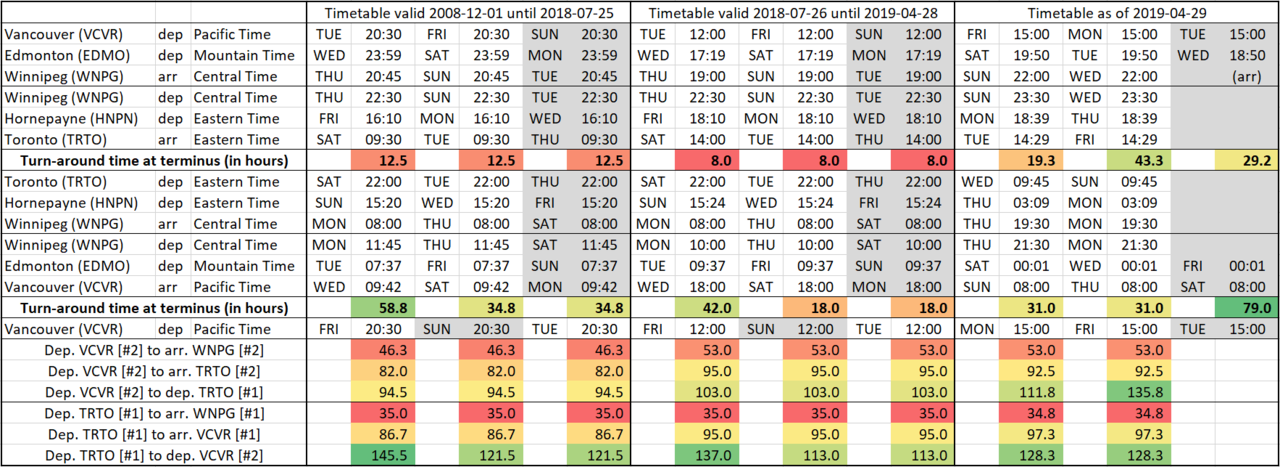
Compiled from: official VIA Rail timetables
The success in reducing the delays on the Canadian can be seen in the following graphs, which shows that arriving no later than the advertised arrival time of Train #2 in Toronto under the new schedule is roughly as likely (44% vs. 46.5%) as arriving no more than 12 hours late was under the old schedule (in early 2018), while arriving no more than 6 hours late under the new schedule is roughly as likely (90.5% vs. 91.5%) as arriving no more than 24 hours late under the old schedule:
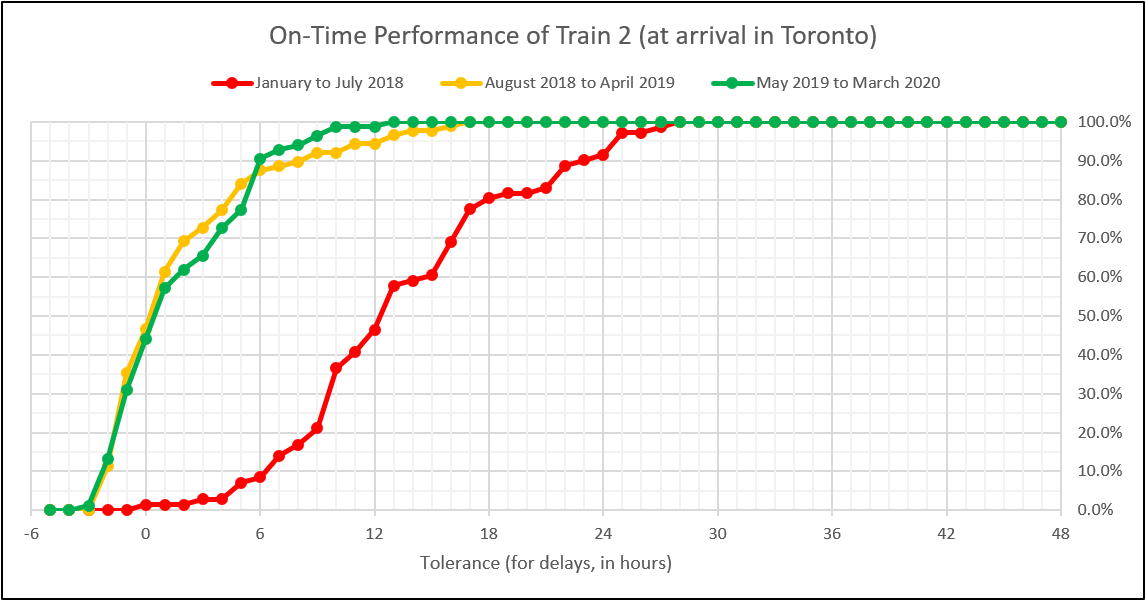
Compiled from: train data obtained from ReserVIA by playing around with the date stamp in the URL.
An even more drastic improvement can be shown for Train #1, where arriving in Vancouver no later than 3 hours prior (!) to the advertised arrival time is roughly as likely (31.7% vs. 31.4%) under the current schedule as arriving 13 hours late under the old schedule, while arriving no more than 4 hours late is roughly as likely (95.1% vs. 95.7%) than arriving no more than 30 (!) hours late under the old schedule:
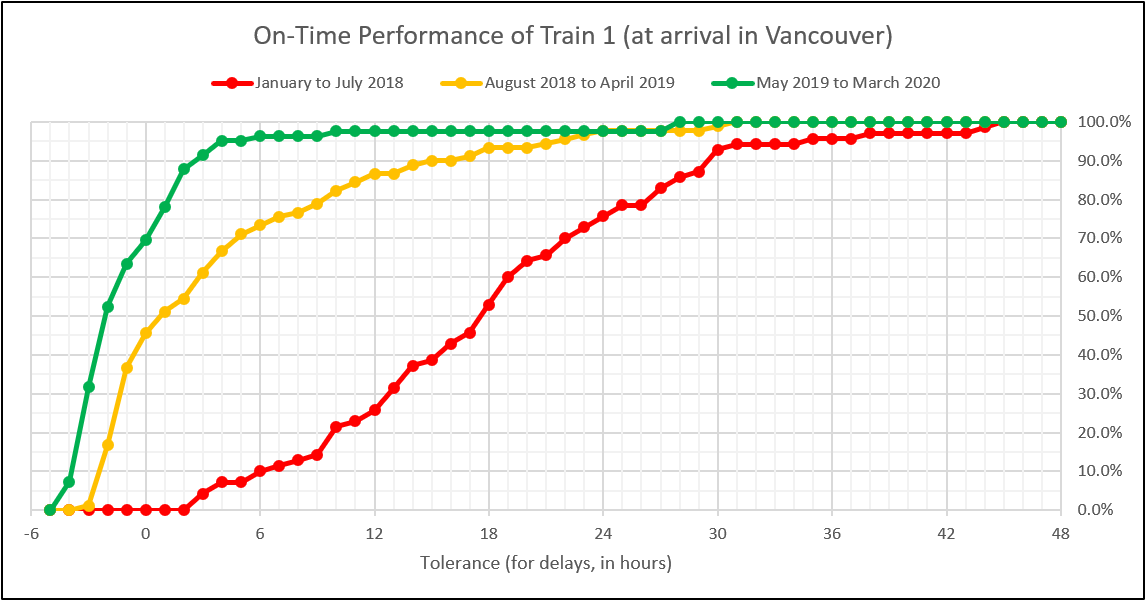
Compiled from: train data obtained from ReserVIA by playing around with the date stamp in the URL.
So what does this tell you about the quality and relevance of certain media reports made about the Canadian? Maybe that heavily relying on a two year old report which describes the situation 3 years ago to describe the current situation might make for a captivating, but not necessarily timely or accurate story...
The Canadian was actually on-time 84% of the time a decade ago? That's not fantasyland?
TIL.
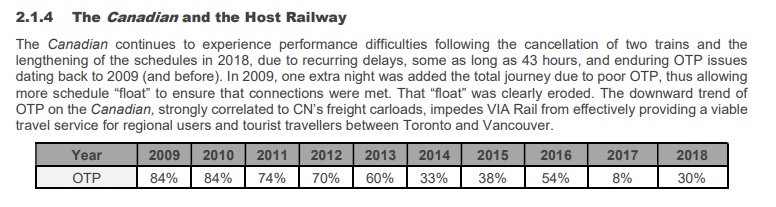
Actually, speaking about unfair (or in this case rather: outdated) criticisms of the Canadian, the problem of excessive delays was subject to a media report recently, which was basically spun around a quote from the 2018-2022 Corporate Plan (i.e. the one preceding the one you were quoting):
Tourism operators have indicated their displeasure and many are contemplating leaving the Canadian off their offerings putting further pressure on the service. It is, as well, becoming increasingly difficult to arrange alternate accommodations, both for passengers and our crews. This situation is a serious embarrassment for Canada's reputation and the Canada brand, in North America and abroad. Travellers return home with the lasting impression wondering how a G7 nation cannot operate its trains on time.
Now, having been delayed myself almost 24 hours on my first trip on the Canadian (together with my wife) in summer 2015, I am well aware how bad delays can get on the Canadian. However, when I took it again last April, it was running more than 6 hours late through the Prairies, but still arrived 18 minutes early into Toronto. To demonstrate that I was not just lucky the second time, I have looked up every single departure on ReserVIA and compiled it into this handy table:
Compiled from: train data obtained from ReserVIA by playing around with the date stamp in the URL.
Note: unfortunately, ReserVIA only saves train data for just over a year and I’ve only started downloading all instances of trains #1 and #2 recently (i.e. starting with Train #1 of 2019-02-09). For the same reason, all data shown for Jasper only includes train departures which can also be found in my Dropbox folder.
Now what change reduced this issue so significantly? We are talking of course about the two timetable changes which took place in the last 2 years, as throughout the first half of 2018, the timetable which had been in place since 2008 (when the timetable was already extended by 12 hours, thus requiring the operation with four instead of 3 consists) only had relevance until Train #2 hit the Prairies, with delays accumulating to the point that Train #2 routinely arrived into Toronto in excess of 10 hours late. This reliably pushed the departure time of Train #1 to the next morning (as a minimum turn-around time of 6 hours in Toronto would place the earliest possible departure time into the middle of the night), meaning that it would already depart almost 12 hours late, at which point the operation of Canadian would become so erratic that it would show up in Edmonton, Jasper and Vancouver at any time of the day. The situation escalated with the operation of the round-trips (from Vancouver to Toronto and back) of trains #2 of Friday, May 11, 2018 and Sunday, May 20, 2018:
- Train #2 of Friday, May 11th departed Vancouver on time (at 20:30), but arrived Toronto only in the early morning (02:28) of Wednesday (16th), thus 17 hours late and 4.5 hours after (!) the scheduled departure time of Train #1 of May 15th.
- Train #1 of Tuesday, May 15th consequently departed only in the early Wednesday afternoon (14:30, thus 16.5 hours late) and arrived into Vancouver Sunday afternoon (15:34), thus almost 30 hours late and less than 5 hours before the scheduled departure of the next round trip.
- Train #2 of Sunday, May 20th was consequently delayed until the next morning and departed at 08:10 (thus 11.5 hours late) and arrived into Toronto only in the early afternoon (13:05) of Friday, May 25th, thus 27.5 hours late and 15 hours after (!) the scheduled departure time of Train #1 of May 24th.
- On Friday, May 25th, VIA Rail cancelled the departure of Train #1 of Thursday, May 24th (which had already been postponed until Friday) would be cancelled, as well as its return trip from Vancouver as Train #2 of Tuesday, May 29th, in order to allow operations to recover from these massive delays.
Even though this reduced the risk of next-morning departures of Train #1, it did not eliminate it entirely (note in above table that the average delay at departure decreased from over 9 to just under 2 hours) and the timetable was completely reworked with the start of last year's peak season, featuring prolonged turn-around times on both ends of the Canadian's route, thus exploiting the fact that the summer-only third weekly frequency would only operate between Vancouver and Edmonton, while CN was increasing track capacity across the Prairies:
Compiled from: official VIA Rail timetables
The success in reducing the delays on the Canadian can be seen in the following graphs, which shows that arriving no later than the advertised arrival time of Train #2 in Toronto under the new schedule is roughly as likely (44% vs. 46.5%) as arriving no more than 12 hours late was under the old schedule (in early 2018), while arriving no more than 6 hours late under the new schedule is roughly as likely (90.5% vs. 91.5%) as arriving no more than 24 hours late under the old schedule:
Compiled from: train data obtained from ReserVIA by playing around with the date stamp in the URL.
An even more drastic improvement can be shown for Train #1, where arriving in Vancouver no later than 3 hours prior (!) to the advertised arrival time is roughly as likely (31.7% vs. 31.4%) under the current schedule as arriving 13 hours late under the old schedule, while arriving no more than 4 hours late is roughly as likely (95.1% vs. 95.7%) than arriving no more than 30 (!) hours late under the old schedule:
Compiled from: train data obtained from ReserVIA by playing around with the date stamp in the URL.
So what does this tell you about the quality and relevance of certain media reports made about the Canadian? Maybe that heavily relying on a two year old report which describes the situation 3 years ago to describe the current situation might make for a captivating, but not necessarily timely or accurate story...
Last edited:


