

News   Feb 27, 2026
 2.7K     5 
News   Feb 27, 2026
 763     0 
News   Feb 27, 2026
 793     0 

TTC: Streetcar Network

There must be a reason why the vast majority of tram systems still use overhead catenary. What problem are we solving with ground level system in Toronto. Seems like it would actually introduce more problems.
It will. The various flavours of ground-level power all have additional circuitry in them so that they are only activating the panels underneath the streetcar. That additional circuitry is all more stuff that can fail. And even better, is all placed below the top of the street, where it needs to be both insulated and protected against water intrusion.

Not only that, but they use induction to transmit power to the trains, which is way less efficient than conduction.

It is not a rational solution to use in a place like Toronto.

Dan
 
We have a critical backlog of major infrastructure repairs that the TTC needs to address, and until those are addressed it makes absolutely no sense to be thinking about nice to haves (ie: removing streetcar overhead wires because they dont look good).
I disagree. If we can have threads about fantasy maps, then I see no reason that we can't discuss what changes we could see during the last half of the 21st century - for the next generation of streetcars.

I don't see that what wires look like would be a factor - it's more about cost effectiveness and simplification. If for example the wiring at a troublesome intersection or part of a yard could be eliminated. How much you'd want to run on battery. etc. There's nothing new in this tech ... there were subway cars in other cities at least as far back as the 1960s with limited batteries on board with the idea that if the power failed, they could at least crawl to the next station.
 
This ground power supply looks like a solution looking for a problem made worse by the fact that it's not even a solution. I think putting street power supply in a city like Toronto is asking for trouble. Not only could the snow be a problem but also the snow plows which could damage the infrastructure. That's not worth the risk and money to get rid of some unsightly wires.

Toronto will eventually get rid of it's catenary wires as will nearly all trams/streetcars worldwide due to the advances in battery technology. In 30 years it's very possible that you may not even find a supplier who builds catenary powered streetcars any more. As batteries become lighter, cheaper, smaller, last longer, have higher power density, and recharge faster, you will find that many systems will simply make new orders as batteries by default. They spare the transit agency of having to repair/replace the wires, have none of the visual pollution, and are not as susceptible to power outages. Much like cars, in 30 years you won't be able to buy an ICE car even if you wanted to.I don't see Toronto, or any city with a large streetcar/tram network, doing a wholesale pull down of the catenary system but just a slow phase out section by section and route by route as new battery trains come online.

Torontonians would be far better served using these funds to bring it's antiquated switching system up to modern standards than wasting it on some ground level power supply idea.
 
If Toronto really wants to cut down on all the wire gore, then it certainly would be a nice middle ground to have a small battery so that loops and diversions could be unpowered.
Think I'll wait a couple of decades before switching to battery-run streetcars.

Oh come on, should I post that awful viral video of an LNG bus tipping over in a shop and killing 3 workers and then claim that we should wait a few decades for buses with an engine? This kind of thermal runaway wouldn't even happen with an LFP battery pack like are common in today's Chinese EV's.
 
Last edited:
Think I'll wait a couple of decades before switching to battery-run streetcars.


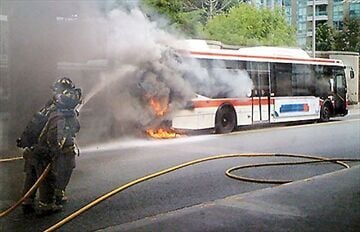
ICE buses, including those in Toronto, experience mechanical failures and catch fire too.

63df9a63d6940.image.jpg


It probably will be a couple decades before catenary streetcars become the norm rather than the exception but it will happen. Toronto's current fleet is fairly new and by the time they have to be replaced in 20 or 30 years, battery trains will be the norm rather than the exception. This will also be true with trolley buses like Vancouver's large fleet.. Transportation technology changes and the rolling stock does so with them.
 
Video of the upgraded programming for the north-bound lights at Spadina and King. This intersection used to prioritize the Left turns but now the traffic and transit going straight proceeds first.

I doubt they installed TSP detectors for the shuttle buses. This would suggest that they just changed the phase order from leading left turns to lagging left turns, which makes no difference to transit delay.
Capture.JPG

That said, they did specifically say they were installing phase rotation at Spadina & King, so it's presumably just temporarily inactive due to the bustitution and will resume operation when streetcars return.
 
I doubt they installed TSP detectors for the shuttle buses. This would suggest that they just changed the phase order from leading left turns to lagging left turns, which makes no difference to transit delay.
What is the difference between the TSP equipment that's on the streetcars, to those that's already on the buses for use elsewhere in the city?
 
What is the difference between the TSP equipment that's on the streetcars, to those that's already on the buses for use elsewhere in the city?
It's the same equipment but the streetcar detectors are located on the streetcar tracks. In that video there were no vehicles on the streetcar tracks.
 
I doubt they installed TSP detectors for the shuttle buses. This would suggest that they just changed the phase order from leading left turns to lagging left turns, which makes no difference to transit delay.
View attachment 717704
That said, they did specifically say they were installing phase rotation at Spadina & King, so it's presumably just temporarily inactive due to the bustitution and will resume operation when streetcars return.
Yes that makes sense, as I've personally witness phase rotation at Dundas and College. So I wouldn't imagine that this installation at King would be different.
 

Back
Top