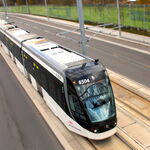
One thing that has been briefly mentioned in the past, but worth mentioning again is the dubious claim that the Flexity Freedom (Line 5 Eglinton) cars have a max capacity of 251 per 5 module train around 30 metres in length. Two trains per trainset for Line 5 would be a total of ~60 metres and ~500 passengers. This has implications for the true route capacity of Line 5. Bombardier claimed this number was with an insane 6 passenger per square metre crush load. (
https://urbantoronto.ca/forum/attachments/bombardier-flexity-freedom-brochure-2011-pdf.95184/)
Since seating layout and rolling stock size is virtually identical to the Outlook streetcars, I highly doubt it would be possible to fit 251 passengers per train. People on the train would start crowding the doors and those waiting to board would skip one train to wait for the next. Furthermore, each Flexity Freedom Eglinton car only has 2 small and 2 large doors for a total of 4 doors over 30 metres. The Toronto Rocket trains on Line 1 have 4 doors 1.5 metres wide for every ~23 metre long car. The widest doors on Line 5 trains would still be narrower than those on Lines 1, 2, 4.
A more reasonable number would be 198 per train (see pdf above), but that would still entail a standing density of ~4.3 passengers/m^2. To roughly match the typical (not max) standing density of a Toronto Rocket, it would be more like 160 per train (~3 passenger/m^2). Thus, two car trainsets would have a typical capacity of 320. If they run them every 5 minutes that would be only 3840 people per direction per hour. Every 3 minutes would be 6400.
The Toronto Rocket 6 car typical capacity is 1080 with 400 seats at a standing density of ~3 passenger/m^2. (
https://www.ttc.ca/transparency-and...erating-Statistics---2018/Conventional-System)
^Note: TTC claimed in 2018 that the Flexity Outlook streetcars had a typical capacity of 130. The Flexity Freedom Line 5 trains are only ~4% wider, 2.65 vs. 2.54 metres.