News   Dec 05, 2025
 325     0 
News   Dec 05, 2025
 1.3K     2 
News   Dec 05, 2025
 352     0 

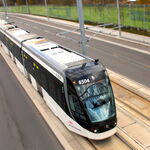
Toronto Eglinton Line 5 | ?m | ?s | Metrolinx | Arcadis

Since both stations are service by bus routes going north-south how do riders transfer to the LRT if one or both stations are remove?? How do you handle a walking transfer while maintaining the 2 hour windon for Presto without having riders having to pay an exta fare if they use time walking to/from an LRT station to/from the bus route??
Exactly what bus routes service Lebovic and especially Ferrand? Ferrand doesn't even have a cross-street for buses to run on. Lebovic also does not have an existing or planned bus route on it.
 
21 minutes for the under and above ground section respectively for a total of ~42 minutes with no passengers but with a simulated dwell time for passenger movement, correct me if I am wrong. I can't help but expect the real world conditions to be slower than 42 minutes in testing. 21 minutes to travel 8km implies an average speed of 22.85km/h above ground. Given how weak the signal priority is, I'll believe it when I see it.

steamed-apple_juice:
"boarding and alighting an LRT will take longer than the subway due to door placement and internal circulation"
I'm sure it's out there somewhere, but are the seating arrangements for ECLRT (and FLRT) the same as the Flexity Streetcars in circulation? I hate those so much: the 4-seat boxes where you play footsy with people across from you, and the very narrow aisles that make walking front or back in the train virtually impossible without jostling everyone in an aisle seat. These things definitely impact loading times too, especially when someone needs to move to an exit with a mobility device or a stroller.
 
  • Like
Reactions: PL1
These things definitely impact loading times too, especially when someone needs to move to an exit with a mobility device or a stroller.
Why would this be the case, when the open area with flip up seats is located immediately across from a doorway?

I hate those so much: the 4-seat boxes where you play footsy with people across from you, and the very narrow aisles that make walking front or back in the train virtually impossible without jostling everyone in an aisle seat.
Unfortunately, that is a consequence of making the vehicles accessible to the groups you mentioned above. We as a society decided high floor vehicles with wheelchair lifts are not it, and thus the only other option is a low floor tram, with all the benefits and drawbacks inherent to the design.

I will agree about the 4 seat boxes, though. I would have much preferred for the seats over the trucks to be all facing inward. They'd probably be (relatively) cleaner, too, since we live in a society of selfish jackasses who insist on putting their dirty shoes up on anything that is within stretching distance of them.
 
Saying the stations are 330 metres apart in reality, while true, still isn't really helping your case I don't think. "rapid transit" stops simply don't need to be that close together.
Rapid transit stations need to be as close or as far as they need to be. Here, considering the passenger loads that regularly get on and off of the buses, it makes sense to have a stop.

Maybe you shouldn't get hung up on terms such as "rapid". It's arbitrary, not an absolute. And it will be faster than the service that exists there today.

Dan
 
I've heard somewhere that the stops on the Scarborough portion of the line were spaced so close together because the plan was to not need a supplementary 34 bus once operational.

Not sure how true that is though 😢
 
The testing trains run pretty slowly to account for those loading time.
I would have thought they run the trains at full speed, and make long stops as a guesstimate of actual stop time if there were passengers getting in and out. How is running trains slower, a simulation or test of the system?
 
I would have thought they run the trains at full speed, and make long stops as a guesstimate of actual stop time if there were passengers getting in and out. How is running trains slower, a simulation or test of the system?
Many times, you see the trains dwell for a whole minute at platforms and traffic lights. They could have totally gone through.
 
Many times, you see the trains dwell for a whole minute at platforms and traffic lights. They could have totally gone through.
not to mention they get the signal shaft since the transit signal goes red first a whole 10+sec before the road's.... unbelievable how hard toronto is trying to neuter themselves.
 
Many times, you see the trains dwell for a whole minute at platforms and traffic lights. They could have totally gone through.
They should just make Don Valley the end of the line and have riders transfer onto a bus to Kennedy. Honestly, what difference would it make at this point?

This is what happens when you have a single transit line that operates as a subway for 2/3, and than switches to a streetcar for the last 1/3.

The surface portion of the line is going to have a negative impact on the underground portion. How can the TTC properly schedule westbound trains in the underground portion if those same trains are constantly being held up by red lights on the surface portion of the line?
 
I'm sure it's out there somewhere, but are the seating arrangements for ECLRT (and FLRT) the same as the Flexity Streetcars in circulation? I hate those so much: the 4-seat boxes where you play footsy with people across from you, and the very narrow aisles that make walking front or back in the train virtually impossible without jostling everyone in an aisle seat. These things definitely impact loading times too, especially when someone needs to move to an exit with a mobility device or a stroller.
One thing that has been briefly mentioned in the past, but worth mentioning again is the dubious claim that the Flexity Freedom (Line 5 Eglinton) cars have a max capacity of 251 per 5 module train around 30 metres in length. Two trains per trainset for Line 5 would be a total of ~60 metres and ~500 passengers. This has implications for the true route capacity of Line 5. Bombardier claimed this number was with an insane 6 passenger per square metre crush load. (https://urbantoronto.ca/forum/attachments/bombardier-flexity-freedom-brochure-2011-pdf.95184/)

Since seating layout and rolling stock size is virtually identical to the Outlook streetcars, I highly doubt it would be possible to fit 251 passengers per train. People on the train would start crowding the doors and those waiting to board would skip one train to wait for the next. Furthermore, each Flexity Freedom Eglinton car only has 2 small and 2 large doors for a total of 4 doors over 30 metres. The Toronto Rocket trains on Line 1 have 4 doors 1.5 metres wide for every ~23 metre long car. The widest doors on Line 5 trains would still be narrower than those on Lines 1, 2, 4.

A more reasonable number would be 198 per train (see pdf above), but that would still entail a standing density of ~4.3 passengers/m^2. To roughly match the typical (not max) standing density of a Toronto Rocket, it would be more like 160 per train (~3 passenger/m^2). Thus, two car trainsets would have a typical capacity of 320. If they run them every 5 minutes that would be only 3840 people per direction per hour. Every 3 minutes would be 6400.

The Toronto Rocket 6 car typical capacity is 1080 with 400 seats at a standing density of ~3 passenger/m^2. (https://www.ttc.ca/transparency-and...erating-Statistics---2018/Conventional-System)
^Note: TTC claimed in 2018 that the Flexity Outlook streetcars had a typical capacity of 130. The Flexity Freedom Line 5 trains are only ~4% wider, 2.65 vs. 2.54 metres.

 
One thing that has been briefly mentioned in the past, but worth mentioning again is the dubious claim that the Flexity Freedom (Line 5 Eglinton) cars have a max capacity of 251 per 5 module train around 30 metres in length. Two trains per trainset for Line 5 would be a total of ~60 metres and ~500 passengers. This has implications for the true route capacity of Line 5. Bombardier claimed this number was with an insane 6 passenger per square metre crush load. (https://urbantoronto.ca/forum/attachments/bombardier-flexity-freedom-brochure-2011-pdf.95184/)

Since seating layout and rolling stock size is virtually identical to the Outlook streetcars, I highly doubt it would be possible to fit 251 passengers per train. People on the train would start crowding the doors and those waiting to board would skip one train to wait for the next. Furthermore, each Flexity Freedom Eglinton car only has 2 small and 2 large doors for a total of 4 doors over 30 metres. The Toronto Rocket trains on Line 1 have 4 doors 1.5 metres wide for every ~23 metre long car. The widest doors on Line 5 trains would still be narrower than those on Lines 1, 2, 4.

A more reasonable number would be 198 per train (see pdf above), but that would still entail a standing density of ~4.3 passengers/m^2. To roughly match the typical (not max) standing density of a Toronto Rocket, it would be more like 160 per train (~3 passenger/m^2). Thus, two car trainsets would have a typical capacity of 320. If they run them every 5 minutes that would be only 3840 people per direction per hour. Every 3 minutes would be 6400.

The Toronto Rocket 6 car typical capacity is 1080 with 400 seats at a standing density of ~3 passenger/m^2. (https://www.ttc.ca/transparency-and...erating-Statistics---2018/Conventional-System)
^Note: TTC claimed in 2018 that the Flexity Outlook streetcars had a typical capacity of 130. The Flexity Freedom Line 5 trains are only ~4% wider, 2.65 vs. 2.54 metres.
Okay, they did use a high passenger density number, but the trains can be three cars long to begin with. And if the line does actually have passenger capacity concerns then you can't possibly be the first person in the more than 15 years that the lines been under study and construction to notice it.
 
This will change, Ferrand is getting lights and will be a cross street. (whether that justifies a stop is a different question)


Correct.

One-way cross street on the south side no? I doubt buses will run on it. And you won't be able to get to the Ferrand LRT stop from the intersection with Eglinton, and the Don Valley LRT station entrance will be closer. 😅
 
I've heard somewhere that the stops on the Scarborough portion of the line were spaced so close together because the plan was to not need a supplementary 34 bus once operational.

Not sure how true that is though 😢
Yet the spacing in north york made them keep the parallel 34 : (
Once development in Golden Mile gets going i could see them moving 34 service to either Golden Mile Blvd or the new O'Connor
1762013794828.png
 

Back
Top