News   Jan 06, 2026
 101     1 
News   Jan 06, 2026
 458     4 
News   Jan 06, 2026
 618     1 

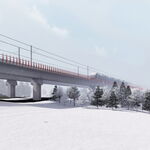
Toronto Eglinton Line 5 | ?m | ?s | Metrolinx | Arcadis

You can't honeslty believe the reason transit ridership falls off a cliff outside of Toronto is because of wayfinding? You know why transit ridership falls off a cliff outside of Toronto? BECAUSE THERE IS NO TRANSIT OUT THERE and its all subruban wasteland where your forced to drive. Fancy signage and way-finding isn't going to put butts in the seats. The low ridership outside of Toronto is not a way-finding problem, its an urban planning problem so I don't understand the point you are trying to make here.
I'd say it is due to lack of fare integration and poor operational integration between regions.
 
You can't honeslty believe the reason transit ridership falls off a cliff outside of Toronto is because of wayfinding? You know why transit ridership falls off a cliff outside of Toronto? BECAUSE THERE IS NO TRANSIT OUT THERE and its all subruban wasteland where your forced to drive. Fancy signage and way-finding isn't going to put butts in the seats. The low ridership outside of Toronto is not a way-finding problem, its an urban planning problem so I don't understand the point you are trying to make here.
While its probably due to other factors, I do think its a contributing factor. Now you and I know about the other transit services, but can you say the same for everyone else? Think of your average Torontonian who only ever used the TTC. If they go out to Durham, they'll probably recognize that the DRT sign is a bus stop, but do you think they'll trust it? They're way more likely to take if there is a unified signage that affects every system because it suggests that "this is a similar service to what I can expect from home", and are thus more likely to trust it.
 
I remember my first trip to Vancouver and thinking to myself: why the hell can't we have a Translink?

20 years later....... :rolleyes:
That'll probably drop the farebox recovery ratio below 50%. The Greater Vancouver area is much smaller than the GTA. I'll say the entire Translink service area would fit in Toronto and Mississauga. Then we still have Brampton, Oakville, Burlington, the entire York region and the entire Durham region.

I'd say it is due to lack of fare integration and poor operational integration between regions.
It's not. Many riders on the TTC aren't taking transit to cross borders nor to downtown. That also means many 905 areas won't need to cross borders or head downtown. The equivalent would be hoping on the bus and riding it for 15-30 min to get to where they want to go. The problem? That get's them nowhere if they even get on the bus. Service is too infrequent, nor does it go directly to where they want to go (on a grid system) vs going in loops and destinations are too sparely located. The second issue is the riders themselves. Poorer families are more likely to ride transit for obvious reasons and they are all mostly located in the suburbs of Toronto in higher density areas. York region is home to all he million dollar houses and that why no is taking transit and instead driving their BMW/Mercedes/etc. SUV around. Peel region has more lower income families and thus their ridership is higher. The only exception are students and workers heading to downtown Toronto via GO transit. Centre Etobicoke is a good example to outline this issue. Outside rush hour, all the north/south routes pretty much operates "express" between Bloor and Eglinton. You only get a few riders between that area. Everyone is heading north. All the express routes like 927, 937 and 945 all connect Rexdale to the subway. It bypasses the richest area in Etobicoke like it doesn't exist.

Even if the TTC took over the entire 905 region, place a flat fare everywhere and boost service to TTC level, I doubt they'll all in a sudden experience TTC level ridership.
 
Who’s walking to Highway 407 station?
I did for half a year, along with at least 100 other people that left through the north access road, and another 150-200 that left through the south access road. With a new Menkes development opening up just across the 407, I can guarantee a bunch more people will too.
 
Why not? And why would unified way-finding fix that?
Think of it as marketing. If people who live in Toronto walk around and see that T everywhere, then go to Durham and see that exact same T, they'll say "Hey I recognize that, I use that all the time, this is trustworthy!" Its marketing 101. People are more likely to trust symbols and brands they already recognize vs what they're seeing for the first time.
 
While its probably due to other factors, I do think its a contributing factor. Now you and I know about the other transit services, but can you say the same for everyone else? Think of your average Torontonian who only ever used the TTC. If they go out to Durham, they'll probably recognize that the DRT sign is a bus stop, but do you think they'll trust it? They're way more likely to take if there is a unified signage that affects every system because it suggests that "this is a similar service to what I can expect from home", and are thus more likely to trust it.
Welll.... maybe they shouldn't trust the DRT bus stop, because the service is probably somewhere between nothing and never ....

Jokes aside, I think unified signage is a good idea, but the "T" specifically is not. I've said this many times, but it just doesn't convey information that is useful to a transit user, no information about mode, fares, etc etc. A set of symbols for each mode would be much better.
 
Welll.... maybe they shouldn't trust the DRT bus stop, because the service is probably somewhere between nothing and never ....

Jokes aside, I think unified signage is a good idea, but the "T" specifically is not. I've said this many times, but it just doesn't convey information that is useful to a transit user, no information about mode, fares, etc etc. A set of symbols for each mode would be much better.
2 things.
A) Yes I agree with you that the symbol is garbage
B) They did already address you concern over mode. All stations/stops will have mode and operator clearly indicated.
1612630124519.png

These images were found in this document which goes into great detail about how unified wayfinding should be done and the specific design requirements: http://www.gosite.ca/engineering_pu...TX Wayfinding Design Standard v3.4 190830.pdf
 
Had a chance to take the bus along Eglinton today and had a good look at the construction from Lebovic all the way to Sunnybrook Park. I’m still in disbelief that this is almost finished considering how long transit projects take let alone from paper to the first shovel in the ground. Quite surreal at least to me since it’s been about 2 years since I last ventured out in that area.

Some things that stood out to me in no particular order:
-the self tensioning catenary apparatus. This I believe was/is what the TTC is looking at installing when they finally come around to upgrading the current downtown streetcar hybrid overhead to a full 100% pantograph catenary.

-based on viewing the trackbed, I noticed that there’s almost no drainage or at least it was hidden away. Makes me question whether the Crosstown will just be bare concrete in the surface parts of the route; Metrolinx has abandoned laying down grass or turf.

-there is no electrical protection barrier installed on the underside of the DVP bridge where it meets the Crosstown and the railway bridge. Just strange to observe as the norm with streetcar wires is a electrical barrier surrounding the wire. Perhaps it’s due to pantograph operation and the unlikeliness of de-wiring.

-the stop shelters offer absolutely zero protection from the elements. They could’ve at least installed some nicer looking bus stop shelters to block the wind and rain. Based on how windy and chilly it was yesterday, one will hope that the ETA be absolutely correct to avoid waiting too long on the platform.
 
Last edited:
This is located on the southwest corner of Eglinton Avenue West and Black Creek Drive. The driveway entrance to the No Frills.

From link.

Street Lighting & Traffic Signal Installation at Keelesdale Rd & Eglinton Ave W - February 15, 2021​

feb_15_lighting.jpg


What Work is Taking Place?
As early as Monday February 15 2021, crews will be installing underground conduits crossing Eglinton Ave W at Keelesdale Rd for permanent street lighting and traffic signals. Work will take place in two phases, with three stages per phase. Each phase is expected to take approximately seven days to complete. Work will take place within regular working hours, from as early as 7:00am – 11:00pm. When crews are not working, they will install steel-plates over the area and all lanes will reopen.​
What to Expect
Crews will be installing conduits crossing Eglinton Ave W at Keelesdale Dr. Each phase will begin on the south side of Eglinton Ave W, and work their way towards the north side. One lane in each direction will always remain open. Lighting and noise from construction equipment can be expected.​
HOURS OF WORK
  • The lane shift will begin as early as February 15, 2021 and remain in place for approx. three weeks
  • Work may occur from 7:00 a.m. to 11:00 p.m., five (5) days per week, Monday through Friday
  • Work may be rescheduled due to unforeseen circumstances
TRAFFIC IMPACTS
  • Installations will take place in two phases, with three stages per phase
  • Phase One
Stage one will involve the closure of one eastbound lane when the work zone is on the south side of Eglinton Ave W., west of Keelesdale Rd. Southbound traffic on Keelesdale Rd will be restricted​
Stage two will involve the reopening of two eastbound lanes when the work zone is in the middle of Eglinton Ave W. Keelesdale Rd will reopen​
Stage three will involve the reopening of three eastbound lanes​
One westbound lane will be maintained through all three stages​
  • Phase Two
Stage one will involve the closure of one eastbound lane when the work zone is on the south side of Eglinton Ave W., east of Keelesdale Rd​
Stage two will involve the reopening of two eastbound lanes when the work zone is in the middle of Eglinton Ave W​
Stage three will involve the reopening of three eastbound lanes​
One westbound lane will be maintained through all three stages​
PEDESTRIAN IMPACTS
  • There will be no changes to existing pedestrian routes or TTC stops
 
Back before the 905 suburbs expanded, the TTC was equivalent to Translink. Vancouver has no suburbs outside the GVRD.
Yeah, fair enough and I understand the difference in scale, but that's entirely besides the point. A single agency should handle all of transit (if not straight up all of transport) in a de facto city-state like Toronto.

The jurisdictional wrangling is counterproductive.
 

Back
Top