News   Dec 23, 2025
 237     0 
News   Dec 23, 2025
 244     0 
News   Dec 23, 2025
 368     0 

Hydro - Third Transmission Line

Edward Skira

http://skyrisecities.com
Staff member
Member Bio
Joined
Apr 22, 2007
Messages
17,322
Reaction score
26,776
Location
Toronto
Couldn't find a relevant thread for this. Please let me know if there is one and I'll merge.


Ontario and Toronto Building Historic Third Transmission Line to Power Downtown Toronto


New electricity line will power homes, transit and businesses while making Toronto’s grid more reliable

June 04, 2025
Ministry of Energy and Mines

TORONTO – The Ontario government and City of Toronto are working together to bring a third electricity transmission line into downtown Toronto to ensure the city has the power it needs to support new homes, economic growth and major infrastructure like transit. The government’s plan to significantly expand energy infrastructure is an important part of its work to protect Ontario by making the province the most competitive jurisdiction and best place to invest and create jobs in the G7.

“We are acting now to protect Ontario families, workers and businesses by ensuring our province’s largest city has the power it needs to grow,” said Stephen Lecce, Minister of Energy and Mines. “By planning for and investing in this critical infrastructure, we’re securing the electricity needed to power new communities like the Port Lands and East Harbour in downtown Toronto, as well as supporting major transit expansions like the Ontario Line and securing a reliable and affordable energy supply without relying on other jurisdictions.”

Toronto’s electricity demand is expected to roughly double by 2050, with the greatest need being projected in the downtown core. The City of Toronto is currently supplied by only two transmission supply paths, one from the west at Manby Transmission Station (TS) near Kipling Road and Dundas Street and one from the east at Leaside TS near Overlea Boulevard and Millwood Road. These pathways will start to reach their capacity in the early 2030s. Following more than a year of technical analysis and public engagement, Ontario’s Independent Electricity System Operator (IESO) has confirmed a third transmission line will be required to meet Toronto’s growing demand.

“Toronto is growing. As we build more housing, transit, and create more jobs, we’re going to need the power that fuels and sustains economic growth," said Olivia Chow, Mayor of Toronto. "With our electricity needs doubling over the coming decades, we’re ready to work with the provincial government to advance a third transmission line that will help power our growing city.”

The IESO has identified three potential options for new transmission supply in Toronto, each of which has been designed to minimize land-use impacts by using existing infrastructure corridors, underground segments or underwater routes:

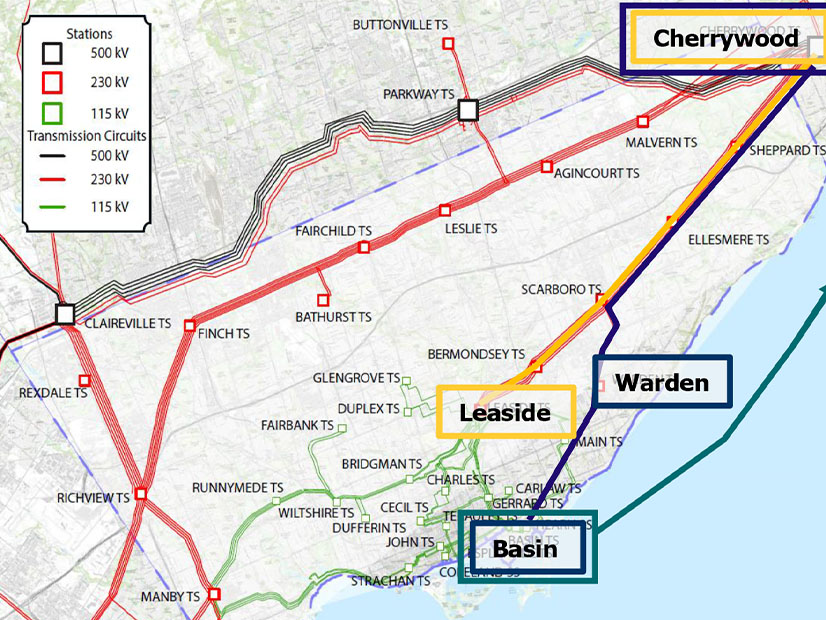
• An overland route from Pickering to Leaside in Toronto. This line would connect Cherrywood Transmission Station (TS) to Leaside TS using an existing transmission corridor.

• An overland route from Pickering to the Port Lands in Toronto. This line would connect Cherrywood TS to Hearn TS via Warden TS, using an existing corridor to Warden TS, then possibly transitioning to an underground cable from Warden TS to Hearn TS.

• An underwater cable from Darlington or Pickering to the Port Lands in Toronto. This line would connect underwater through Lake Ontario.


The IESO – as part of its Integrated Regional Resource Plan - will conduct further engagement this summer — including continued public engagement and targeted discussions with the City of Toronto, Indigenous communities, and key stakeholders — to inform a final recommendation to the government by the end of August 2025.

Once a final recommendation is made, the Ontario government will evaluate what actions must be taken to kickstart its development. Depending on the option selected and the necessary approvals, construction and commissioning could take between seven to 10 years to complete — underscoring the importance of acting now to further Ontario’s clean energy advantage, ensure reliability and position the province and city to put shovels in the ground sooner on critical infrastructure projects.

In addition to a third transmission line, the IESO will also continue engagement to identify complementary solutions to meet electricity demand across Toronto. This could include small-scale generation and storage, such as rooftop solar and battery systems, as well as expanded energy efficiency programs to reduce strain on the grid and help manage peak demand. Taken together, these actions will ensure the province can meet future demand while reducing reliance on natural gas generation.

This initiative is one of several actions being advanced through Ontario’s first Integrated Energy Plan, which will be released later this month. It reflects the coordinated, long-term approach the province is taking to make Ontario energy secure and create opportunities to export Ontario energy abroad. The government’s record investments in energy infrastructure are also helping protect workers and the economy by supporting economic growth and keeping workers on the job at a time of economic uncertainty.

Quick Facts

• Peak electricity demand in Toronto is 4,700 megawatts, which is approximately 20 per cent of peak demand for all of Ontario. According to Ontario’s Independent Electricity System Operator after 20 years of flat electricity demand in the city, Toronto’s peak demand is expected to roughly double by 2050, which includes:

◦ Building New Homes: Energy to power at least 285,000 new homes in Toronto as part of the city’s 10-year housing target. That includes new communities at Downsview, Port Lands, East Harbour and Golden Mile.

◦ Economic growth: Toronto is an attractive investment destination and serves as a provincially and nationally significant centre for job creation and economic growth.

◦ Transit expansion: GO Transit Electrification and the new Ontario Line alone are anticipated to add an additional 100 megawatts of energy demand to Toronto’s system, equivalent to adding a city the size of Kingston.

◦ Electrification: Increased adoption of electric vehicles.

• The Integrated Regional Resource Plan (IRRP) for Toronto, developed by the IESO, is part of a broader effort to anticipate and plan for localized electricity needs across Ontario.
 
Quotes

"Toronto’s continued growth requires a reliable and affordable electricity system that grows along with it. The IESO will work closely with city officials, Indigenous leaders, residents, industry and other partners across the community to explore options, including new transmission lines into the city, to ensure the right solutions are in place to support Toronto’s families and businesses."
- Lesley Gallinger
President and CEO of Ontario’s Independent Electricity System Operator

"This is a critical investment in the infrastructure necessary to power Toronto’s future. As our economy grows and electrifies, our power system must keep pace. To attract high-productivity industries like artificial intelligence and advanced manufacturing — the kinds of businesses that will anchor our economic future — we need electricity that is abundant, reliable, and affordable. This project is more than a transmission line; it’s a foundation for growth, innovation, and economic resilience. With Toronto’s electricity demand projected to nearly double by 2050, the Ontario government is rightly moving rapidly to build the necessary infrastructure required to ensure prosperity in our region for our decades to come."
- Giles Gherson
President and CEO, Toronto Region Board of Trade (TRBOT)

"We are encouraged by today’s announcement to advance options for a third electricity transmission line into the City of Toronto. Local hydro utilities across the province are actively working to support electrification in their communities through capital investments—each with its own unique customer and system needs. Frequent utility and community engagements on infrastructure planning in all regions will help identify energy solutions, including small-scale generation, energy storage, and expanded energy efficiency programs, that are vital to make Ontario grid-ready for economic growth."
- Teresa Sarkesian
President and CEO, Electricity Distributors Association

"The Building Industry and Land Development Association (BILD) welcomes the announcement today that the Ontario government and the City of Toronto are working together to advance options for a third electricity transmission line into downtown Toronto. Building the homes Ontarians, and Torontonians, need today and in the future is dependent on the availability of housing supportive infrastructure including the means for electrification. By examining transmission corridor options, the government is taking concrete steps to secure the ability to meet the housing needs of tomorrow."
- Dave Wilkes
President and CEO, BILD

"Electricity powers daily life, supports growth and is the backbone of Ontario’s economy. Hydro One applauds the government for taking steps to bring clean and reliable energy to downtown Toronto as demand grows. Every new, major transmission line offers an opportunity for First Nation partnership and another step towards reconciliation."
- David Lebeter
President and CEO, Hydro One

"The Ontario Energy Association commends the Government of Ontario for proactively advancing plans for a third transmission line into the City of Toronto. This important infrastructure is needed to bring much needed electricity to Toronto Hydro for distribution to growing needs for transit, homes and businesses, every moment of every day."
- Vince Brescia
President and CEO, Ontario Energy Association (OEA)

"The plan for a third electricity transmission line into downtown Toronto is a much-needed step forward for Ontario. The Toronto Regional Real Estate Board (TRREB) applauds this announcement as a significant contribution towards reliable and sufficient power supply for new home construction and economic development by the Ontario government. A robust electrical grid will meet the growing demand for housing supply and transit infrastructure. These efforts continue to build on the GTA’s role as Ontario’s economic engine, and TRREB looks forward to taking part in the ongoing consultations along with other stakeholders."
- Elechia Barry-Sproule
President, Toronto Regional Real Estate Board (TRREB)

"Toronto Hydro welcomes this commitment by the Government of Ontario and the City to expand electricity transmission capacity into our community. Core infrastructure, including transmission and distribution, is the foundation of a thriving and growing region. We look forward to integrating the Third Line as we continue to serve our customers and support the City of Toronto’s clean energy goals with affordable and reliable electricity."
- Jana Mosley
President & CEO, Toronto Hydro Corporation
 
Since I was not sure where some of these TS were I googled:

Cherrywood is in Pickering.

Herne is in Portlands - adjacent to the (former) Herne Generating Station and Warden is on Warden south of St Clair

WARDEN

1749047595036.png
 
The maps for the three routes being considered, can be found here:


Of course, I'm bringing them forward below:

1749074128981.png


1749074166729.png


1749074200698.png


Options 1 and 2 use the existing Gatineau Corridor (the Meadoway) for the bulk of the plan, with the real question mark being how they get the power from either Leaside or the corridor to downtown/the PEC.

I can't speak to the technical side of this, but my main concern is that connection to downtown, which I would want to see be underground.

The water route is an option but strikes me as being more challenging in some respects.
 
If option 1 doesn't require much in the way of new lines, and no long-distance lines, then isn't it the no-brainer they are planning, and the other 2 options are there to check the box about considering other options?
 
It is interesting that the images use the term "re-energize lines". That part of the 'Gatineau Corridor" is eight 230Kv circuits (four tower lines, two circuits each). Is one of them dormant? Seems unlikely. shoe-horning another circuit or two would obviously require more cable and there doesn't appear to be a lot of space. I'm no Hydro One systems engineer, but typically, if they decide to go with higher voltages, obviously new cable and I believe design standards require increased clearances.
 
Related.


Ontario Building New Transmission Lines to Power Growth Across the Province

Four new and expanded electricity lines will power manufacturing, greenhouses and growing communities


June 06, 2025
Ministry of Energy and Mines


BARRIE — The Ontario government is building two new transmission lines and two major transmission upgrades to ensure the province has the power it needs to meet growing energy demand to build new homes and support economic growth — which represents one of the largest transmission investments in the province’s history. The government’s plan to significantly expand energy infrastructure is an important part of its work to protect Ontario by securing reliable and affordable energy that can power economic growth and reduce Ontario’s reliance on energy providers from outside the province.


“Ontario is growing fast and so is our energy demand,” said Stephen Lecce, Minister of Energy and Mines. “That’s why we’re planning early and advancing approximately 160 km of new and upgraded transmission lines to connect people and businesses to the affordable, secure, reliable and clean energy they’ll need in the years ahead. After announcing the largest nuclear expansion in Ontario history, we are building for the future by advancing one of the largest transmission expansions in Ontario history. This is part of Ontario's long-term integrated plan for economic self-reliance.”


In the next 25 years electricity demand is expected to increase by 75 per cent, with industrial demand alone set to increase approximately 40 per cent in the next five years. That’s why Ontario is acting now to build the infrastructure today that will deliver power from new electricity sources — including nuclear, hydroelectric, renewables and storage — to the communities and industries that rely on it.


To meet this growing demand, the government is launching consultations on proposals to prioritize three transmission projects. These projects will deliver more power to growing communities — including in the Greater Toronto Area, Windsor-Essex, Central Ontario and Eastern Ontario — helping to connect new small modular reactors (SMRs), boost local manufacturing, support greenhouse operations and improve grid reliability.


Declaring these as priority projects would streamline Ontario Energy Board (OEB) reviews and enable faster approvals and development for the following critical transmission lines:


• A new line from Bowmanville to the Greater Toronto Area (GTA), to connect new generation in Eastern Ontario — including Darlington SMRs 2, 3 and 4 — to Ontario’s grid.


• A new line from Windsor to Lakeshore, to meet fast-growing regional demand in Windsor-Essex and drive continued growth in manufacturing and greenhouse industries.


• An upgrade to existing lines between Orangeville and Barrie, to improve reliability and support economic development in Central Ontario while maintaining system capability for electricity transfer between Ontario’s northern and southern regions.


The province is also announcing its support for upgrades to existing lines between Manby and Riverside Junction in Toronto, to increase capacity and support continued electricity demand growth in Toronto’s west end and downtown core.


“For Ontario’s energy-intensive industries — from greenhouses to auto manufacturing — access to affordable, secure and reliable electricity isn’t optional - it’s essential,” said Sam Oosterhoff, Associate Minister of Energy Intensive Industries. “By advancing these lines, we’re leveraging Ontario’s energy advantage to unleash the full potential of our economy and ensure the energy system can power investment, support increased production and protect jobs.”


The government strongly supports Hydro One’s commitment to creating 50-50 partnerships for Indigenous participation when building new large-scale transmission lines, supporting meaningful economic reconciliation and long-term benefits for participating communities.


This expansion is one of several actions being advanced through Ontario’s first Integrated Energy Plan, which will be released later this month. It reflects the coordinated, long-term approach the province is taking to make Ontario energy secure and create opportunities to export Ontario energy abroad. The government’s record investments in energy infrastructure are also helping protect workers and the economy by supporting economic growth and keeping workers on the job at a time of economic uncertainty.


Quick Facts


• Ontario is home to over 30,000 km of high voltage electricity transmission lines that carry power from generating stations to the communities, industries and homes that rely on it.


• Electricity demand in the Windsor-Essex region is expected to grow at least 500 MW over the next 10 years, from 1100 MW to approximately 1600 MW by 2035.


• Electricity demand in Toronto is expected to roughly double by 2050, driven by population growth, major housing and commercial developments, expanded public transit, and increased electrification of vehicles and buildings.


• The proposals that would be consulted on would be to:


◦ Issue Orders-in-Council and Minister’s Directives to declare these lines as priority projects with the intent of speeding up their development given Ontario’s electricity demand growth.


◦ Designate Hydro One to develop the line from Bowmanville to Toronto to provide regulatory clarity necessary for them to kickstart development work and avoid project delays.


• Hydro One was designated by the government in 2022 to begin early development work on the Windsor to Lakeshore transmission line following public and Indigenous consultation. Hydro One will also carry out upgrades on the Orangeville to Barrie and Manby to Riverside corridors, as the transmitter that owns and operates the existing infrastructure in those areas.


• On June 3, 2025, Minister Lecce introduced Protect Ontario by Securing Affordable Energy for Generations Act, which includes a number of other key measures to enhance Ontario’s energy system.
 
• Hydro One was designated by the government in 2022 to begin early development work on the Windsor to Lakeshore transmission line following public and Indigenous consultation. Hydro One will also carry out upgrades on the Orangeville to Barrie and Manby to Riverside corridors, as the transmitter that owns and operates the existing infrastructure in those areas.

The bolded is the reason for the laugh............

Not Riverside............. Richview.

That's the Etobicoke Greenway project. You'd think they could check their news releases better.

Project Page:


That one will interest @lenaitch

1749219422999.png
 
I wonder if the increase in transmission capacity will negate the biggest reason for the Port Lands power plant?!
 
I wonder if the increase in transmission capacity will negate the biggest reason for the Port Lands power plant?!

Not the intention right now, this is stage-setting to deal with projected demand growth and connect in the power from the new SMRs at Darlington.

Offsettng the PEC would be a different project.
 
Related.


Ontario Building New Transmission Lines to Power Growth Across the Province

Four new and expanded electricity lines will power manufacturing, greenhouses and growing communities


June 06, 2025
Ministry of Energy and Mines


BARRIE — The Ontario government is building two new transmission lines and two major transmission upgrades to ensure the province has the power it needs to meet growing energy demand to build new homes and support economic growth — which represents one of the largest transmission investments in the province’s history. The government’s plan to significantly expand energy infrastructure is an important part of its work to protect Ontario by securing reliable and affordable energy that can power economic growth and reduce Ontario’s reliance on energy providers from outside the province.


“Ontario is growing fast and so is our energy demand,” said Stephen Lecce, Minister of Energy and Mines. “That’s why we’re planning early and advancing approximately 160 km of new and upgraded transmission lines to connect people and businesses to the affordable, secure, reliable and clean energy they’ll need in the years ahead. After announcing the largest nuclear expansion in Ontario history, we are building for the future by advancing one of the largest transmission expansions in Ontario history. This is part of Ontario's long-term integrated plan for economic self-reliance.”


In the next 25 years electricity demand is expected to increase by 75 per cent, with industrial demand alone set to increase approximately 40 per cent in the next five years. That’s why Ontario is acting now to build the infrastructure today that will deliver power from new electricity sources — including nuclear, hydroelectric, renewables and storage — to the communities and industries that rely on it.


To meet this growing demand, the government is launching consultations on proposals to prioritize three transmission projects. These projects will deliver more power to growing communities — including in the Greater Toronto Area, Windsor-Essex, Central Ontario and Eastern Ontario — helping to connect new small modular reactors (SMRs), boost local manufacturing, support greenhouse operations and improve grid reliability.


Declaring these as priority projects would streamline Ontario Energy Board (OEB) reviews and enable faster approvals and development for the following critical transmission lines:


• A new line from Bowmanville to the Greater Toronto Area (GTA), to connect new generation in Eastern Ontario — including Darlington SMRs 2, 3 and 4 — to Ontario’s grid.


• A new line from Windsor to Lakeshore, to meet fast-growing regional demand in Windsor-Essex and drive continued growth in manufacturing and greenhouse industries.


• An upgrade to existing lines between Orangeville and Barrie, to improve reliability and support economic development in Central Ontario while maintaining system capability for electricity transfer between Ontario’s northern and southern regions.


The province is also announcing its support for upgrades to existing lines between Manby and Riverside Junction in Toronto, to increase capacity and support continued electricity demand growth in Toronto’s west end and downtown core.


“For Ontario’s energy-intensive industries — from greenhouses to auto manufacturing — access to affordable, secure and reliable electricity isn’t optional - it’s essential,” said Sam Oosterhoff, Associate Minister of Energy Intensive Industries. “By advancing these lines, we’re leveraging Ontario’s energy advantage to unleash the full potential of our economy and ensure the energy system can power investment, support increased production and protect jobs.”


The government strongly supports Hydro One’s commitment to creating 50-50 partnerships for Indigenous participation when building new large-scale transmission lines, supporting meaningful economic reconciliation and long-term benefits for participating communities.


This expansion is one of several actions being advanced through Ontario’s first Integrated Energy Plan, which will be released later this month. It reflects the coordinated, long-term approach the province is taking to make Ontario energy secure and create opportunities to export Ontario energy abroad. The government’s record investments in energy infrastructure are also helping protect workers and the economy by supporting economic growth and keeping workers on the job at a time of economic uncertainty.


Quick Facts


• Ontario is home to over 30,000 km of high voltage electricity transmission lines that carry power from generating stations to the communities, industries and homes that rely on it.


• Electricity demand in the Windsor-Essex region is expected to grow at least 500 MW over the next 10 years, from 1100 MW to approximately 1600 MW by 2035.


• Electricity demand in Toronto is expected to roughly double by 2050, driven by population growth, major housing and commercial developments, expanded public transit, and increased electrification of vehicles and buildings.


• The proposals that would be consulted on would be to:


◦ Issue Orders-in-Council and Minister’s Directives to declare these lines as priority projects with the intent of speeding up their development given Ontario’s electricity demand growth.


◦ Designate Hydro One to develop the line from Bowmanville to Toronto to provide regulatory clarity necessary for them to kickstart development work and avoid project delays.


• Hydro One was designated by the government in 2022 to begin early development work on the Windsor to Lakeshore transmission line following public and Indigenous consultation. Hydro One will also carry out upgrades on the Orangeville to Barrie and Manby to Riverside corridors, as the transmitter that owns and operates the existing infrastructure in those areas.


• On June 3, 2025, Minister Lecce introduced Protect Ontario by Securing Affordable Energy for Generations Act, which includes a number of other key measures to enhance Ontario’s energy system.
This in addition to previously announced grid improvements in northern Ontario. Lack of capacity has been cited a number of times over the years as one of the impediments to bringing new mines into production.
 
The bolded is the reason for the laugh............

Not Riverside............. Richview.

That's the Etobicoke Greenway project. You'd think they could check their news releases better.

Project Page:


That one will interest @lenaitch

View attachment 656784
Thanks for that. I note in the EA it talks about dismantling the existing (non-energized) two-circuit infrastructure and replacing it, due to the increased capacity.

Reading the EA brought back memories of a time when I reviewed EA proposals for the Sol-Gen. Man, you sure can see how a reasonable streamlining of the process could go a long way to speed up projects.
 
To me it’s about capacity and robustness. It seems to me option 1 puts a lot of eggs in the Leaside TS basket but option 3 may not recognize the need to provide capacity across both the 416 downtown and the suburbs/inner 905.

So my option 4 would be “why not both”, especially if a larger downtown TS with a waterborne transmission line corridor already developed also allowed for rapid development of post-Doug Ford lake wind farms. But that may be hamstrung by reluctance to invest sufficiently far ahead of demand.
 

Back
Top