

News   Apr 02, 2026
 756     1 
News   Apr 02, 2026
 567     0 
News   Apr 02, 2026
 1.6K     2 

GO Transit: Service thread (including extensions)

With respect to Niagara Falls tourism, this is true. But for the “normal” public transit in this corridor, we are at the point where bus is no longer viable - as the Milton rerouting demonstrates, the QEW/Gardiner is just not reliable and trip times are not acceptable.

The bus does not use the Gardiner. It runs from Burlington Station to Niagara Falls station. That segment is significantly faster by express bus than by express train, even if the bus gets stuck in traffic.

Weekday Schedule, May 2023
Capture.PNG


The train is scheduled for 90 minutes from Burlington to Niagara Falls, while express the bus is scheduled for 60. So an express bus timed to meet an express train in Burlington would be 20 minutes faster than a direct train.

It’s a long way off before we can handle 2WAD “express” service beyond Clarkson, but we need to start thinking about this corridor as frequent 2WAD beyond Confederation.

The corridor already handled 4+ GO trains per hour all day in both directions in 2021. Whether one or two of those trains make limited stops from Oakville to Union is purely a matter of preference.
 
Last edited:
GO Expansion has all day express services planned on LSW to service Hamilton. From what I recall the plan is to have the eventual 30-minute frequency service to Confederation GO operate express.

We will have to see when we even get 30 minute service to Hamilton / Confederation, yet alone if we will get express service.


Train speeds on the Niagara Peninsula have also always bothered me - the corridor is dead straight from Hamilton to St Catharines. There is no reason GO shouldn’t be able to operate at 140km/h for the entire stretch, but yet that clearly doesn’t happen.I believe there are reduced speeds through central Hamilton due to the high number of level crossings, but once trains hit the Red Hill Parkway track speeds should really be 140-160km/h.

Long term the goal should be for GO to operate a Toronto-Niagara Falls service which does the trip in around an hour and a half. There is no reason that shouldn’t be achievable on the corridor which should be able to support very high travel speeds for most of its length.
 
The bus does not use the Gardiner. It runs from Burlington Station to Niagara Falls station. That segment is significantly faster by express bus than by express train, even if the bus gets stuck in traffic.

Ah…. Now I see what you meant. Yeah, the train takes a long time to round the bend at Hamilton and the route over the Skyway has a time advantage, although the QEW can get congested over the Skyway.

I would hope that the speeds could be raised eventually, at least from Hamilton eastwards to St Catherines. One concern may be not so much the number of grade crossing as the volume of truck traffic, although there are lots of busy grade crossings elsewhere with higher track speeds.

When ML built the third track from Aldershot to West Harbour, there were constraints that forced some slow stretches and slow speed turnouts. That is unfortunate, but one would hope that the gap can be closed somewhat.

- Paul
 
It always felt like they could build bus lanes somewhere to help the Hamilton-Niagara travel. Either on the QEW, one of the service roads, or some of the roads further south.

Even if trains are improving, it wouldn't hurt to still build some bus infrastructure as well.
 
It always felt like they could build bus lanes somewhere to help the Hamilton-Niagara travel. Either on the QEW, one of the service roads, or some of the roads further south.

Even if trains are improving, it wouldn't hurt to still build some bus infrastructure as well.
Absent tolls, the HOV lanes should be for truly high occupancy vehicles only -- that is, buses. With tolls, bus lanes would be unnecessary, and buses much more popular.
 
Absent tolls, the HOV lanes should be for truly high occupancy vehicles only -- that is, buses. With tolls, bus lanes would be unnecessary, and buses much more popular.
The success of GO's 407 bus routes despite low-density surroundings is a clear illustration of this point.
 
The success of GO's 407 bus routes despite low-density surroundings is a clear illustration of this point.
its probably not the density the more it is the 99% free flowing traffic, plus the connections to almost every single GO line and TTC Subway on top of them.

Take Bramalea GO for example, if you miss a train heading to Union and have to wait another hour, you might as well just take the 407 GO buses that comes at least in 15 mins to 407 Station and then the Subway from there which is roughly around the same price as an adult presto fare anyway and can save you a bit of time instead of waiting for the GO train to come in the next hour.
 
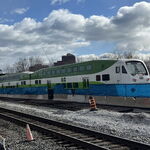
According to an Alstom worker that did a count earlier today, there apparently was close to 4,000 on one of the Niagara trains. I have no idea if this was a rough estimation or not because that’s an insane number and close to crush load on a 12 car train
 
Never seen them put a random 11pm niagara train into service before:


I am surprised that they chose to run a train so late. If the train arrives late at Union there is no way to get home from there.

Yesterday for example there was a door problem leaving Union in the morning and a bridge problem leaving Niagara Falls in the evening. l ended up arriving at Union an hour late last night.

Anything is possible.
 
According to an Alstom worker that did a count earlier today, there apparently was close to 4,000 on one of the Niagara trains. I have no idea if this was a rough estimation or not because that’s an insane number and close to crush load on a 12 car train
That seems impossible, especially since aren't several of the coaches the bike variety with no lower level seating? There would be 150+ standees in every single coach.

EDIT: That raises a question I've never thought of. Is there any kind of absolute maximum capacity for a train imposed on GO? Like some kind of max limit for insurance purposes, or by a law that says they cannot operate with more than X passengers per car?
 
Last edited:
That seems impossible, especially since aren't several of the caoches the bike coaches with no lower level seating?

Plus others with dedicated stroller storage. Mind you though I have seen some overly packed cars in the past, it usually involves people standing or sitting on the stairs/
 
That seems impossible, especially since aren't several of the coaches the bike variety with no lower level seating? There would be 150+ standees in every single coach.

EDIT: That raises a question I've never thought of. Is there any kind of absolute maximum capacity for a train imposed on GO? Like some kind of max limit for insurance purposes, or by a law that says they cannot operate with more than X passengers per car?
The crush load is the absolute maximum that a coach can hold, the crush load for each coach is 438 people: 162 seated and 276 standees. On a 12 car train that’s 5,256, though this number will be slightly smaller with the stroller car, accessibility coach, and 3 bike coaches on the consist.
 

Back
Top