News   Mar 31, 2026
 1.3K     2 
News   Mar 31, 2026
 220     3 
News   Mar 31, 2026
 1.2K     0 

GO Transit: Service thread (including extensions)

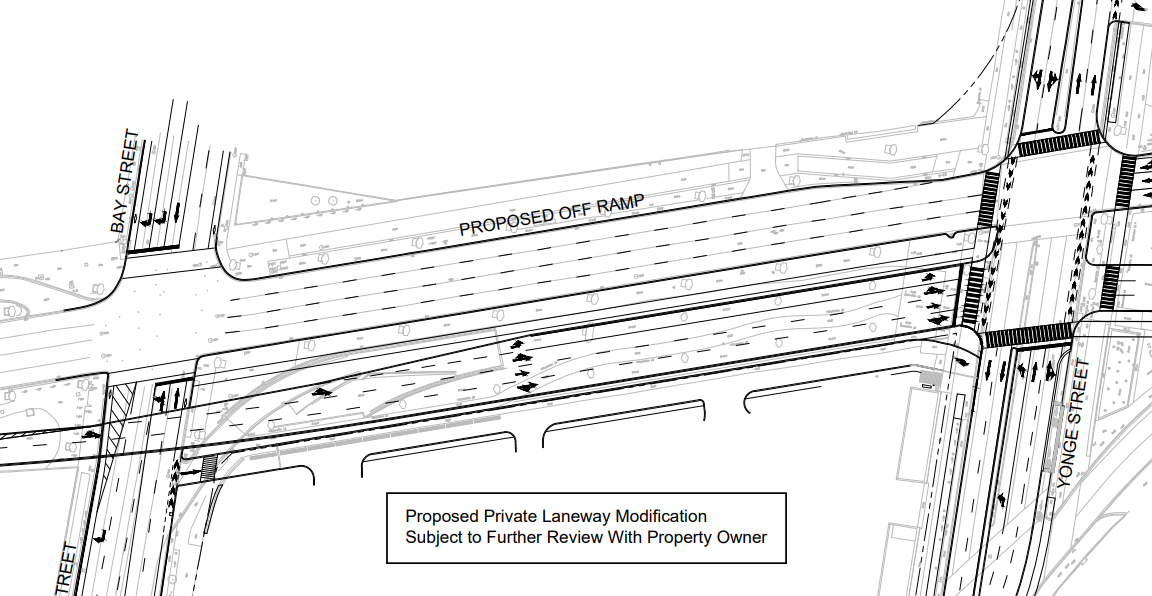
The Lower Yonge Precinct Environmental Assessment Study Identifies some lane re-configurations in the area, including bringing the Jarvis Off-ramp back to terminate at Yonge St instead, as well as the extension of the 4th WB lane on Lakeshore as shown by @reaperexpress.

I wonder if this could allow for some sort of dedicated U-turn lane off the Yonge St Off-ramp, perhaps on a specialized signal, for GO buses to access the terminal direct from this reconfigured ramp.

lower yonge.png
 
Really not a fan of off-peak fares. We really shouldn't be charging people extra based on when they travel.
Compared to current rates, it wouldn't be charging people more for peak travel, just less for off-peak travel.

If you're going to continue travelling during peak, you won't be paying any more than you are now. But if you want to save a couple of bucks, or you're debating between different modes of transportation for an evening or weekend trip, discounted GO fares may tip the balance in favour of GO.
 
I don't think off peak fares are particularly valuable right now. Their intent is to dilute peak-hour volume pressures on capacity, and that isn't exactly an issue right now.
 
I don't think off peak fares are particularly valuable right now. Their intent is to dilute peak-hour volume pressures on capacity, and that isn't exactly an issue right now.
Reducing peak-hour pressures is half of the equation. The other half is making better use of off-peak capacity by enticing people using other modes (i.e. driving) onto transit through more attractive pricing. Entice enough 'newcomers', and it lowers the subsidy required to run those off-peak services. Of course, you need X number of newcomers to offset the lost revenue from the existing ridership now paying a discounted price for their trip.

The Niagara Falls trains have shown how well this strategy can work. Only issue is that it may have worked a little too well, to the point where GO may need to add service to keep up with demand.
 
Im begging you please do not add more stops I cannot sit in traffic for an extra half hour just to stop somewhere that already has decent transit connections already
I meant terminating at Kipling in replacement of Union at least on the weekends, but if you’re going to add a stop there it still works for passengers that know that they’ll be intense traffic on the Gardiner as seen below.

More on the traffic chaos at the Union Station Bus Terminal last weekend:


Hoping that we could get weekend Kitchener line service really soon and we can just reroute the Milton buses to another line (Port Credit/Kipling works just fine for them).
 
The Lower Yonge Precinct Environmental Assessment Study Identifies some lane re-configurations in the area, including bringing the Jarvis Off-ramp back to terminate at Yonge St instead, as well as the extension of the 4th WB lane on Lakeshore as shown by @reaperexpress.

I wonder if this could allow for some sort of dedicated U-turn lane off the Yonge St Off-ramp, perhaps on a specialized signal, for GO buses to access the terminal direct from this reconfigured ramp.
Like this?
lowerYongeX.jpg
 
Terminating at Kipling would have been a terrible idea last weekend with the Jane to Ossington closure. Would probably take longer to get downtown than sitting at Yonge/Harbour for 30 minutes.
 
While I like the idea, I'm not sure that the grades would permit an early left-turn like that. Much like the Simcoe Off-ramp, the Yonge Off-ramp will be a steep downward grade meeting grade immediately at the intersection from my understanding. GO cutting across 3-lanes of traffic mid-block on a stretch of road that is often extremely congested will also be quite challenging.

Regarding 10 car trains, what do you mean? GO right now is running a fraction of it's pre-COVID peak hour service with 10-car trains, there is an absolute ton of room to improve peak hour capacities before crowding becomes a problem again.
 
While I like the idea, I'm not sure that the grades would permit an early left-turn like that. Much like the Simcoe Off-ramp, the Yonge Off-ramp will be a steep downward grade meeting grade immediately at the intersection from my understanding.
Could be. In which case the U-turn would need to occur in the intersection which is unfortunate from a pedestrian delay standpoint since the north half of the west crosswalk would no longer be able to display Walk during the eastbound left turn phase.

GO cutting across 3-lanes of traffic mid-block on a stretch of road that is often extremely congested will also be quite challenging.
It would be a fully-protected turn, simultaneous with the north-south crosswalk. You just turn when you get a green arrow. In the City's proposed design, the westbound capacity at Bay has been increased (due to the additional lane), while the westbound capacity at Yonge has been significantly reduced due to the additional turning phases required (i.e. less green time for westbound Lakeshore). The gridlock will therefore be relocated a block eastward, out of this particular block.

Regarding 10 car trains, what do you mean? GO right now is running a fraction of it's pre-COVID peak hour service with 10-car trains, there is an absolute ton of room to improve peak hour capacities before crowding becomes a problem again.
They are running heavy 10-car trains all day on many lines, while for most of the day ridership does not require more than a 6 or possibly 8 car train. But if the train has been made 10 cars long, it means that there is at least one trip during the day which requires it. And I'd be willing to bet that that trip is at rush hour.

We're definitely not pushing against the capacity limitations of our infrastructure or rolling stock at the moment, as you mentioned. But the point is that big time-of-day spikes ridership have associated costs compared to more evenly-spread demand. In this case, the cost is that everyone on an off-peak train needs to suffer through the glacial acceleration of a 10/12-car train, even though those particular trips don't actually need the extra capacity.
 
Yes we should. It costs a rail system far more to add capacity during the peak hour than during other times, since that's the service pattern around which the tracks need to be designed. If you run 8tph peak and 2 tph off-peak your line needs to be able to support 8tph. If you can spread out demand to run 4 tph all day, you only need the infrastructure to support 4 tph, saving a lot of construction and maintenance costs.

In all of the office jobs I've ever had, people commuting by car have had wildly differing hours to avoid traffic, arriving insanely early or very late in the morning, while transit riders all showed up between 8 and 9. Because although rail transit gets more crowded, it doesn't get much slower so demand doesn't disperse the same way it does around road traffic congestion. Providing discounts outside of rush hour helps create an incentive to disperse demand around the peak periods.

Variable pricing goes a long way to making the system a lot more affordable to operate, and those savings could easily be passed on to the riders in the form of great off-peak discounts.

An alternative to official "peak" and "off-peak" prices are time-restricted discounts. For example, here in the Netherlands there is only one base ticket price, but for €5/mo you can get a NS subscription which gives you 40% off off-peak.

Or on the TTC, parking is paid on weekdays until the early afternoon, then free on evenings and weekends. So in effect if you're going to drive to the station, it's cheaper to travel outside of peak periods. This latter example would be highly effective on GO given what a large percentage of ridership drives to the station. It would also have the valuable side effect of limiting parking demand during periods when the car park is typically full.
Talk to me when we're back to running 12 car trains more than every 15 mins. Peak hour fares only make sense when there is so much demand that the current infrastructure simply can't handle the demand, and as such there is a need to try and push people to take the train at less busy times if possible. GO is nowhere near this point. Whilst we have hit 100% of our weekend ridership, our weekday ridership is at 45% pre-pandemic. This doesn't even begin to scratch the fact that within the next year or 2 we're going to see our single track lines begin double track service which should further improve frequencies, and we haven't hit our theoretical maximum headways on the Lakeshore + Kitchener Lines.

Let's also not ignore the fact that GO is desperately trying to bring back it's rush hour commuter crowd by offering incentives like unlimited passes: https://globalnews.ca/news/8773488/metrolinx-presto-back-work-pass-covid/. Whilst I am generally more optimistic when it comes to transit usage in a post-COVID world than most others, let's not kid ourselves and pretend that COVID hasn't done a major impact in the rush hour market, and has naturally distributed transit passengers from rush hours to off peak times on its own. So no, there isn't a need for any off peak discount or peak hour tariff anytime soon.
 
Makes me wonder why all the Milton and Kitchener/Guelph buses don't also use Kipling as well. There's like 3 empty bus bays there and its literally next to the subway. Its also a regional hub according to them and technically at a GO station so they cant make the excuse that its not a suitable location. Maybe its the downside of having the new Union bus terminal, but we could honestly just leave that to all intercity buses and some GO bus routes and there wouldn't be any loss overall.

Im begging you please do not add more stops I cannot sit in traffic for an extra half hour just to stop somewhere that already has decent transit connections already

If anything it would make more sense for GO to extend the 25 Waterloo buses to Kipling using the transitway, it would make travel between Toronto and KW much easier now that Greyhound is gone.
 
I do think there is some logic in Milton and some other western GO bus routes running through Kipling to USBT, even if it adds 10-minutes. It builds some resiliency in the service due to downtown traffic delays, but would also acknowledge that not everyone is going to Union. Getting to Yonge/Bloor, Midtown, etc. would be faster via Kipling.
 

Back
Top