News   Apr 02, 2026
 107     0 
News   Apr 02, 2026
 228     0 
News   Apr 01, 2026
 401     0 

GO Transit: Service thread (including extensions)

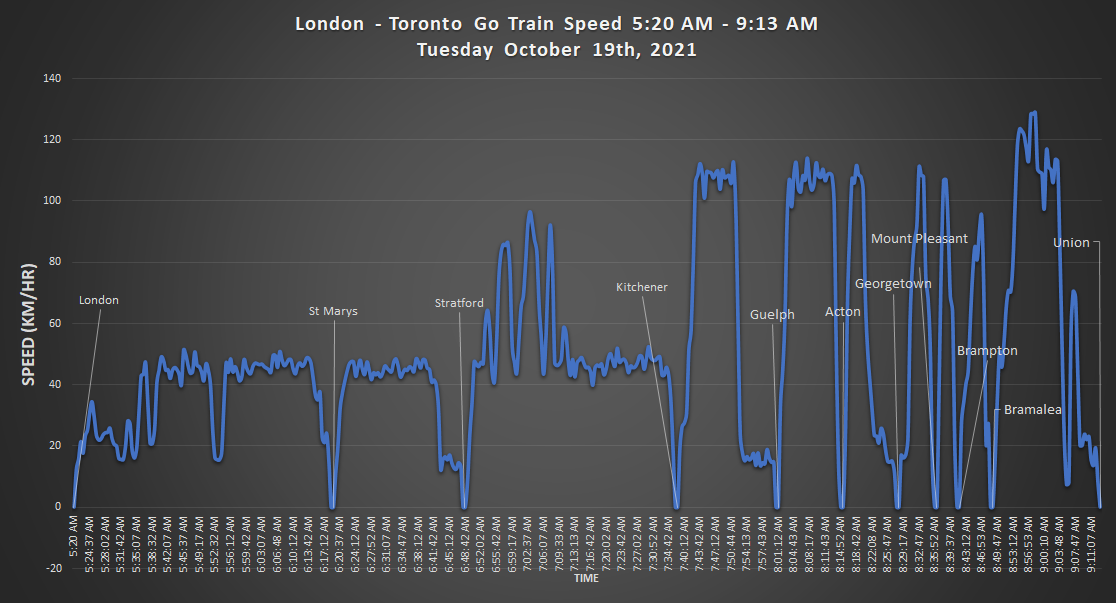
Great news! Based on the chart you posted earlier, this was the lowest-hanging fruit along the line: a short 30 mph slow order in an otherwise 60 mph zone. Hopefully they are also working on the two other similar slow orders (one just east of Stratford and the other crossing Hwy 7 west of New Hamburg).

Speed diagram previously posted by Krypto98
london-toronto-png.356687


Location of the 30 mph slow order which still exists west of New Hamburg (as of today):
View attachment 371560


I highly doubt the time savings of resolving the single 30 mph slow order in Shakespeare would be 4-5 minutes, given that it was only a couple hundred metres long, and even a full station stop on a 60 mph line only adds about 2 minutes, including coming to a full stop and sitting still for 30 seconds.

And by the way, how do you make these charts? I looked quickly on transsee.ca but I didn't see any obvious way of exporting data.
Another correction, They are usually now 3 minutes early at stratford. Thus including duel time, i only see this improving the schedule by 2 minutes.
 
What was the 1970s time for kitchener to Stratford?

Best time in the Jan 7 1970 timetable - westbound #159 - 27 minutes (plus 3 mins dwell in Stratford), That was a conventional train.

From June 1 80 - with most services running as RDC trains - westbound # 665 - 27 minutes plus 3 dwell in Stratford

May 5/91 - with service reduced after the Mulroney cuts - #80 eastward, 29 minutes (no dwell shown)

2001 (GEXR) - #87 - 29 minutes

2009 (GEXR) - #84 - 27 minutes

2017 (GEXR) #85 - 37 minutes

In theory, CN has received compensation from G+W which ought to be applied to restoring the line to its pre-GEXR condition.

- Paul
 
Last edited:
I copy and pasted each individual line into excel and formated with one column with time and another with speed. I'll likely make another chart soon with the Guelph speed improvements.
I meant where did you get the data to copy to Excel?
What was the 1970s time for kitchener to Stratford?
Here's April 1976 (27 min travel + 3 min dwell, same as the tables described by crs1026):
Capture0.JPG
 
So how do you make the schedule reflect the original schedule before the track deteriorated? Shouldn't they be able to shave an hour off that trip?
I don't know exactly how to do that but if GO3775 followed the 1970s schedule, the schedule would look like this
4:19 Union
4:46 Bramalea
4:53 Brampton
5:00 Mount Pleasant
5:12 Georgetown
5:26 Acton
5:41 Guelph Central
6:06 Kitchener
6:33 Stratford
6:48 St Marys
7:15 London

You Could subtract an additional 5-7 minutes for the Guelph Speed increases since that is not reflected here.
 
So how do you make the schedule reflect the original schedule before the track deteriorated? Shouldn't they be able to shave an hour off that trip?

Yep, 59 minutes. Here's how that would look for the morning trip.
Capture.JPG

The 2021 column is the current (Oct 2021) schedule. The 2022 column is the schedule I think will be implemented soon, to reflect track improvements completed in Dec 2021. The 1976 column then swaps out the London-Kitchener travel times for the ones from the April 1976 schedules. The numbers between are the time savings between stations.

Apart from the segment between New Hamburg and Kitchener, the railway alignment is extremely straight. With track and crossing improvements, the speed limit could be raised a lot higher than the 70 mph (112 km/h) limit which was in effect in 1976. The alignment looks like it could easily support 95 mph (153 km/h) west of New Hamburg.
 
Last edited:
Yep, 59 minutes. Here's how that would look for the morning trip.
View attachment 371700
The 2021 column is the current (Oct 2021) schedule. The 2022 column is the schedule I think will be implemented soon, to reflect track improvements completed in Dec 2021. The 1976 column then swaps out the London-Kitchener travel times for the ones from the April 1976 schedules. The numbers between are the time savings between stations.

Apart from the segment between New Hamburg and Kitchener, the railway alignment is extremely straight. With track and crossing improvements, the speed limit could be raised a lot higher than the 70 mph (112 km/h) limit which was in effect in 1976. The alignment looks like it could easily support 95 mph (153 km/h) west of New Hamburg.
With 95 mph speeds, 2hr 40 mins or lower could be possible?
 
So about 45 minutes faster than the trip today...
45-60 minutes faster. 2hr 50 minutes would be the potential time if stuff like Georgetown is also improved.

Then if upgrades are done to get the line to 90mph I think 2hr 40 minutes could be possible. Maybe lower if there is electrification.
 
Does raising the line beyond class 4 (80mph) really do anything for Metrolinx, given the diesel-bilevels equipment likely deployed on the line for the foreseeable future, setting aside the issue that it is further public capital investment (following VIA paying for signalling) in an asset the public neither owns or controls?
 
Does raising the line beyond class 4 (80mph) really do anything for Metrolinx, given the diesel-bilevels equipment likely deployed on the line for the foreseeable future,
Yes. GO's current diesel bilevel stock operates at 150 km/h (93 mph) on Lakeshore West express services, and the 6 car consists used west of Kitchener have decent acceleration too. Furthermore the average stop spacing west of Kitchener is 30 km, which is triple the aforementioned Lakeshore West services.

I suggested 95 mph specifically because it's the top speed of GO's current equipment.

setting aside the issue that it is further public capital investment (following VIA paying for signalling) in an asset the public neither owns or controls?
This talk of raising the line speed above 70 mph is all under the assumption that Metrolinx or Via owns the line. I certainly wouldn't recommend doing any significant investment while CN still owns the line.
 
Last edited:
Apart from the segment between New Hamburg and Kitchener, the railway alignment is extremely straight. With track and crossing improvements, the speed limit could be raised a lot higher than the 70 mph (112 km/h) limit which was in effect in 1976. The alignment looks like it could easily support 95 mph (153 km/h) west of New Hamburg.

A very reliable source tells me that the curve east of Petersburg is rated at 1 degree 30 minutes, and the curves just west of Petersburg are rated at 0 degrees 30 to 1 degree even.

By way of comparison, the curve on the Oakville Sub east of Mimico is also rated at 1:30, and express GO trains can do 80 through that curve.

- Paul
 

Back
Top