|
|
|



You are using an out of date browser. It may not display this or other websites correctly.
You should upgrade or use an alternative browser.
You should upgrade or use an alternative browser.
GO Transit: Service thread (including extensions)
- Thread starter drum118
- Start date

Allandale25
Superstar
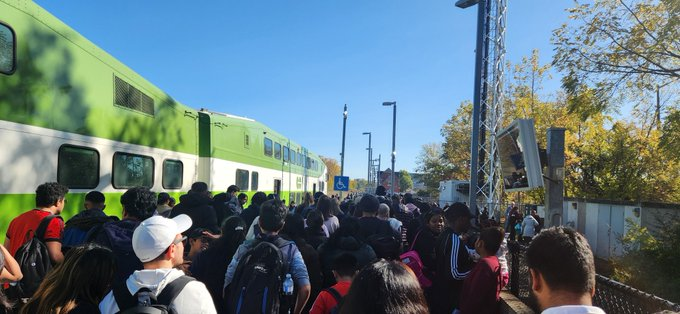
^ apparently the CSA said on the PA that people should complain on social media. Someone also said that the decision may have been made because it's getting colder out so they assumed a man would go down.


ShonTron
Moderator
Member Bio
- Joined
- Apr 24, 2007
- Messages
- 13,318
- Reaction score
- 12,153
- Location
- Ward 13 - Toronto Centre
The weekend after Thanksgiving is often the best Fall weekend. It certainly is this year. This is ridiculous.
Allandale25
Superstar
^ One more picture from the same account above.
Northern Light
Superstar
^ apparently the CSA said on the PA that people should complain on social media. Someone also said that the decision may have been made because it's getting colder out so they assumed a man would go down.
View attachment 605641
This is a run that should really be aiming for everyone seated. Two hours standing isn't remotely reasonable.
The post above notes that this is one car lighter than normal, but the crowding suggests this should be nothing less than an L10, and an L12 would not be unreasonable.
Allandale25
Superstar
^ further tweet was made where the author was corrected. Apparently it's only a six pack.

AlvinofDiaspar
Moderator
Maybe they need to reorganize Mlinx again /s.
AoD
AoD
Bojaxs
Senior Member
Maybe they had no MP locomotives available for the Niagara run, and had to resort to using the F59?
Don't they usually use the F59's for the Niagara runs?
Don't they usually use the F59's for the Niagara runs?

reaperexpress
Senior Member
That is already the loading standard. Something evidently went very wrong here, there should obviously not have been a 6 coach train on a weekend morning departure from Toronto to Niagara Falls .This is a run that should really be aiming for everyone seated. Two hours standing isn't remotely reasonable.
Yeah it was not one coach shorter than normal, it was 6 coaches shorter than normalThe post above notes that this is one car lighter than normal, but the crowding suggests this should be nothing less than an L10, and an L12 would not be unreasonable.
Last edited:
Allandale25
Superstar
^ apparently the CSA said on the PA that people should complain on social media. Someone also said that the decision may have been made because it's getting colder out so they assumed a man would go down.
View attachment 605641
Northern Light
Superstar
They had to know they had a serious problem this morning..........it should have been remedied by mid-day..........either use the spare board and take an extra set out..........use layover time to add to the consist..........

Richard White
Senior Member
They had to know they had a serious problem this morning..........it should have been remedied by mid-day..........either use the spare board and take an extra set out..........use layover time to add to the consist..........
The Niagara services have always been prone to overcrowding.
@smallspy Dan, is there any operational reason you know of that these services always have issues? I am starting to wonder if people just don't like the work for some reason (runtime, etc).
As I said many times before, they need to stop subsidizing the cost to Niagara Falls with weekend passes, WEGO packages, etc. If people had to pay the true cost of this journey it would not be as packed.
When they first started this service in 2015 it was just over $20.00 each way for a total of $40.00 or so return. Back then the trains were not as packed because of the high cost.
Now you can get a $10 weekend pass to go to Niagara and back again. As a result the trains are overloaded to the point where it is a borderline safety hazard.
I get that this is primarily a tourism driven service but they need to match the prices of Megabus, Flixbus etc if they want to bring things like this under control.

Garuda
Active Member
Currently on the special weekend Kitchener Line train from Guelph this weekend. And the platform is packed! Lots of students and families utilizing the service.
And something that’s never happened before at smaller GO stations: a live announcement over the PA system about crowding and the length of the train.
They must have had someone watching the CCTV cameras from the operations centre. They were warning people not to use the yellow strip to pass, train lengths and whatnot. The train even crawled through the platform to avoid hitting someone. That’s rare.
If this isn’t a sign that frequent all day (re: weekend) service is needed on the Kitchener Line all the way to Kitchener then I don’t know what will do it.
And something that’s never happened before at smaller GO stations: a live announcement over the PA system about crowding and the length of the train.
They must have had someone watching the CCTV cameras from the operations centre. They were warning people not to use the yellow strip to pass, train lengths and whatnot. The train even crawled through the platform to avoid hitting someone. That’s rare.
If this isn’t a sign that frequent all day (re: weekend) service is needed on the Kitchener Line all the way to Kitchener then I don’t know what will do it.

Metroscapes
Active Member
Re: Niagara, it takes a little foresight, but it's forseeable.
When the forecast a week out says highs of 20+, and the leaves are starting to look good, a reasonable person responsible for service scheduling should be able to know that there will likely be some demand. And perhaps they have past data to rely on.
If you tell me it takes over 5 days to book an extra coach or two, fine. If not, I don't see an excuse.
When the forecast a week out says highs of 20+, and the leaves are starting to look good, a reasonable person responsible for service scheduling should be able to know that there will likely be some demand. And perhaps they have past data to rely on.
If you tell me it takes over 5 days to book an extra coach or two, fine. If not, I don't see an excuse.
guavadelic
Active Member
There really should be a seasonal inter-city Toronto-Niagara Falls service run by Ontario, similar to the Northlander. Would be aimed at seasonal tourism, higher priced, but more comfortable journey. Say from April-October. And a parallel GO Transit service for regular users.The Niagara services have always been prone to overcrowding.
@smallspy Dan, is there any operational reason you know of that these services always have issues? I am starting to wonder if people just don't like the work for some reason (runtime, etc).
As I said many times before, they need to stop subsidizing the cost to Niagara Falls with weekend passes, WEGO packages, etc. If people had to pay the true cost of this journey it would not be as packed.
When they first started this service in 2015 it was just over $20.00 each way for a total of $40.00 or so return. Back then the trains were not as packed because of the high cost.
Now you can get a $10 weekend pass to go to Niagara and back again. As a result the trains are overloaded to the point where it is a borderline safety hazard.
I get that this is primarily a tourism driven service but they need to match the prices of Megabus, Flixbus etc if they want to bring things like this under control.
We've got one of the natural wonders of the world in our backyard that is major global tourist attraction and we service it with mediocre transportation connections.