News   Jan 28, 2026
 548     1 
News   Jan 28, 2026
 1.4K     5 
News   Jan 28, 2026
 672     1 

GO Transit: Construction Projects (Metrolinx, various)

They do clear the snow during the day with shovels or snow blowers, and push it onto the tracks too, I saw both happening at multiple stations last Sunday.
Because of their location, platforms are now only allowed to be serviced by the regular corridor maintenance crews. So platform clearing efforts are not happening nearly as fast as they should.

They are not supposed to push the snow onto the tracks as the operating crews are told to be cautious when they can't see the railhead, but it does indeed happen.

Dan
 
Impressive for Metrolinx to construct 5km of double tracking in 7 years. With these speeds, if we put Metrolinx in charge of Alto construction in Ontario, we could even see HSR from Toronto to Ottawa in just 935 years!
This entirely. I don't buy the woe-is-me or they're-trying-their-very-best narratives like double tracking or triple-tracking an existing rail ROW is some groundbreaking concept never done on this Earth. Metrolinx already owns the roughly 260 km of ROW earmarked for GO Expansion on 5 lines: https://en.wikipedia.org/wiki/GO_Transit_rail_services#History

This isn't them being hamstrung by freight companies rationing out trackage-rights agreements. This is some combination of lack of initiative, expertise, capacity, and funding.
--------------------------------------------------

When I bring up how fast greenfield projects are done in comparison, I never get a proper answer along the lines of economic, political & labour differences.

This may be another Stuttgart 21 or Brandenburg Airport: literally the slowest rail and airport projects in human history---that were never formally paused, suspended, or cancelled---bar none. Only difference is that GO Expansion might actually be slower than Stuttgart just to reach minimum viable product, and might be further descoped into oblivion.

Whereas Berlin actually got a consolidated transport hub, and Stuttgart will benefit the southern half of Germany and more. At least we'll set a world record by the 2040 Lakeshore launch.
 
Last edited:
On first thought, double tracked so ~664km, but on second thought knowing Metrolinx they'd probably descope it and construct most of it single tracked and say that we won't need more than bi-hourly service.
And leave some half built platforms, fire the HSR expert vendor, and then get stuck in the snow.
 
And leave some half built platforms, fire the HSR expert vendor, and then get stuck in the snow.
1769550069153.png
 
Impressive for Metrolinx to construct 5km of double tracking in 7 years. With these speeds, if we put Metrolinx in charge of Alto construction in Ontario, we could even see HSR from Toronto to Ottawa in just 935 years!
I guess it's worth noting that it's a lot more difficult to do corridor works like double tracking on actively used lines, vs something mostly/fully greenfield like Alto. Even on a line that only has hourly service might only be able to have 20m worth of meaningful work done every hour due to safety procedures. Theoretically if Metrolinx decided to just completely shutdown the GO train for a few years GO Expansion could come along far quicker.

Note that I'm not trying to completely exonerate MX here, even with that caveat the pace is frankly way too glacial. However it's just worth bringing up that Alto is naturally going to have a much easier time getting work done.
 
I guess it's worth noting that it's a lot more difficult to do corridor works like double tracking on actively used lines, vs something mostly/fully greenfield like Alto. Even on a line that only has hourly service might only be able to have 20m worth of meaningful work done every hour due to safety procedures. Theoretically if Metrolinx decided to just completely shutdown the GO train for a few years GO Expansion could come along far quicker.

Note that I'm not trying to completely exonerate MX here, even with that caveat the pace is frankly way too glacial. However it's just worth bringing up that Alto is naturally going to have a much easier time getting work done.
Fair point.

There are probably reasons I am unaware of and someone will explain how its not so simple (Thank you in advance to anyone who educates me), but I have always found it interesting how able road crews are capable of working on live roads and highways, expecting probably 10s of ks of motorists of all abilities and sanities to not crash into them, but with the tightly managed rail controls and experienced engineers live rail work on is nigh on impossible / discouraged.
 
I guess it's worth noting that it's a lot more difficult to do corridor works like double tracking on actively used lines, vs something mostly/fully greenfield like Alto. Even on a line that only has hourly service might only be able to have 20m worth of meaningful work done every hour due to safety procedures. Theoretically if Metrolinx decided to just completely shutdown the GO train for a few years GO Expansion could come along far quicker.

Note that I'm not trying to completely exonerate MX here, even with that caveat the pace is frankly way too glacial. However it's just worth bringing up that Alto is naturally going to have a much easier time getting work done.

You make a good point regarding GO vs. Alto.

Not that you are the one saying this, but I have heard the narrative that working on active lines is not only more difficult, but more expensive than building from scratch. This makes no sense. It is more difficult on active lines in some ways, sure. But it's still cheaper to electrify an existing rail corridor than build a new one. Otherwise, why not just build new lines?

As an aside, I misused 'greenfield' earlier. What I actually meant were projects largely built from scratch like the Grand Paris Express, Sydney Metro, and regional rail networks in China and South Korea. These projects had expropriation and even wholesale redevelopment, much moreso than GO Expansion.

There is a big difference between building hundreds of kilometres of metros and elevated regional rail in dense urban areas than double-tracking 13 km of Lakeshore East and electrifying 100 km of Lakeshore East&West by 2040. See photo below.

Lakeshore doesn't run for 5 hours at night, ample time to get work done. The problem IMO is A. the province doesn't want to spend more money, because B. Metrolinx blew all the money as usual, on things like consultants, some of whom were fresh grads that went right into consulting/advisory: https://www.thetrillium.ca/news/the-trillium-investigations/how-metrolinxs-plan-to-deliver-european-style-train-service-went-off-the-rails-10786705#:~:text=England presented the minimum viable product

Linkedin is open source information. Apparently Metrolinx was/is handing out internal VP titles to external consultants.

1769577648338.png
 
Last edited:
There are probably reasons I am unaware of and someone will explain how its not so simple (Thank you in advance to anyone who educates me), but I have always found it interesting how able road crews are capable of working on live roads and highways, expecting probably 10s of ks of motorists of all abilities and sanities to not crash into them, but with the tightly managed rail controls and experienced engineers live rail work on is nigh on impossible / discouraged.

There is a huge difference in the knowledge and training requirements for the average highway construction worker and forepersons versus what every last worker on a railway site needs to be qualified in with respect to operating rules and procedures

There are plenty of rail contractors out there today, but many only emerged in the last 5 years or so. Many are in growth mode and their workforces are still new to all this. Their supervision is still learning their jobs. Some are cast-offs from Class 1 railways and aren't necessarily the best minds out there. There are major rail projects in other provinces so even where it exists Ontario is competing for such skilled labour.

ML in particular has had plenty of near-misses where contractors misunderstood or disregarded the established operating rules. There was even one fatality a couple years ago on a ML work site, and another more recently on a ML contractor's work site..

This will change over time, as this labour force grows and matures, but it's a specialty within the Canadian construction workforce and one simply can't parachute perfectly capable trades people who do highway or building construction onto a railway job. ML's decision to physically separate virtually all construction work from live trackage is extreme, but not wrong-headed.... but it's a statement of just what a gap exists at the moment.

As to working at night, the time required to mobilise and then demobilise is not condusive to a lot of important jobs. Imagine building a 40-storey downtown tower using 5-hour work windows every evening. And if you have ever been in the stop and go flow of a 400-series highway that is down to one lane at 01:00 due to construction.... highway construction isn't necessarily pretty, either.

The issue for me (and that bridge is a good example) is - in any business I have seen, if the company's C suite execs submit a report to their Board saying that something will be ready next year, and a year goes by, and that thing isn't ready....the trip back to the Board to fess up will be painful. Better have your CV tidied up. In ML's case, none of these projections seems to be noticed or remembered or followed up by the Board, and people just turn up and keep promising new things that will be ready in another year. Look, squirrel..... seems to be quite helpful towards keeping your job.

At one point, I was told that ML and its contractors had a falling out over the contractors' demands for more all-weekend closures on the Stouffville line, which ML was unwilling to allow. As it turns out, the bridge became the critical path, and so the remaining work just plodded along to completion but now sits unusable as the tracks don't connect at the bridge. But ML has never acknowledged the delay from the original commitment. It's a micro Crosstown, I'm surprised that the media and the Markham-Stouffville communities have left this one alone. This doesn't need investigative reporting or inside sources, enough key facts are already in the public domain.

- Paul

 
Last edited:
Lakeshore doesn't run for 5 hours at night, ample time to get work done.
Just a reminder - when CN sold the Lakeshore tracks to Metrolinx CN retained running rights, and uses the overnight hours when GO is not running to make its deliveries and pick-ups at its customers along the Lakeshore tracks. So there are not five clear hours without traffic most nights along the Lakeshore.
 
Not that you are the one saying this, but I have heard the narrative that working on active lines is not only more difficult, but more expensive than building from scratch. This makes no sense. It is more difficult on active lines in some ways, sure. But it's still cheaper to electrify an existing rail corridor than build a new one. Otherwise, why not just build new lines?
From a civil cost, maintaining existing operations and construction phasing, yes, a new line is cheaper and easier. But once you bring property into scope, it gets more expensive and difficult. It's insanely frustrating to see projects pitched or discussed as being rational, but then you look closer at the assumptions, and they ignore expropriation / property costs. Having the land to do it is arguably the most important part!
 
Just a reminder - when CN sold the Lakeshore tracks to Metrolinx CN retained running rights, and uses the overnight hours when GO is not running to make its deliveries and pick-ups at its customers along the Lakeshore tracks. So there are not five clear hours without traffic most nights along the Lakeshore.
A gross oversimplification, if not misrepresentation from me.

But really, I think @crs1026 explains it well, it being difficult to work on active lines is a given. However... this is not used as an excuse in other countries, to the extent it is used for GO. So something else is afoot:
This will change over time, as this labour force grows and matures, but it's a specialty within the Canadian construction workforce and one simply can't parachute perfectly capable trades people who do highway or building construction onto a railway job.
I long suspected it had to do with the lack of labour. Ontario lacks the workforce needed to build rail projects quickly, regardless of project funding. Even if they threw $100 billion at GO Expansion, where would they find the workers?

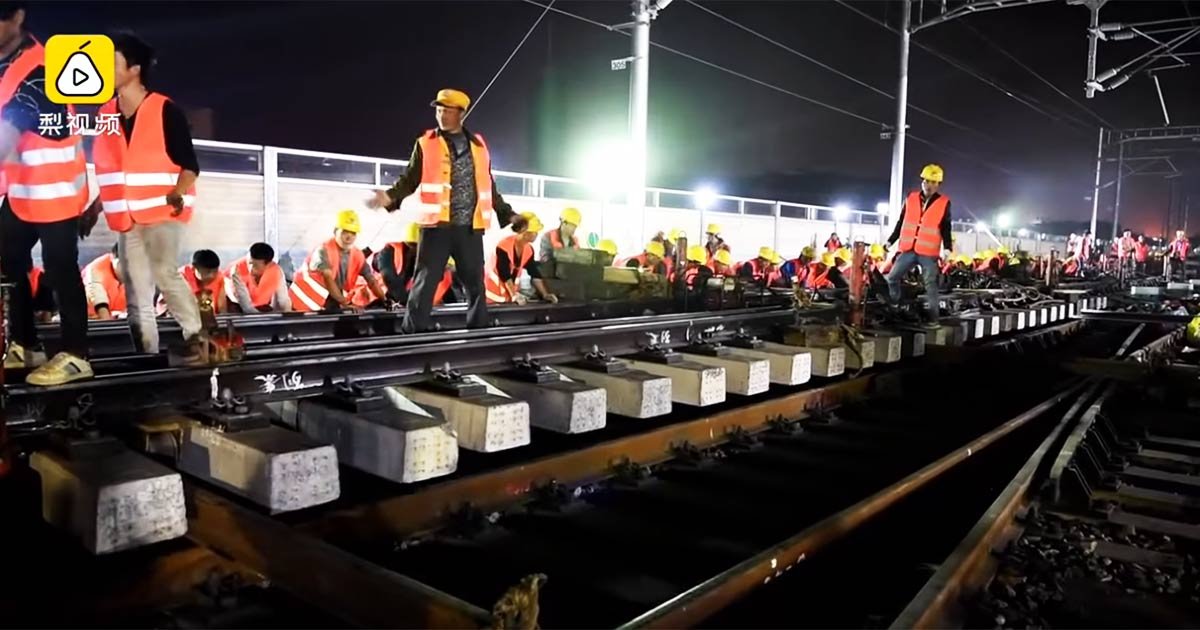
It brings up the question of importing labour where it's actually needed. The original Canadian Pacific Railway was mostly built by ____________?

Pardon my ignorance: are there even 1,500 line workers working on GO Expansion on any given day? If you include staff, 1,500 seems more plausible.
 
Last edited:
Fair point.

There are probably reasons I am unaware of and someone will explain how its not so simple (Thank you in advance to anyone who educates me), but I have always found it interesting how able road crews are capable of working on live roads and highways, expecting probably 10s of ks of motorists of all abilities and sanities to not crash into them, but with the tightly managed rail controls and experienced engineers live rail work on is nigh on impossible / discouraged.
Thank you to crs1026 for the explanation

Funny update though, I'm on the LSW to Union and there were people working on the tracks near a switch on the south side of Exhibition and west of the platform. Trains only running on the north side.

So they are at least allowed to do this, sometimes. I had thought MX banned all red light work.
 
Thank you to crs1026 for the explanation

Funny update though, I'm on the LSW to Union and there were people working on the tracks near a switch on the south side of Exhibition and west of the platform. Trains only running on the north side.

So they are at least allowed to do this, sometimes. I had thought MX banned all red light work.

There are plenty of maintenance workers out there, working under CROR protection rules. But that is running maintenance - and likely critical to getting the plant working again - as opposed to new construction or major component replacement.

- Paul
 

Back
Top