


reaperexpress
Senior Member
I haven't made my annual commuter rail summary yet, but here is last year's summary.You both are proving my point. Which is that busiest GO lines already have a frequency that is acceptable to most. Increasing frequency from here won't bring tons of new riders. Keyword being "tons of". People here are expecting multifold increase in ridership. Yes, the ridership can double in 20 years but that will be mostly because of population growth and increasing congestion. How many people do you know are not using GO because their frequency is 30 minutes but would have used it if it were running at 10 min intervals?
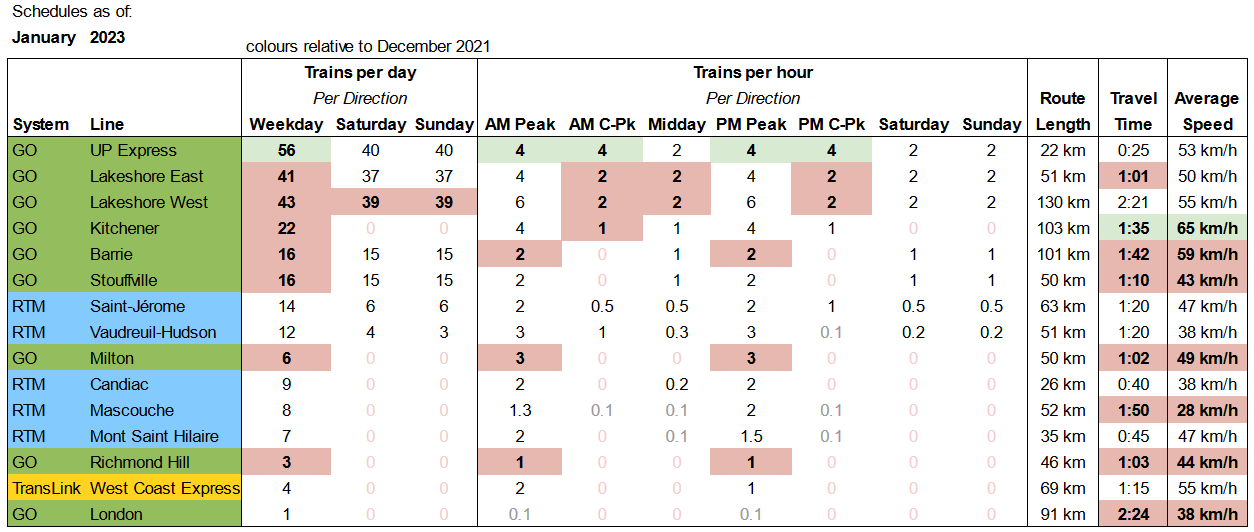
Looking down the columns for Midday, Saturday and Sunday, I see an awful lot of 1s and 0s. This year UP Express increased to 4tph midday and Kitchener gained 1tph weekend service, but even then, only a single line (UP Express) has 15-minute off-peak service, and two lines (Lakeshore) have 30-minute off-peak service. The remainder of all-day lines only have hourly off-peak service. Milton and Richmond Hill only have bus service off-peak, and even then the Milton buses are just shuttles to the Lakeshore West line and the Richmond Hill buses don't run on weekends.
Improving frequency does not preclude us from adding new lines, improving speeds or reducing fares. To achieve increased frequencies we are substantially rebuilding our network and electrifying it. That is the same thing we need to do to improve speeds and reduce operating costs.New lines (such as Bolton or Midtown), much better speeds, lower fares, etc. can bring a lot more net new riders.
In fact, frequency is one of the major tools that enables higher speeds. One of the easiest ways to improve average speed is to make fewer stops, but in order to skip stops, you need to have a separate service that serves them. With only one train per hour on most of our lines, it's going to be pretty hard to justify having trains skipping stations, since that would leave two-hour gaps. Which would decimate potential ridership at those stations. But when we've got many trains per hour on the line, it's much easier to justify having a variety of different service patterns, with the longer distance services making limited stops where they overlap with local services.


