News   Dec 05, 2025
 164     0 
News   Dec 05, 2025
 1.1K     2 
News   Dec 05, 2025
 328     0 

Commonwealth Cities/Urbanism

rdaner

Senior Member
Member Bio
Joined
Apr 25, 2007
Messages
8,955
Reaction score
38,040
I need your help. I have been explaining to several people outside of Canada what explains the growing difference between urban areas in the US and Canada and I have arrived at the conclusion that our membership in the Commonwealth is increasingly a big factor, especially in regards to demographics. If you look at the country of origin of newcomers to NA they are roughly the same until after WW2 when UK/HK and South Asian dominated here versus increasing numbers from Mexico to the US.

The second feature of this is a common education background as well as institutions. For example the architects/planners guiding Canadian urban policy were British trained thus the presence of tower blocks across the country and in suburban areas unlike the US.

This is just an initial idea but one that goes a long way to explaining trends in Canada since 2000. Thoughts?
 
I need your help. I have been explaining to several people outside of Canada what explains the growing difference between urban areas in the US and Canada and I have arrived at the conclusion that our membership in the Commonwealth is increasingly a big factor, especially in regards to demographics. If you look at the country of origin of newcomers to NA they are roughly the same until after WW2 when UK/HK and South Asian dominated here versus increasing numbers from Mexico to the US.

The second feature of this is a common education background as well as institutions. For example the architects/planners guiding Canadian urban policy were British trained thus the presence of tower blocks across the country and in suburban areas unlike the US.

This is just an initial idea but one that goes a long way to explaining trends in Canada since 2000. Thoughts?

Not really.

I don't think the built form is primarily dictated by more recent immigration patterns. We saw far more hirise construction here, albeit much of it the 'Tower in the Park' variety than was ever common in the U.S.

I also don't think the Commonwealth per se is a factor in recent immigration trends either.

All Anglo countries (Britain, the U.S., Australia and Canada) have been inordinately open to immigration.

The demographic breakdown of immigrants is linked to the legal channels for immigration, to illegal immigration, of course, and geography plays a big role in the latter.

The U.S., historically had a greater focus on chain/family migration, meaning you got more of people you already had, who could act as sponsors. We have that too, but our points system in immigration counted for a higher proportion of immigrants vs family class, and that skewed the numbers, along with those coming through various other channels.

****

Back to built form. The divergence can be ascribed to many things, but I think you need to go back and look at that latent difference, the one that goes back particularly to the post WWII era.

That difference, I think can be said to a greater belief in government and in planning, in part.

The same mentality differences that led Canada to adopt Universal Healthcare (albeit with some omissions); saw the U.S. stop, for most part, at Medicare for Seniors and Medicaid for the acutely poor.

Without engaging in national self-flattery, Canadians are also a more traveled people vs Americans and are, therefore, more exposed to the world, above and beyond what higher levels of immigration have done. Higher rates of passport holding and higher rates of having traveled outside the country are material and affect what considerations go into planning vs a somewhat more insular and 'exceptional' United States.

The Greenbelt here in the GTA is very much an influencing document by restricting vast areas of land from sprawl. But it wasn't the first greenbelt, these have existed in/around Vancouver and Ottawa among other places for much longer.

Montreal, being on an Island with finite capacity in/out saw some of the same effect by default.

****

One can certainly speak of many global influences on Canadians and Canadian policy in recent years, some of which are from Britain, and by weight of immigration, India.

But much is from other sources, Quebec/France, obviously, but also waves of immigration from China, have had an effect on built form, and policy in some measure.

Its a complex thing not attributable to anyone feature of Canadian society. Its also a feedback loop. The better transit gets, the more people take it, the more demand there is to make it better. The more people
grow up in apartments/condominiums the more people accept this as a likely housing option and maybe even a preferred one.
 
Last edited:
Thanks! Good points for a complex, multi-layered trend that has many factors. I thought of the Commonwealth due to the massive increase in immigration from Commonwealth countries post 2000 and especially post COVID. An example is, South Asia aside, the surge in Nigerian migrants who bring very different patterns than US Blacks and I had to point this out to a relative who is relocating to Toronto from Florida (Trump).

Also the effect of HK investment starting in the late 1980s which is very much tied to it having preferred access and has had a big effect on the built form of many Canadian cities that I don’t see in the US.

And I would point out the inclusion of high-density zones in much Canadian planning starting in the 1950s (Don Mills, Edmonton) which is a feature of British planning that is absent elsewhere in NA.

But perhaps the biggest factor is South Asian migration and institutions, which are based on UK models, which I don’t see in the US. But more later.

And now that I reread NL points I wonder if the trend is actually driven by increasing EU practice post 2000 and especially since Trudeau and now Carney.

Food for thought.
 
Last edited:
Between this and a similar thread on SSP I am much clearer but will post some additional thoughts that may be of interest:
1) The surge in S. Asian immigration is a new trend whose medium/long term effects are yet to be seen in built form but will have an effect. This is echoed in a smaller way by Ukrainian inflows. Both of these have a much larger effect here than in the US.
2)Heavy transit investments that are now coming to completion in Canada will have a larger effect on their cities than counterparts in the US as well as being more effective in creating change because of more widespread zoning reform.
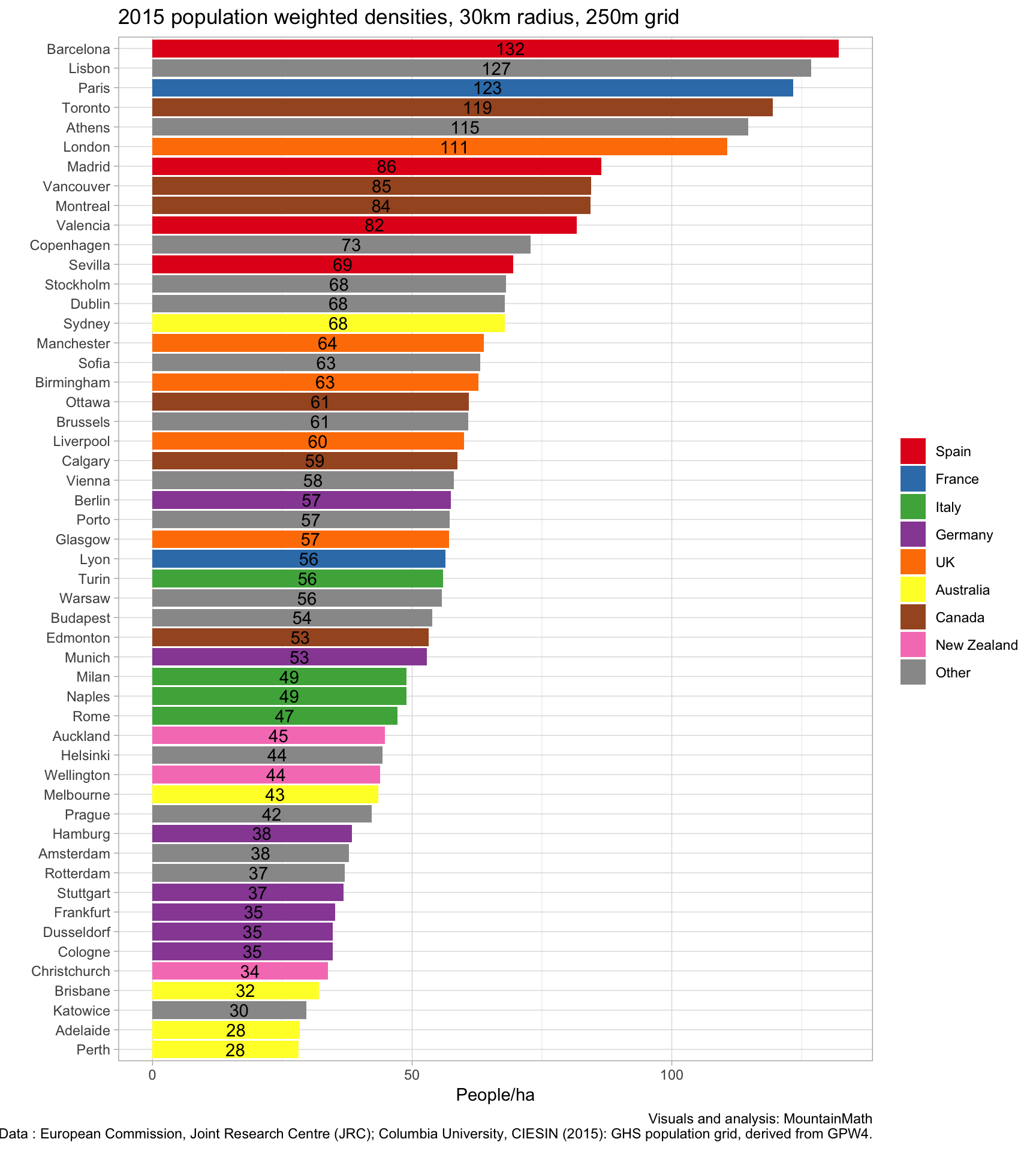
3)Canadian metros are rapidly converging with UK urban areas as far as measurements go and are approaching EU norms in small ways.

The point of this is that although I have known there were key differences it has been pointed out by professionals that I talk with on my tours that this is really accelerating and wanted better answers as to why. Sounds like a great article for someone! Lol
 
Another thought that has occurred to me is one of time and its effect on the built environment in NA and the Anglosphere in general. It is well documented that many US states had a policy of creating a new settlement for the administrative capital as well as for the main university. Without getting too bogged down it makes sense from an expansion perspective and a desire to separate legislators from the urban ‘mob.’

From what I can gather many government functions are more centralized in the main city in Canadian/Australian regional jurisdictions. Now these happened a full generation or two later. For example Toronto has both the provincial govt as well as the effective ‘provincial university’ and has benefited from that immensely versus Michigan which has Lansing (capital) and Ann Arbor (university) widely separated. Also Winnipeg contrasted to Illinois/Wisconsin.
 
Just another little morsel for this evolving thread: based on rough estimates Canada is building as much urban rail infrastructure as the entire US so more divergence of our respective built forms.
 
Thanks! So I have modified my thinking about The Commonwealth element and moved on to wider ‘rest of world vs. US model’ thinking. Here’s another example:

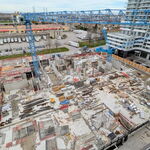
The Davis Tannery project in central Kingston, Ontario now has approval and will add 1600+units to the downtown as well as a revitalized (and bougie) waterfront promenade. The reason I’m putting this here is that there are a dozen small Canadian cities that are seeing an explosion in central housing/facilities such as Kelowna, Saskatoon, Cambridge, Guelph, Brantford, Moncton, Saint John, Sydney, etc and most of these already had decent amounts of high density/healthy downtowns. But I can’t think of any examples of US or even Australian counterparts that are seeing similar growth/density. And if correct then why?
This showed up in the 2021 Census and I’m thinking that it will be seen again in 2026. And again I don’t see any evidence of US examples seeing similar trends. It appears that not only are our top 6 metros moving rapidly to converge with OECD norms but several, if not most, CMAs below them are now accelerating in a similar fashion which shows me that there are fundamental drivers here that are absent in the rest of NA.
 
Thanks! So I have modified my thinking about The Commonwealth element and moved on to wider ‘rest of world vs. US model’ thinking. Here’s another example:

. But I can’t think of any examples of US or even Australian counterparts that are seeing similar growth/density. And if correct then why?

Australia is definitely adding density.

I certainly can't speak to every small town, I'm sure not all of them are.......

But aside from booming Melbourne, and Sydney and everything in their orbit......

Canberra, Perth and Gold Coast have have added significant new density.


On Rail, Sydney is undertaking a massive expansion of its rail-based public transport:


There are also expansions underway in Melbourne and Brisbane.

This showed up in the 2021 Census and I’m thinking that it will be seen again in 2026. And again I don’t see any evidence of US examples seeing similar trends. It appears that not only are our top 6 metros moving rapidly to converge with OECD norms but several, if not most, CMAs below them are now accelerating in a similar fashion which shows me that there are fundamental drivers here that are absent in the rest of NA.

I would have to study the U.S. more closely before making any definitive statements.

There are definitely pockets of central city growth such as downtown Chicago; but the overall city/region there is still flat to declining in population.

I would broadly agree the U.S. remains divergent in this area, whether that is increasing or decreasing I would have to take some time to examine.

I expect it would vary by region somewhat.
 

Back
Top