News   Dec 05, 2025
 708     2 
News   Dec 05, 2025
 2.3K     4 
News   Dec 05, 2025
 476     0 

Montréal Transit Developments

Gasp!

A transit agency that actually communicates with the public!

That's certainly an improvement on Mx......but hardly stuff to brag about.

They will be more than 2 full years late on the Anse-à-l’Orme branch, assuming they meet the latest revised timeline.

The much vaunted CDPQI and REM are years late and billions over budget. (yes, much like Mx) point being these are not the brilliant rescuers of public transit in North America they were billed as.
 
Last edited:
That's certainly an improvement on Mx......but hardly stuff to brag about.

They will be more than 2 full years late on the Anse-à-l’Orme branch, assuming they meet the latest revised timeline.

The much vaunted CDPQI and REM years late and billions over budget. (yes, much like Mx) point being these are no the brilliant rescuers of public transit in North America they were billed as.
I'm not fully up on the REM construction timelines, but one has to admit that finding a bomb inside of a tunnel probably had somwthing to do with it.

But yea, the standard is low i admit.
 
That's certainly an improvement on Mx......but hardly stuff to brag about.

They will be more than 2 full years late on the Anse-à-l’Orme branch, assuming they meet the latest revised timeline.

The much vaunted CDPQI and REM are years late and billions over budget. (yes, much like Mx) point being these are not the brilliant rescuers of public transit in North America they were billed as.
So the budget went up from some $7 billion to $9 billion. Okay, it’s an increase, and CDPQi very likely lowballed the initial budget, and delayed by 2 years due to pandemic (and YUL / ADM funding issues for the terminal station at YUL).

But let’s be realistic, it’s still a far cry from the traditional P3 project where the budget would likely be something like $10 billion (with a very large contingency fund that likely gets all used up), ends up being $16 billion, and then 5 years + delayed, just because why not. We have a very real case of this playing out in front of our eyes in the form of Eglinton where it blew past original budget of $5.3 billion (which is already a mind boggling budget on a per km basis compared to global standards for a glorified streetcar line) to now some $12-13 billion, and 5+ years delayed and counting.

Maybe CDPQi never meant to keep the original budget, but in the end, I’d take a $9 billion project that covers an entire 67 km transit NETWORK anyday of the week over a $13-$17 billion single line at grade LRT that is still going to end up being late regardless.

The optics may not look pretty to our media - but REM by all accounts is still (even if over budget) one of the “cheapest” rapid transit projects on a per KM basis in North America ($118-$140 mil / km VS. $670 mil / km for Eglinton VS. god knows how much for Ontario Line).
 
So the budget went up from some $7 billion to $9 billion. Okay, it’s an increase, and CDPQi very likely lowballed the initial budget, and delayed by 2 years due to pandemic (and YUL / ADM funding issues for the terminal station at YUL).

Listen, we all get that you're a member of the REM and CPPQI fan club, and I am not.

We can have different takes, to a point.

But you come very close to being outright misleading with yours.

Lets start with timeline. The base project, with CPPQ involvement was announced in January....2015. By the time it wraps...........it will have been at least 11.5 years.

If you measure from the initially announced construction date, it began December 2017, so 8.5 years.

if you measure from the actual start of construction, that was April 2018, which would see it about 8 years, if there are no further delays.

Finally, the initial opening date was July 31st, 2023.

Measured from the actual ground breaking date, construction was supposed to have lasted 5 years, 3 months.

If the line completes in April '26 it will be 2 years and 9 months late; which is an increase of 2 years 9 months which is a 49% overrun/delay.

****

On budget. The final version of the project, from 2017 was publicly announced at 5.9B in cost.

By groundbreaking in April '18, 10 months later, pre-pandemic, the cost had risen to 6.5B

The current estimated budget is 9.4B an increase from the Jun 2017 date of 3.5B an increase of 59%!

But let’s be realistic, it’s still a far cry from the traditional P3 project where the budget would likely be something like $10 billion (with a very large contingency fund that likely gets all used up), ends up being $16 billion, and then 5 years + delayed, just because why not. We have a very real case of this playing out in front of our eyes in the form of Eglinton where it blew past original budget of $5.3 billion (which is already a mind boggling budget on a per km basis compared to global standards for a glorified streetcar line) to now some $12-13 billion, and 5+ years delayed and counting.

REM re-used existing rail corridor for the most part, including an existing tunnel, only a small amount of net new ROW was required. But you must consider the impact to existing or then existing commuter rail service to be removed.

The net gain is not as large as you would make it out to be, in any event a comparison to a line

I'm more than happy to rip the province and Metrolinx over Eglinton Crosstown. But just to point this out.

Assuming (big if) it opens by year end, the project will completed ~ 5 years late; on a construction schedule of ~ 9 years (broke ground October '2011) or 55% overrun.

On budget, the Crosstown construction tender was 9.1B the current estimated budget which I will be the first to put a big asterisk beside) is 12.8B that's an overage of 2.38B that's an overage of 40.6%

Overall comparison as follows:

Project Name: Percent delayed Percent over budget

REM 49% 59%

Crosstown 55% 40.6%


Maybe CDPQi never meant to keep the original budget, but in the end, I’d take a $9 billion project that covers an entire 67 km transit NETWORK anyday of the week over a $13-$17 billion single line at grade LRT that is still going to end up being late regardless.

The optics may not look pretty to our media - but REM by all accounts is still (even if over budget) one of the “cheapest” rapid transit projects on a per KM basis in North America ($118-$140 mil / km VS. $670 mil / km for Eglinton VS. god knows how much for Ontario Line).

Not a legitimate comparison in either case

Crosstown was an entirely new corridor, there was no existing commuter line to reuse it has 10km of brand new tunnel. Building the line elevated was never an option through the tunneled stretch.

The Ontario Line had no existing tunnel to re-use either, its 9km of new tunnel, there is only about 3km shared with the existing GO Lines with an elevated guideway and 3 bridges, 2 significant making up the balance
 
Last edited:
By groundbreaking in April '19 ...
Groundbreaking in 2018? The new rail bridge over the St. Lawrence is the most expensive element of this project - which required an separate deck between the highway decks. Construction on that started in 2015! And I bet the cost isn't included in that total. The second most expensive element is probably the tunnels under Montreal up to McGill station and the tunnel from there through the mountain, which started construction in 1912. I'd guess the third-most expensive element is the main downtown terminal (well station if phase 2 ever opens) which started in 1929, and took 14 years to open. The LRT platforms for the REM aren't even moved horizontally or vertically from those constructed in the 1930s (1920s, and 1940s)! The finish looks improved though. The majority of the stations for this project date to the 1920s.

The design of the upgrade of the tunnel and Deux-Montagnes service to subway-like service started over 60 years ago, with the official announcement (of the then Line 3) was in the early 1960s!.

I don't think any of these numbers are included in these cherry-fished costs. Nor the land acquisition. The only piece opened so far on "new corridor" is the Autoroute 10 median, from the early 1960s. Planning to convert that median to LRT was well underway at the turn of the century. I doubt the land acquisition and grading of that land is included here. There is that small piece of track on new alignment along the edge of the rail yard to get to Nun's island. The main feature of that is the Griffintown station - who knows how long before they finish building that station, given construction started in 2018 - probably stalled for years now.

Even that spur to Baie d'Urfé (cut back in the middle of nowhere from original discussions to go to a major destination closer to the tip of west island) follows old railway corridors and Autoroute 40 - including part of the alignment of the the not-yet-completed 100-year old plan to redirect the GTR/CN/VIA service from Dorval/St.Henri/The Point along a faster entry to Central Station through the tunnel. A century later, it's still using the very slow, winding detour through The Point.
1758899109177.png


Normally I'm accused of being anti-Quebec or something by making fun of how long this project has taken. Perhaps @Northern Light can remind the Urban Toronto members who seem to seldom leave this thread that I'm equally, if not more, vocal about projects that are actually here - or in the exurbs!

Kudos though on completing the 1970s plan to have an interchange station at the Metro Vincent-d'Indy Blue Line (Line 5) station!
 

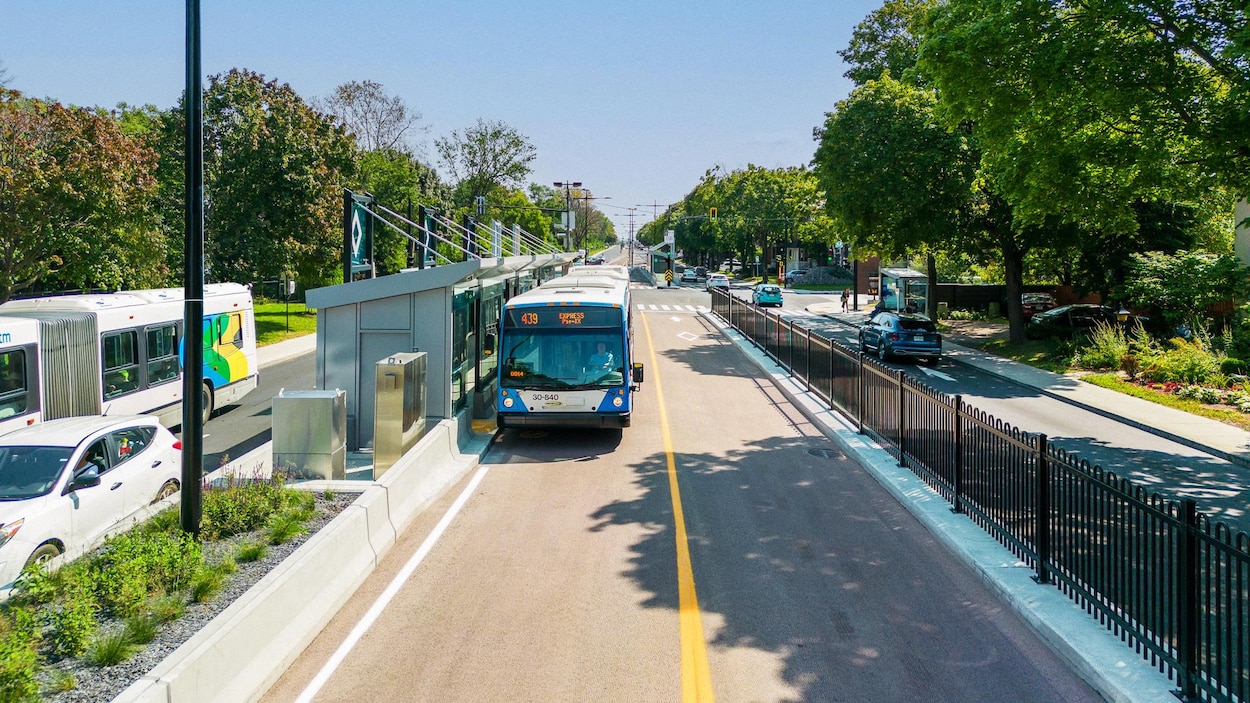
Radio Canada reports that the BRT on Pie-IX is now slower than the express bus it replaced*.

The STM attributes this to the fact that the BRT doubled the line's ridership to 32k per day, causing longer boarding/unboarding times. The article also states that Montreal's Vision Zero has given pedestrians longer crossing times, further adding to the slowdown.

"the speed difference between the 139 line, which makes many stops along Pie-IX Boulevard, and the SRB has shrunk. At the inauguration of the SRB, in November 2022, it was 4.8 km/h in favour of the SRB, while it was only 2.5 km/h this month."

1758901133325.png
 
@Northern Light it’s a good comparison to see normalized and with better context. With or without it I think most still feel disappointed for Toronto when you compare the total length of rapid rail being delivered by each project.
How? Montreal has, what, 2 major projects on the GO? This and the Line 5 extension by 5 stations (first announced in the early 1980s).

We have about 15, perhaps more? Providing more far more km.
 

Radio Canada reports that the BRT on Pie-IX is now slower than the express bus it replaced*.

The STM attributes this to the fact that the BRT doubled the line's ridership to 32k per day, causing longer boarding/unboarding times. The article also states that Montreal's Vision Zero has given pedestrians longer crossing times, further adding to the slowdown.

"the speed difference between the 139 line, which makes many stops along Pie-IX Boulevard, and the SRB has shrunk. At the inauguration of the SRB, in November 2022, it was 4.8 km/h in favour of the SRB, while it was only 2.5 km/h this month."

View attachment 683824

Strange. Boarding times shouldn’t really matter unless the buses are stuffed full. It’s all door boarding for anyone using an Opus card or a paper L’Occasionalle card, which are most passengers.

The lack of left turn cycles (they’re banned at most intersections on Pie-IX) helps too compared to Viva.
 
Strange. Boarding times shouldn’t really matter unless the buses are stuffed full. It’s all door boarding for anyone using an Opus card or a paper L’Occasionalle card.

Certainly a stuffed bus sees acute changes in boarding times.

But in general, higher passenger volumes do dictate more dwell time.

First, it means more stops. Buses will skip some lightly used stops when traffic on board is lower, no one exiting, no one waiting. When volumes are higher, fewer/no stops are skipped.

That results in an increased average dwell time.

But also, it does take longer to board 5 people than 1, if all other things are equal, and similarly it takes longer for 5 to alight than 1.

Now, the difference, for non-stuffed buses should probably be measured in single-digit seconds at most stops, but there is a cumulative impact.
 
Last edited:
Speaking of overcrowding, exo seems to be struggling with serious overcrowding on some of their routes. Saw an Instagram post yesterday saying, that some people might want to consider taking the trip before or after their usual one to balance things out.


The Montreal region’s commuter train and suburban bus operator is pleading with its customers to be patient as a sharp increase in ridership has left many unable to board the first buses that pass by at their stops during morning rush hour. Exo, which operates most regional buses outside the island of Montreal as well as commuter trains, said this week it has seen an unprecedented 11 per cent increase in ridership during the back-to-school period compared with this time last year.

The operator attributed the rise to a record number of CEGEP registrations as well as a larger number of downtown commuters returning to work in person. Students represent about half of all Exo customers.
 
Groundbreaking in 2018? The new rail bridge over the St. Lawrence is the most expensive element of this project - which required an separate deck between the highway decks. Construction on that started in 2015! And I bet the cost isn't included in that total. The second most expensive element is probably the tunnels under Montreal up to McGill station and the tunnel from there through the mountain, which started construction in 1912. I'd guess the third-most expensive element is the main downtown terminal (well station if phase 2 ever opens) which started in 1929, and took 14 years to open. The LRT platforms for the REM aren't even moved horizontally or vertically from those constructed in the 1930s (1920s, and 1940s)! The finish looks improved though. The majority of the stations for this project date to the 1920s.

The design of the upgrade of the tunnel and Deux-Montagnes service to subway-like service started over 60 years ago, with the official announcement (of the then Line 3) was in the early 1960s!.

I don't think any of these numbers are included in these cherry-fished costs. Nor the land acquisition. The only piece opened so far on "new corridor" is the Autoroute 10 median, from the early 1960s. Planning to convert that median to LRT was well underway at the turn of the century. I doubt the land acquisition and grading of that land is included here. There is that small piece of track on new alignment along the edge of the rail yard to get to Nun's island. The main feature of that is the Griffintown station - who knows how long before they finish building that station, given construction started in 2018 - probably stalled for years now.

Even that spur to Baie d'Urfé (cut back in the middle of nowhere from original discussions to go to a major destination closer to the tip of west island) follows old railway corridors and Autoroute 40 - including part of the alignment of the the not-yet-completed 100-year old plan to redirect the GTR/CN/VIA service from Dorval/St.Henri/The Point along a faster entry to Central Station through the tunnel. A century later, it's still using the very slow, winding detour through The Point.
View attachment 683808

Normally I'm accused of being anti-Quebec or something by making fun of how long this project has taken. Perhaps @Northern Light can remind the Urban Toronto members who seem to seldom leave this thread that I'm equally, if not more, vocal about projects that are actually here - or in the exurbs!

Kudos though on completing the 1970s plan to have an interchange station at the Metro Vincent-d'Indy Blue Line (Line 5) station!
Northern Light makes a good point here. It was a lucky coincidence that the new bridge and old tunnel were already done/planned prior to REM construction. However, it's still really impressive the cost per km for effectively doubling the rail rapid transit network in Montreal with automated 'express' metro with double the potential capacity of L5 Eglinton (pphpd). Even if taking $18 billion CAD for 67km, that is still $270 million per km, which is likely going to be 1/3rd the per km cost of Line 5 Eglinton.
 
Speaking of overcrowding, exo seems to be struggling with serious overcrowding on some of their routes. Saw an Instagram post yesterday saying, that some people might want to consider taking the trip before or after their usual one to balance things out.

Reading this article is frustrating. It's sad how Quebec doesn't seem to care for EXO in the same way Ontario does for GO.

It sounds like they're relying on REM to help take some (or a lot) of the load off of EXO once it's up and running. The last couple sentences were somewhat concerning. What is this "restructuring" they speak of? Sounds like they're toying with the idea of completely shutting down EXO once the REM is fully up and running. They'll probably run buses along the former Mascouche and Candiac lines.

The REM will offer service on the West Island, just a few kilometers parallel to the Exo line. It will also run up to the city of Deux-Montagnes, which could alleviate some of the crowding issues on buses there. Rousseau said it's too soon to tell how Exo will adjust its offer to respond to the new transit service. However, Rousseau's predecessor, Sylvain Yelle, told The Gazette last year he expected a ridership drop of 20 per cent on the Vaudreuil-Hudson line because of the REM. Rousseau said Exo is preparing a restructuring of its offer to adjust to the new reality, and that plan will be made public when a date for the next REM extension is known.

Read more at: https://www.montrealgazette.com/news/article1192957.html#storylink=cpy
 
Last edited:
Reading this article is frustrating. It's sad how Quebec doesn't seem to care for EXO in the same way Ontario does for GO.

It sounds like they're relying on REM to help take some (or a lot) of the load off of EXO once it's up and running. The last couple sentences were somewhat concerning. What is this "restructuring" they speak of? Sounds like they're toying with the idea of completely shutting down EXO once the REM is fully up and running. They'll probably run buses along the former Mascouche and Candiac lines.

It is worth pointing out that Exo operates most buses outside of the STM, STL (Laval) and RTL (Longueuil) areas, when AMT merged with the outer suburban CITs to create Exo. They certainly have not done a good job of linking the two modes together since amalgamation. There’s still definitely a need for commuter/regional rail on its remaining routes, even if the St. Jerome and Mascouche Lines are truncated to meet REM rather than going Downtown.
 

Back
Top