

News   Mar 09, 2026
 2K     5 
News   Mar 09, 2026
 370     0 
News   Mar 09, 2026
 2.3K     7 

Toronto Eglinton Line 5 | ?m | ?s | Metrolinx | Arcadis

Toronto needs to replace the farside traffic signals with nearside traffic signals. That'll force motorists to stop BEFORE the nearside signals to be able to read them. With farside signals, motorists edge past the stop line and into the crosswalk at the intersections. Sometimes blocking the crosswalk from pedestrians using the crosswalk. The motorists will then be able to see the light rail vehicles entering the intersection.

See link.

Near Side Signals: Thinking Outside the Pedestrian Box

 
Far side traffic lights are definitely not the reason why motorists "don't see" light rail vehicles.

Source:


The user in question, from Prague, Czechia, has a playlist compiling all such videos.

https://www.youtube.com/playlist?list=PLsBLotWJdXk9iREFfqk9wl670RHTWdk94

The reason why motorists "can't see" them is because the average person in a car has no business operating a bike, never mind a motor vehicle. If there were standards for getting a license in this country, the roads would be safer and there would be no traffic congestion.
 
Far side traffic lights are definitely not the reason why motorists "don't see" light rail vehicles.

Source:


The user in question, from Prague, Czechia, has a playlist compiling all such videos.

https://www.youtube.com/playlist?list=PLsBLotWJdXk9iREFfqk9wl670RHTWdk94

The reason why motorists "can't see" them is because the average person in a car has no business operating a bike, never mind a motor vehicle. If there were standards for getting a license in this country, the roads would be safer and there would be no traffic congestion.
I think the only way you'd be getting your wish is with robotaxis, and very few/no one getting licensed.
 
Toronto needs to replace the farside traffic signals with nearside traffic signals. That'll force motorists to stop BEFORE the nearside signals to be able to read them. With farside signals, motorists edge past the stop line and into the crosswalk at the intersections. Sometimes blocking the crosswalk from pedestrians using the crosswalk. The motorists will then be able to see the light rail vehicles entering the intersection.

See link.

Near Side Signals: Thinking Outside the Pedestrian Box

The problem with this is that if the light turns red before the street car moves then it has to wait for the light. If it had traffic signal priority it might work. Why not have a button for the operator to push to hold the light green? Similar to a railway crossing.
 
The problem with this is that if the light turns red before the street car moves then it has to wait for the light. If it had traffic signal priority it might work. Why not have a button for the operator to push to hold the light green? Similar to a railway crossing.
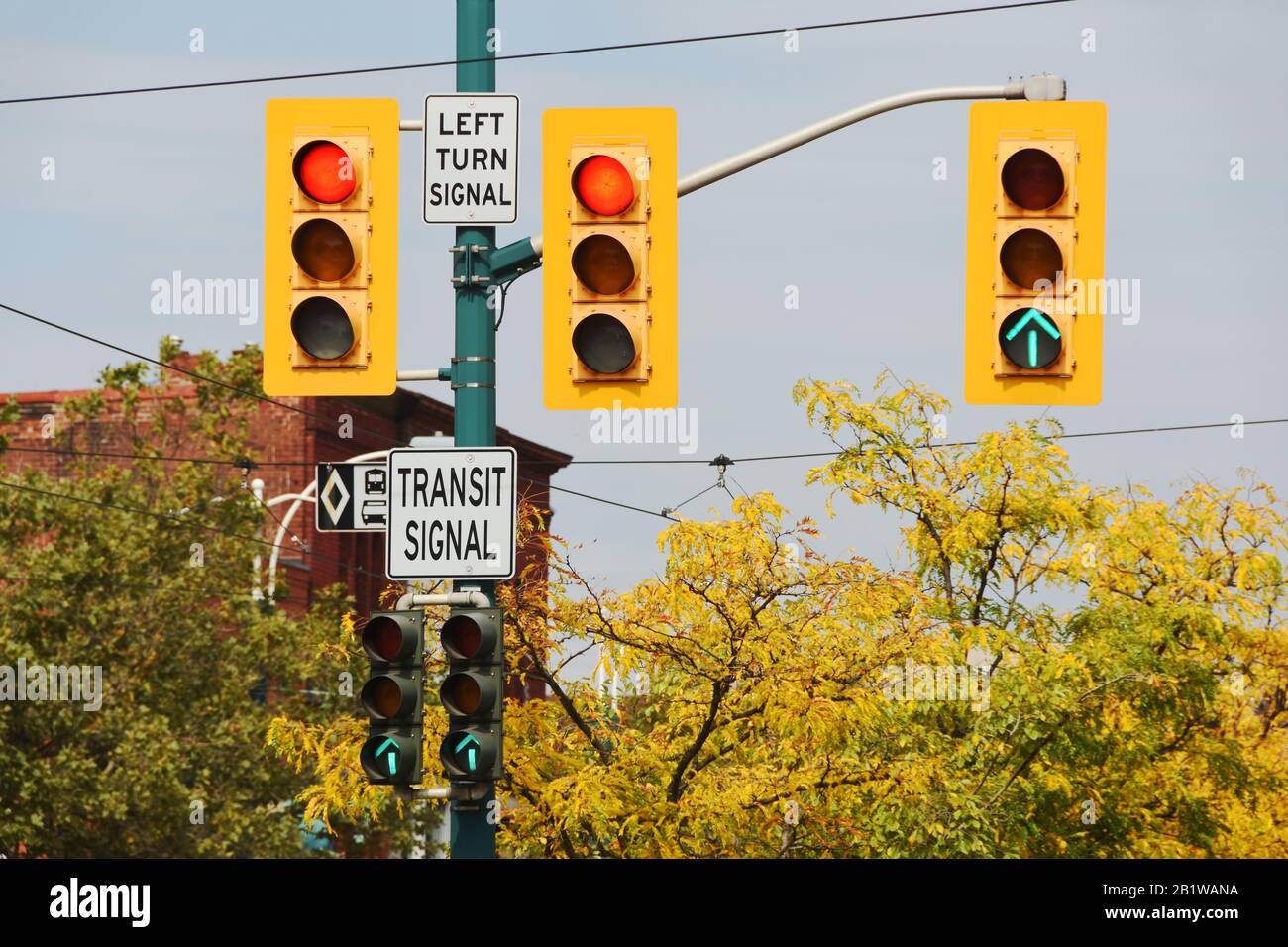
In Ontario, we have...
transit-signal-traffic-lights-toronto-canada-2B1WANA.jpg

Transit-Priority-Signal.png

Which can be messed, until we have more verbage clutter signs in all the languages in the world.

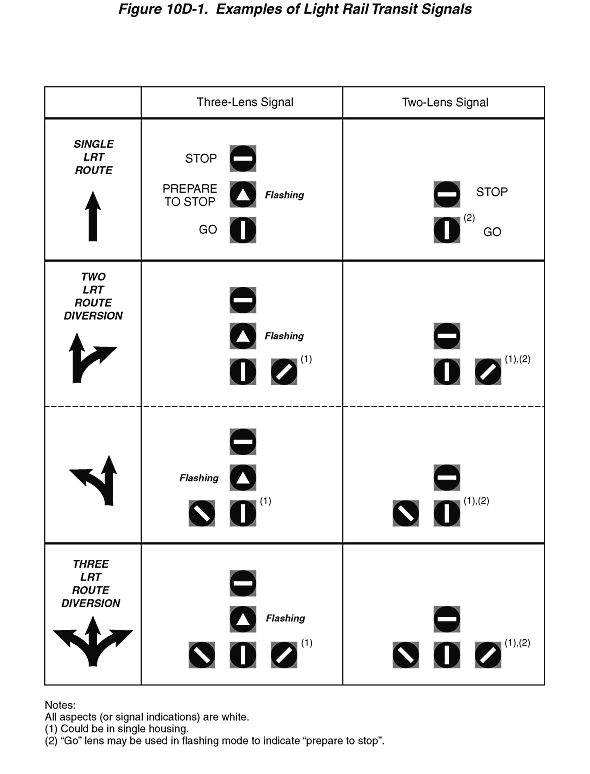
While the rest of world uses...
fig-10d-01.gif
Without verbage signage.
 
Far side traffic lights are definitely not the reason why motorists "don't see" light rail vehicles.

Source:


The user in question, from Prague, Czechia, has a playlist compiling all such videos.

https://www.youtube.com/playlist?list=PLsBLotWJdXk9iREFfqk9wl670RHTWdk94

The reason why motorists "can't see" them is because the average person in a car has no business operating a bike, never mind a motor vehicle. If there were standards for getting a license in this country, the roads would be safer and there would be no traffic congestion.
Czechia has a higher traffic-related mortality rate than does Canada: https://data.worldbank.org/indicator/SH.STA.TRAF.P5

Canadian provinces do have high standards for getting a licence, with Québec being one of the toughest jurisdictions in the world.
otoh Alberta is planning to pull away from graduated licensing however (because of course Alberta is), and I do think we need better enforcement of the rules.
 
If this is true, it definitely doesn't cover Ontario, where it feels like the only criteria that exists for having a license is being alive.
Have any of you driven in the GTA recently? The skill level of drivers is certainly not getting any better. Constantly hogging both lanes driving at the same speed preventing people from passing holding up traffic.

Not moving forward into the intersection when making a left turn.

Blocking lanes of traffic even though there is a left turn lane.

Blocking people from changing lanes by accelerating into their blind spot.

Not turning on an advanced green.

Blocking the bus lane or bike lane on purpose

I can keep going. This is why we need better transit.
 
If this is true, it definitely doesn't cover Ontario, where it feels like the only criteria that exists for having a license is being alive.
Ontario has a very similar system with heavy restrictions during the licensing process, but what we lack compared to Québec is the requirement to take a theory course before being allowed to write the learner's test.
My guess is that our traffic safety issues are exacerbated from lack of enforcement. Some jurisdictions such as the UK are also less lenient about reciprocal licensing than Ontario is. (You're less likely to need to retake a driving test here than in the UK if you got your licence elsewhere. Even US drivers licences are non-exchangeable there.)
 
Have any of you driven in the GTA recently? The skill level of drivers is certainly not getting any better. Constantly hogging both lanes driving at the same speed preventing people from passing holding up traffic.

Not moving forward into the intersection when making a left turn.

Blocking lanes of traffic even though there is a left turn lane.

Blocking people from changing lanes by accelerating into their blind spot.

Not turning on an advanced green.

Blocking the bus lane or bike lane on purpose

I can keep going. This is why we need better transit.
I'm aware of all of this. That is the exact premise of my post.

Ontario has a very similar system with heavy restrictions during the licensing process, but what we lack compared to Québec is the requirement to take a theory course before being allowed to write the learner's test.
My guess is that our traffic safety issues are exacerbated from lack of enforcement. Some jurisdictions such as the UK are also less lenient about reciprocal licensing than Ontario is. (You're less likely to need to retake a driving test here than in the UK if you got your licence elsewhere. Even US drivers licences are non-exchangeable there.)
I have trouble reconciling this with what I see on the roads every day. If there are so many heavy restrictions, why are there so many reckless and stupid people with driver's licenses? Surely it can't be just the threat of a fine or jail time that causes people to behave in other jurisdictions?
 
Last edited:
Ontario has a very similar system with heavy restrictions during the licensing process, but what we lack compared to Québec is the requirement to take a theory course before being allowed to write the learner's test.
Doesn't Ontario offer an incentive to take a course? I recall taking drivers ed to shorten the amount of time I spent between stages.
 
I have trouble reconciling this with what I see on the roads every day. If there are so many heavy restrictions, why are there so many reckless and stupid people with driver's licenses? Surely it can't be just the threat of a fine or jail time that causes people to behave in other jurisdictions?
I fully agree that infractions occur constantly across the GTA, and a lot of selfish behaviour is on display. But I also believe that enforcement is the key differentiator.
In Australia, fines are so high and enforcement so widespread, with speed and red light cameras plentiful throughout the country, in my experience living there for a few years people just drive at the speed limit to avoid i.e. a $1100 fine + demerits for going 30km/h over the speed limit.
 
Doesn't Ontario offer an incentive to take a course? I recall taking drivers ed to shorten the amount of time I spent between stages.
Yes, the incentive (but not requirement) to taking an accredited driving course offered in Ontario reduces the waiting period from 1 year down to 8 months before being allowed to take your first road test.

Québec does not incentivize this, as they simply don't allow you to write your learner's test until you pass a theory course, which is 12x2 hour lessons.
Then you need to take 15x1 hour driving lessons and wait a year before you can do your road test.
 

Back
Top