News   Dec 18, 2025
 277     1 
News   Dec 18, 2025
 307     0 
News   Dec 18, 2025
 286     0 

Toronto Eglinton Line 5 | ?m | ?s | Metrolinx | Arcadis

It would be interesting to know what has happened to commercial rents along Eglinton since the line was approved. Many of those traditional small businesses may have been doomed by changes in property value, rather than by the disruption on the street.

- Paul

The rents could only escalate with demand. There would be little demand knowing the construction was coming and has arrived. The rents will go substantially up upon completion and by that time very few small businesses will survive anyway although that could certainly be the nail in the coffin for many. The big pockets have likely already been hawking the space and will take over immediately. Capitalism at work for better or worse
 
Last edited:
I don't even think most Fortune 500 companies could meet that standard W. K. Lis ;) . As for street retail most are basket cases on a good day let alone resilient enough to survive a major disruption such as the construction of a transit line.
 
The rents could only escalate with demand. There would be little demand knowing the construction was coming and has arrived. The rents will go substantially up upon completion and by that time very few small businesses will survive anyway although that could certainly be the nail in the coffin for many. The big pockets have likely already been hawking the space and will take over immediately. Capitalism at work for better or worse

This is commercial property where leases are frequently 20+ years long with built in annual increases.

A landlord may prefer to have an empty shop for a couple years (or build in an automatic substantial jump) than to get locked in for 20 at a low rate. So yeah, if a lease is up for renewal, there is going to be some strong-arming by landlords even if the project is 5+ years from finishing. Opportunity cost of missing out on future demand driven price increases pretty much requires it.
 
Last edited:
I can't really see people using Crosstown to access businesses on Eglinton or make Eglinton a destination; they will just use it to get to University/Yonge lines faster.

That said, it should result in many new condos and residents, who will need nearby stores and amenities.
 
I can't really see people using Crosstown to access businesses on Eglinton or make Eglinton a destination; they will just use it to get to University/Yonge lines faster.

That said, it should result in many new condos and residents, who will need nearby stores and amenities.
Not right now doesn't mean it won't happen 20-30 years down the road. The city needs to ensure there is enough office and commercial use along the corridor and not allow residential towers only. The Eglinton West from Allen to Keele has high potentials for redevelopment.
 
Not right now doesn't mean it won't happen 20-30 years down the road. The city needs to ensure there is enough office and commercial use along the corridor and not allow residential towers only. The Eglinton West from Allen to Keele has high potentials for redevelopment.
but it seems all the city does is approve condos north of bloor, never mind even south of it
 
I don't even think most Fortune 500 companies could meet that standard W. K. Lis ;) . As for street retail most are basket cases on a good day let alone resilient enough to survive a major disruption such as the construction of a transit line.
most of the businesses are /were dives. I live near and only used that stretch to go eat or west along eglinton
 
but it seems all the city does is approve condos north of bloor, never mind even south of it
There isn't really a huge demand for more office towers right now. If the city stops approving condo, there will be nothing much going up. It took a long while for the Mars building to rent out all the units. Startups in TO can really occupy all new office towers if they continue to grow in number.

If we look at this map: http://urbantoronto.ca/news/2017/02/downtown-office-market-records-all-time-record-low-vacancy
There were only 3 office towers built downtown in 2016 compared to the many condo towers. It can take a while for office towers to pop up along Eglinton but if the corridor can attract them there. We'll probably see more of a mix development were the lowest 3 floors would be retail, the next 5 to 10 floors up be offices and the remaining be condos. I would like to see the city require more office spaces in new developments along the corridor. Once they screw up by building condos only, the corridor will never develop into an urban core. It would look like Sheppard with towers everywhere but no pedestrian walking around unlike North York Centre or Eglinton-Yonge were office towers exist.

The Sheppard line was terrible and I think the city understands that now. There is no growth in ridership while new towers keep popping up around Fairview. If they repeat Sheppard along Eglinton, we'll likely see the similar result. Maybe they'll able to keep the local businesses setting it ahead of Sheppard.
 
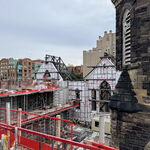
How long was it an open excavation as shown?
I notice that timber planking laid down in the foreground. Is that for construction use, or was it open to traffic?
From photos I have seen, the road was open until there was room under the timber beam for equipment to dig the earth. Once that was done, then traffic and streetcar ran on top of it until it had to be back fill for the new road and sidewalks to be built.
 
I can't really see people using Crosstown to access businesses on Eglinton or make Eglinton a destination; they will just use it to get to University/Yonge lines faster.

That said, it should result in many new condos and residents, who will need nearby stores and amenities.

Many say that Line 2 killed the vibrancy of Danforth Avenue when it opened in the 1960s. Former surface travel was moved underground and people could no longer see the offerings of Danforth as they were whisked past the neighbourhood underground. Apparently.

That said, most of Eglinton is fairly dead and suburban. Even the most urban parts of Eglinton (with the exception of a small stretch near Yonge) are lacking pedestrian street activity. I can't imagine Line 5 will make it any worse.
 
From photos I have seen, the road was open until there was room under the timber beam for equipment to dig the earth. Once that was done, then traffic and streetcar ran on top of it until it had to be back fill for the new road and sidewalks to be built.
Thanks,
The impression is given that Yonge was an open pit for 5 years.

I am still convinced that with precast concrete and high-early (HE) strength concrete (formerly Type 30), they could cut, lay down tunnel, and cover within a month. At the stations, they would have to do decking (similar to the photo above), but the excavation would be half the depth (or less) of the tunneled station and its construction would be done in less time than the current method. (Eglinton may be an exception, because if the road has steep grades, the cuts may become excessively deep).
 
Is there any kind of explainer on how the transit signaling priority in the grade portion of the LRT is going to be figured out?
 
Thanks,
The impression is given that Yonge was an open pit for 5 years.

I am still convinced that with precast concrete and high-early (HE) strength concrete (formerly Type 30), they could cut, lay down tunnel, and cover within a month. At the stations, they would have to do decking (similar to the photo above), but the excavation would be half the depth (or less) of the tunneled station and its construction would be done in less time than the current method. (Eglinton may be an exception, because if the road has steep grades, the cuts may become excessively deep).

That's basically what they did on Yonge at the time - replacing timbers for the concrete slabs - and what they have been doing at sites such as Sheppard-Yonge and Finch West stations more recently. And what they will be doing at most of the station sites on the Crosstown as well.

The problem is that you still need to have some access to the surface - the trucks need to be able to get in and out of the site somehow - so no matter what, there will be some reduction in lane capacity at the site for a long period of time.

Dan
Toronto, Ont.
 
I am still convinced that with precast concrete and high-early (HE) strength concrete (formerly Type 30), they could cut, lay down tunnel, and cover within a month. At the stations, they would have to do decking (similar to the photo above), but the excavation would be half the depth (or less) of the tunneled station and its construction would be done in less time than the current method. (Eglinton may be an exception, because if the road has steep grades, the cuts may become excessively deep).

A great idea for tunneling. You only cut half way down, deep enough to take the overhead off the TBM, so nothing collapses. Then you let the TBM run along, waist deep, boring out the bottom half. That way, your temporary retaining walls are only half as deep as traditional cut and cover. Probably, with the top of the TBM exposed, the tailings could be fed directly out the top instead of back down the tunnel. You run a conveyor back to where you need to cover, and dump the tailings there. It covers itself as it moves. You build out of prefab shell, just like a true TBM does.....no forms needed.

Of course, with the stations being voids, you still have to do them the same way, but the impact along the route is much less, and doesnt last long. You can do the tunnels. much closer to the surface, making stations cheaper.

- Paul
 
I am still convinced that with precast concrete and high-early (HE) strength concrete (formerly Type 30), they could cut, lay down tunnel, and cover within a month.

Remember, this work was done in the early 1950s. Concrete technology was much less advanced than now. I don't have precise timelines, but the timbers across the I-beams became the road surface while work went on below, section by section, not the entire length of the project. And that involved an incredible amount of work relocating (and rebuilding) infrastructure. So nothing was done in a mere month.
 

Back
Top