News   Mar 31, 2026
 1K     2 
News   Mar 31, 2026
 193     2 
News   Mar 31, 2026
 1.1K     0 

VIA Rail

Sure seems to me that there needs to be a higher power that takes charge for any delay where passengers are kept on train for over x hours. I feel the same way about airplanes held on the tarmac or out of gate. Passengers should not have to come equipped with enough living supplies to camp out.

This is what I'm thinking as well. At minimum there should be additional staff who can drop their regular duties and be called upon to assist the response teams when delays are expected to be over x hours. Perhaps the additional office staff could help out with tasks such as figuring out how to get food and water to the train.

Here's a comparable incident from last week in the Netherlands. A train had broken down in the countryside. The first response team drove with lights and sirens to the train to assess the situation and coordinate further response. They ordered bottles of water, to be brought by the second unit on site. They ordered a shuttle bus but there was no public road adjacent to the train so they evacuated passengers onto the railway and escorted them as they walked 15 minutes along the railway to the nearest roadway crossing where the bus could pick them up.
 
Last edited:
According to groups.io, 2300/2209 was the guilty party, and a pair of P42s bracketing a HEP car fetched it.

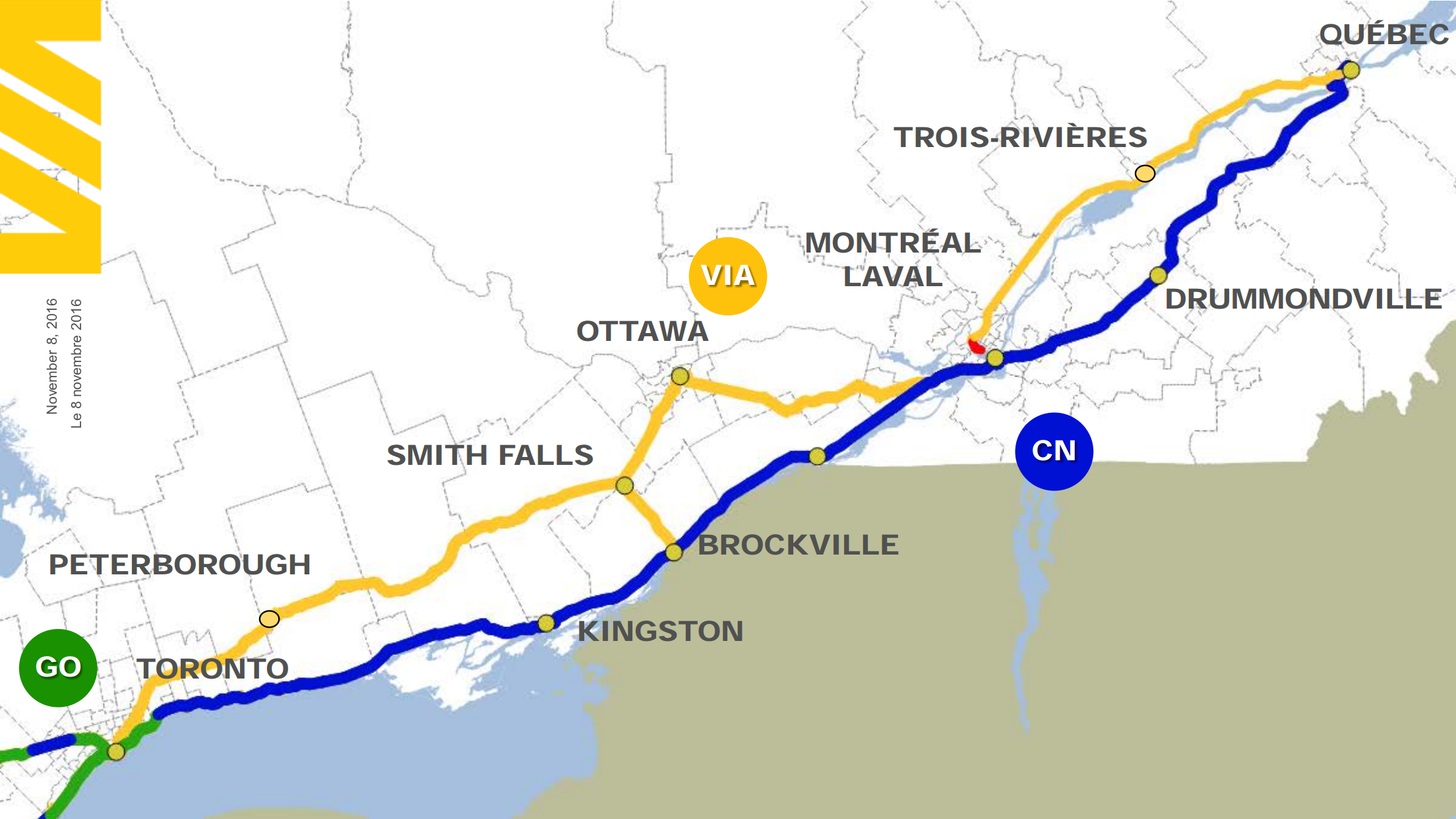
The question that occurs to me is - shouldn’t Montreal-Quebec City services be busy enough to justify some double track on the Drummondville Subdivision in the foreseeable future, and not merely a scattering of sidings? A rescue train (with sufficient capacity) could have cross decked those passengers off.

image.jpg
 
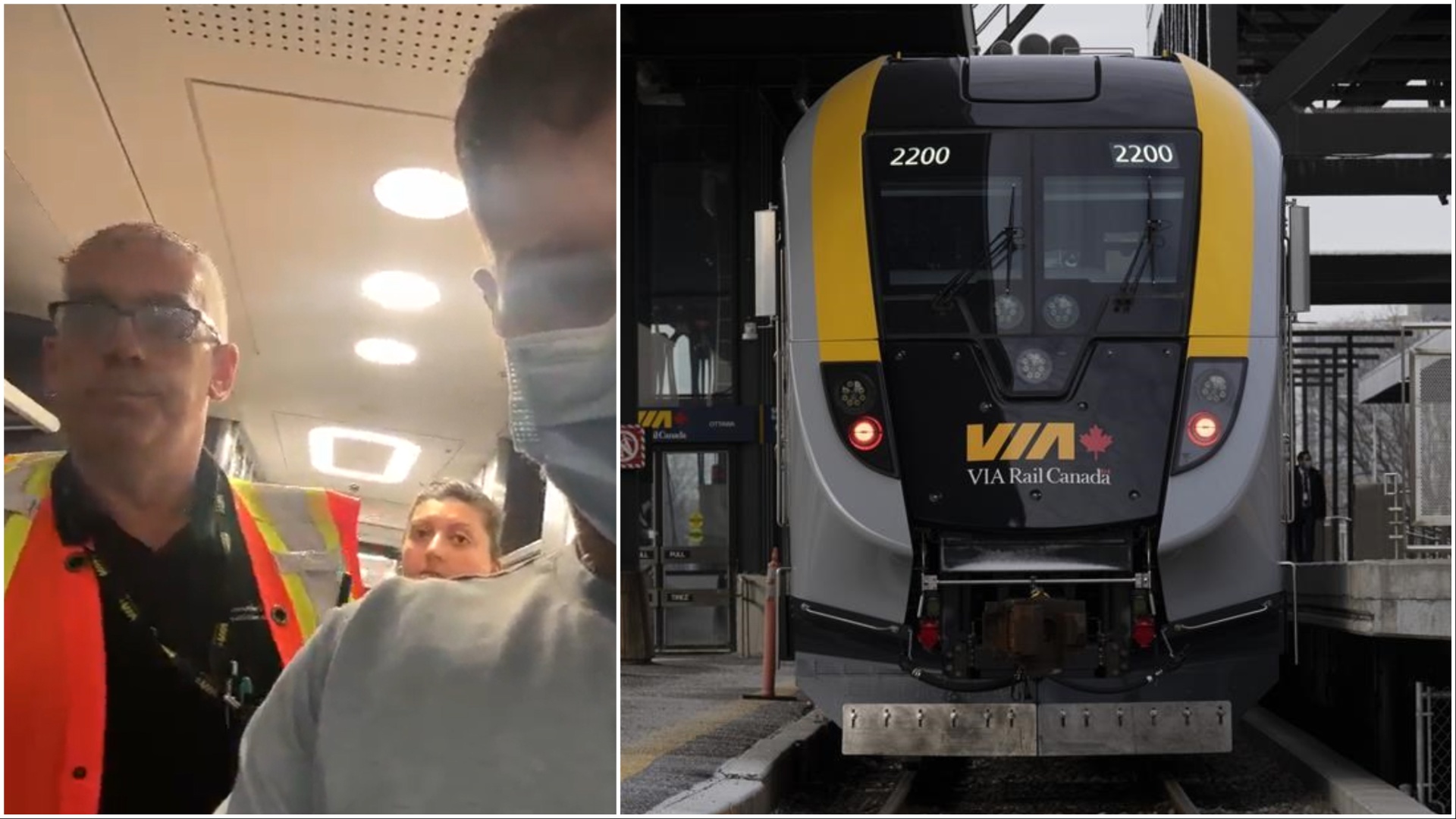
The incident is getting some media attention. Stressful situation for the crew and passengers.

 
I suspect it will get media attention mostly because of the report that a VIA staff member was physically assaulting passengers than because the train was late.
 
The question that occurs to me is - shouldn’t Montreal-Quebec City services be busy enough to justify some double track on the Drummondville Subdivision in the foreseeable future, and not merely a scattering of sidings? A rescue train (with sufficient capacity) could have cross decked those passengers off.

The number and spacing of controlled sidings is pretty reasonable, actually - in keeping with what VIA has on its own single track lines, and possibly more than a vanilla HFR proposal might require. . If more frequent trains were planned, one might look at extending some sidings to allow freight to clear more expeditiously.

Try guessing where double tracking might be needed for such a contingency..... if one added track for that purpose, one would have to double track much of the line.

The bigger question that a look at the timetable begs is..... what is the service plan for this line post HxR? My angst is that VIA might be reducing, not adding trains, and that might actually drive withdrawal of some sidings..

- Paul
 
The bigger question that a look at the timetable begs is..... what is the service plan for this line post HxR? My angst is that VIA might be reducing, not adding trains, and that might actually drive withdrawal of some sidings..

- Paul

My understanding is they would use the line north of the River.
 
This is what I'm thinking as well. At minimum there should be additional staff who can drop their regular duties and be called upon to assist the response teams when delays are expected to be over x hours. Perhaps the additional office staff could help out with tasks such as figuring out how to get food and water to the train.

When I was a planner at the TTC, the office staff were all trained for front line duty for the purpose of helping out with crowd control during the Pan Am games. My office was in North York Centre so during the van attack I walked to Sheppard-Yonge station to help with crowd control there, since trains were offloading thousands of confused customers who had intended to go to Finch.

Here's a comparable incident from last week in the Netherlands. A train had broken down in the countryside. The first response team drove with lights and sirens to the train to assess the situation and coordinate further response. They ordered bottles of water, to be brought by the second unit on site. They ordered a shuttle bus but there was no public road adjacent to the train so they evacuated passengers onto the railway and escorted them as they walked 15 minutes along the railway to the nearest roadway crossing where the bus could pick them up.
I’m not going to deny that the way in which VIA’s Operations Control Centre has responded to this incident appears to have been once again woefully inadequate, but VIA will always be at a structural disadvantage due to the fact that they never operate more than maybe 20 trains over a network which spreads six thousand kilometers from Halifax to Vancouver and Prince Rupert. That’s about the same number of moving trains as OC Transpo has to deal with on the Confederation Line, but spread over a surface area two orders of magnitude larger than the Netherlands.

Even worse, unlike transit operators like the TTC or Metrolinx, which operate sizeable bus networks on top of its rail networks, VIA only operates these trains and therefore can’t just redeploy bus dispatching staff to help out with its rail dispatching.

As for your example with the Netherlands, densely populated European countries can afford to space out Emergency Managers 100 km or less from each other, but if you did the same with VIA, they would end up being a signficant percentage of VIA’s workforce with less than one emergency to respond to per employee and year. It should also be noted that these “Emergency Managers” are usually deployed by the infrastructure manager (ProRail in the UK, DB InfraGo in Germany) and that absolutely makes sense, because even in Europe they couldn’t afford to duplicate such an expensive and lowly-utilized resource across multiple operators. However, even for CN and CP it might not make much economic sense to duplicate such emergency response (since their non-human cargo doesn’t usually need to be physically reached within only a few hours to avoid human harm) and with remote roadways facing similar issues, I would propose to create such capabilities at the federal level directly with emergency supplies and even helicopters placed at strategic locations.

I’m pretty sure I already said something very similar after a Christmas storm brought VIA’s Lakeshore services to a meltdown 2 or 3 years ago, but nobody can respond effectively and efficiently to such emergencies unless you bundle the transportation networks and areas to be overseen, as you need to justify having multiple employees available immediately and more on very short notice…

The bigger question that a look at the timetable begs is..... what is the service plan for this line post HxR? My angst is that VIA might be reducing, not adding trains, and that might actually drive withdrawal of some sidings..

- Paul
Whereas I still fail to understand your rationale for foreseeing a massive decline of Lakeshore services post-HxR, I do share your concerns about VIA service on the Drummondville subdivision. One just has to add up the reapective population figures to grasp how much the population centers served along the Lakeshore and Saint-Lawrence dwarf that of SHYA and DRMV…

 
Last edited:
The incident is getting some media attention. Stressful situation for the crew and passengers.

Heads should be rolling over this. Just saying.
 
Heads should be rolling over this. Just saying.
I suggest you might want to actually work in a customer-facing job where you might find yourself locked with hundreds of increasingly anxious and exasperated passengers into a confined space while their 3-hour trip and your 4-hour shift unexpectedly triples in length before you start volunteering your opinions about what kind of behaviors might be excusable given the circumstances and which ones aren’t…

Disclaimer: I have not watched the video footage, in respect of the privacy of everyone involved in such a stressful and extraordinarily uncomfortable situation.
 
Last edited:
I suggest you might want to actually work in a customer-facing job where you find yourself locked with hundreds of increasingly exasperated and anxious passengers into a confined space while their 3-hour trip and your 4-hour shift unexpectedly triples in length before you start volunteering your opinions about what kind of behaviors might be excusable given the circumstances and which ones aren’t…
These trains are new. Should we ignore that and be ok with the poor performance? These new sets are supposed to bring reliability back to Via.
 
I’m not going to deny that the way in which VIA’s Operations Control Centre has responded to this incident appears to have been once again woefully inadequate, but VIA will always be at a structural disadvantage due to the fact that they never operate more than maybe 20 trains over a network which spreads six thousand kilometers from Halifax to Vancouver and Prince Rupert. That’s about the same number of moving trains as OC Transpo has to deal with on the Confederation Line, but spread over a surface area two orders of magnitude larger than the Netherlands.

Even worse, unlike transit operators like the TTC or Metrolinx, which operate sizeable bus networks on top of its rail networks, VIA only operates these trains and therefore can’t just redeploy bus dispatching staff to help out with its rail dispatching.

As for your example with the Netherlands, densely populated European countries can afford to space out Emergency Managers 100 km or less from each other, but if you did the same with VIA, they would end up being a signficant percentage of VIA’s workforce with less than one emergency to respond to per employee and year. It should also be noted that these “Emergency Managers” are usually deployed by the infrastructure manager (ProRail in the UK, DB InfraGo in Germany) and that absolutely makes sense, because even in Europe they couldn’t afford to duplicate such an expensive and lowly-utilized resource across multiple operators. However, even for CN and CP it might not make much economic sense to duplicate such emergency response (since their non-human cargo doesn’t usually need to be physically reached within only a few hours to avoid human harm) and with remote roadways facing similar issues, I would propose to create such capabilities at the federal level directly with emergency supplies and even helicopters placed at strategic locations.

I’m pretty sure I already said something very similar after a Christmas storm brought VIA’s Lakeshore services to a meltdown 2 or 3 years ago, but nobody can respond effectively and efficiently to such emergencies unless you bundle the transportation networks and areas to be overseen, as you need to justify having multiple employees available immediately and more on very short notice…


Whereas I still fail to understand your rationale for foreseeing a massive decline of Lakeshore services post-HxR, I do share your concerns about VIA service on the Drummondville subdivision. One just has to add up the reapective population figures to grasp how much the population centers served along the Lakeshore and Saint-Lawrence dwarf that of SHYA and DRMV…
My brother used to drive for Trentway-Wagar and was dispatched to pick up stranded VIA passengers a number of times. None 'greenfield' that I recall. Certainly not expedient since people need to be called in then deadhead to the locations. Heck, at that time of day they could have scared up some school bus drivers or even an o/t shift or two from Drummondville Transit.

Back when the earth was still cooling and not much technology existed, every detachment of my former police service had an 'emergency services' binder listing all manner of local services along with contact persons/phone numbers, etc. which had to be updated or confirmed annually. It's not that hard.
 
My brother used to drive for Trentway-Wagar and was dispatched to pick up stranded VIA passengers a number of times. None 'greenfield' that I recall. Certainly not expedient since people need to be called in then deadhead to the locations. Heck, at that time of day they could have scared up some school bus drivers or even an o/t shift or two from Drummondville Transit.

Back when the earth was still cooling and not much technology existed, every detachment of my former police service had an 'emergency services' binder listing all manner of local services along with contact persons/phone numbers, etc. which had to be updated or confirmed annually. It's not that hard.
As presumably the only commenter in this thread who has actually seen VIA Rail’s Operations Control Center from the inside, I can assure you that they do have lists of bus operators together with their respective emergency contacts. However, every bus operator’s dispatcher will think three times before committing any buses and drivers whether the incremental income of this gig can possibly justify the opportunity cost if as a consequence that particular bus and/or driver will now be unavailable when responding to their own operational needs. Also, it is in the nature of their business that school bus operators won’t necessarily employ someone to remain reachable as an emergency contact on a Saturday.

As a general rule of thumb: if some dude on an internet forum can come up with a plausible and failry obvious idea, you can kind of assume that those professionals which are actually paid to make contingency plans have already come up with your idea and exhaustively investigated how practical it is…
 
Last edited:
As presumably the only commenter in this thread who has actually seen VIA Rail’s Operations Control Center from the inside, I can assure you that they do have lists of bus operators together with their respective emergency contacts. However, every bus operatirs will think three times whether the incremental income can possibly justify the opportunity cost if as a consequence that particular bus and/or driver will now be unavailable when responding to their own operational needs. Also, it is in the nature of their business that school bus operators won’t necessarily employ someone to act as an emergency contact on a Saturday.

As a general rule: if some dude on an internet forum can come up with an idea, you can kind of assume that those professionals which are actually paid to make contingency plans have already come up with your idea and exhaustively investigated how practical it is…
I wasn't being the good idea fairy bud; I was recounting my brother's experience. I don't doubt supervisors in the OCC have local services references, I'm just not sure they use them (or have the authority to). This is the second time in my meagre memory (Cobourg?) that VIA passengers have been unwitting players in a remake of the Lord of the Flies. Are they continually plagued with local transportation and food providers who refuse to respond to their requests? Seems odd. Heck, for the distances involved, they could have got a taxi or two to make shuttle runs to the nearest Tim's. The last time folks took refuge at a Tim's they made a play out of it.

VIA's certainly not alone in this regard with airlines leaving passengers stranded on aprons for hours at a time. It seems these days, when carriers are encountering problems to be solved, the passengers aren't one of them. Clearly, if this is the best the professionals can do, they need better ones. The alternative conclusion is this is an appropriate and acceptable response.
 

Back
Top