News   Apr 01, 2026
 50     0 
News   Apr 01, 2026
 261     0 
News   Apr 01, 2026
 455     1 

VIA Rail

If VIA is allowed to lift it's federal mask/vaccine mandate/requirement before the airlines, the airlines will be kicking and screaming.
The whole Federal Transportation COVID mitigation policy needs to be updated to reflect current realities. Airports, Railways, Cruse ships etc. all have an additional burden that very few to no other developed countries currently have.
 
The whole Federal Transportation COVID mitigation policy needs to be updated to reflect current realities. Airports, Railways, Cruse ships etc. all have an additional burden that very few to no other developed countries currently have.
Maybe instead of complaining about the mask/vaccine mandate, you should take advantage of the lower fares, shorter lines, and an empty seat next to you currently available before the crowds of students come back in September, and the people who dislike masks/vaccines come back when the mandate is lifted.

Book between May 31 and June 8 and use promo code VIA2022 for upto 40% off fares.

Edit: At Kitchner a station attendant checks vaccine certificates.
 
Last edited:
When people try to take the UK Tory's 1993 British Rail privatization as a warning for why not to privatize any VIA operations, it’s worth pointing out that per-capita rail ridership has grown faster since then than anywhere else in Europe:
01C88A18-A472-4346-B395-758FE12FE869.jpeg


Edit: interesting to see how fast some people delete their Tweets when they find their narrative soundly debunked…
 
Last edited:
When people try to take the UK Tory's 1993 British Rail privatization as a warning for why not to privatize any VIA operations, it’s worth pointing out that per-capita rail ridership has grown faster since then than anywhere else in Europe:
So we should look forward to post-privatization fare increases like in UK?
 
So we should look forward to post-privatization fare increases like in UK?
Contrary to popular belief, almost half of rail fares in the UK are set by a national regulator, including the two fare types which effectively set the maximum cost for one-off ("Anytime", i.e. fully flexible tickets) and frequent ("Season tickets", i.e. commuter passes) travelers:
Around 40 per cent of rail fares are 'regulated', including Season tickets on most commuter journeys, some Off-Peak return tickets on long distance journeys and Anytime tickets around major cities. The government uses July's Retail Prices Index (RPI) measure of inflation to determine the increase in the price of these fares.


To provide a random example (let's take the 13:35 and 13:55 departures), regulated fares allow you to travel in Standard (i.e. Economy) Class for £184.70 on a flexible ticket (valid on any train) and for £68.60 on a semi-flexible ticket (valid on any non-peak train), whereas unregulated fares allow you to travel on a closed ticket (valid only for the specified train) for £39.40:

1654262244177.png


The two two major (and highly inter-related) issues faced by the UK passenger rail sector (under-investment in infrastructure and high ticket prices) are the result of a miss-guided fiscal policy of austerity and have nothing to do with privatization itself...
 
Last edited:
Worth saying that the UK has 3 times the population density of southern Ontario and 5 times that of southern Quebec. Privatization is not a good idea because it's just not profitable in Canada. The only way a private company could make a profit carrying passengers here is if CN decided it was in that business again, and freight is way too profitable for that to happen.

AND, let's not forget that the UK government owns the infrastructure, which is the real problem here in Canada.
 
Worth saying that the UK has 3 times the population density of southern Ontario and 5 times that of southern Quebec. Privatization is not a good idea because it's just not profitable in Canada. The only way a private company could make a profit carrying passengers here is if CN decided it was in that business again, and freight is way too profitable for that to happen.

AND, let's not forget that the UK government owns the infrastructure, which is the real problem here in Canada.
I never claimed that the UK rail privatization model would work in Canada (it would require the nationalization of all passenger rail infrastructure, which is indeed a non-starter in Canada). My point was that the frequent claims by certain people that its results were "disastrous" are beyond ludicrous (just look at that 3tph all-day frequency for Manchester-London - with 296 km a longer corridor than QBEC-MTRL, MTRL-KGON, KGON-TRTO or TRTO-SARN)...
 
Last edited:
Worth saying that the UK has 3 times the population density of southern Ontario and 5 times that of southern Quebec. Privatization is not a good idea because it's just not profitable in Canada. The only way a private company could make a profit carrying passengers here is if CN decided it was in that business again, and freight is way too profitable for that to happen.

AND, let's not forget that the UK government owns the infrastructure, which is the real problem here in Canada.
I'm not a proponent of privatizing Via Rail, but not because of the density of southern Ontario. We need to stop being so dismissive of the population density in this part of the country. Southern Ontario is more densely populated than much of Europe, including France, Spain, Ireland, Austria, Greece, and most of Eastern Europe and Scandinavia.
 
Last edited:
Worth saying that the UK has 3 times the population density of southern Ontario and 5 times that of southern Quebec. Privatization is not a good idea because it's just not profitable in Canada. The only way a private company could make a profit carrying passengers here is if CN decided it was in that business again, and freight is way too profitable for that to happen.

AND, let's not forget that the UK government owns the infrastructure, which is the real problem here in Canada.
Here you’re stuck in the mentality that privatization means not regulated and subsidized by government to provide services of a certainty quality and a certain cost.

You could privatize via rail tomorrow, and 99% of people would have no idea it was done. None at all. Go Transit’s rail operations have been privatized for a long time. Do users know? Do they care?
 
Here you’re stuck in the mentality that privatization means not regulated and subsidized by government to provide services of a certainty quality and a certain cost.

You could privatize via rail tomorrow, and 99% of people would have no idea it was done. None at all. Go Transit’s rail operations have been privatized for a long time. Do users know? Do they care?
Exactly, the magic word is a "Public Service Obligation (PSO)":
In EU transport law, a PSO is an arrangement by which a governing body or other authority offers subsidies in an auction, whereby the winning company will be obliged to operate a specified service of public transport for a specified period of time in return for the subsidy. This usually leads to the winning bidder having a monopoly on the route, as competing services would not be viable without subsidies. PSOs are aimed at routes which are unprofitable in a free market, but where there is a socially desirable advantage to transport being available.

The use of PSO can be applied to many modes of transport, including air, sea, road or rail. In many cases, the introduction of PSO has been a way to privatize government-owned transport. Infrastructure is often separated from operations, and may be owned by a governing body or a third party. The authority may also maintain the ownership of the vehicles, such as ferries or rolling stock.

Traditionally, public transport has been operated by a company wholly-owned by the state with a monopoly, like a national railway company. Alternatively, private companies were granted privileges (with or without subsidies) granting them a monopoly. In recent years, many markets have been deregulated, especially in Europe, by paying the lowest bidding operator to carry out services.

 
I was obviously referring to full privatisation, which is what basically happened in the UK in the 90s, and what was talked about in this thread for the last few pages, i.e. dismantling Via. My comments should not be looked at any other way.

There's a difference between privatising operations and letting the private sector build capital-intensive infrastructure. The UK experiment shows how tough that can be for any private entity.
 
Last edited:
Contrary to popular belief, almost half of rail fares in the UK are set by a national regulator
Personally I thought 100% of the fares were still regulated. I hadn't realised it was that bad.

Regulation doesn't mean that fares don't significantly increase beyond the rate of inflation. Subsidies per journey have dropped since privatisation - and that's before considering the 60+% inflation in that time. Hydro prices are regulated here; in some provinces gasoline prices are regulated. That doesn't mean they don't go up based on market forces.

This article shows that fares are up well beyond the inflation rate - in may cases 3 times the rate of inflation for single tickets. Season tickets on Great Western routes seem particularly impacted. The only major exception seems to be trains to Shoeburyness. I've never heard of Shoeburyness.


I was obviously referring to full privatisation, which is what basically happened in the UK in the 90s, and what was talked about in this thread for the last few pages, i.e. dismantling Via.</quote>

The operation of the passenger trains was fully privatized in the UK, but the infrastructure and tracks are now owned by the government. This isn't terribly different on how GO operates, other than the branding.

UK tried this and at the same time privatizing the infrastructure to a different company. That was such a disaster than they renationalized the infrastructure!

UK literally tried what we are looking at here - and it failed. (though some of VIAs service will be on their own infrastructure).
 
Personally I thought 100% of the fares were still regulated. I hadn't realised it was that bad.
Regulated fares are available for 100% of rail journeys in the UK. Nobody forces any passenger to purchase an unregulated fare, if they don't want to forgo the flexibility "Anytime" or "Off-Peak" tickets offer...

Regulation doesn't mean that fares don't significantly increase beyond the rate of inflation. Subsidies per journey have dropped since privatisation - and that's before considering the 60+% inflation in that time. Hydro prices are regulated here; in some provinces gasoline prices are regulated. That doesn't mean they don't go up based on market forces.
Regulation means that the government sets the limits to how much rail operators can charge for any given journey, but neither it nor privatization absolves the government from providing the necessary capital funding to expand the rail infrastructure for busy corridors and the operating funding required to serve desirable, but economically unattractive corridors...
 
Regulated fares are available for 100% of rail journeys in the UK. Nobody forces any passenger to purchase an unregulated fare, if they don't want to forgo the flexibility "Anytime" or "Off-Peak" tickets offer...
And yet far less than 100% of the rail journeys use regulated fares. :)

Looking at London to Glasgow a week from today, the only unregulated fare I see is about 5 AM! Clearly they limit regulated fares.\

That's not really my point. The article I linked was for regulated fares - not unregulated fares! If we compare to current unregulated fares, there must be some 500% increases - except to Walmington-on-Sea; or was that cancelled?
 
And yet far less than 100% of the rail journeys use regulated fares. :)
Because they are cheaper than regulated fares (otherwise nobody would buy them, as they offer less flexibility)! Didn't you just complain that regulated fares are too expensive?

Looking at London to Glasgow a week from today, the only unregulated fare I see is about 5 AM! Clearly they limit regulated fares.
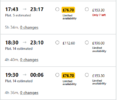
It is a well-known fact that Fridays are the busiest days of the week, but I see five trains which still offer "Advance" tickets for London-to-Glasgow:
1654305455050.png
1654305470054.png
1654305498100.png
1654305510422.png


Travel a day earlier and "Advance" tickets are still available for every single hour between 09:30 and 18:30:
1654305251681.png
1654305205211.png
1654305306415.png
1654305336845.png


That's not really my point. The article I linked was for regulated fares - not unregulated fares! If we compare to current unregulated fares, there must be some 500% increases - except to Walmington-on-Sea; or was that cancelled?
It is almost impossible to do any meaningful comparisons with unregulated fares, as their price levels and the distribution of available/sold tickets at each price bucket are only known by the operator itself, so what exactly is your point...?
 

Attachments

  • 1654305176621.png
    1654305176621.png
    21.3 KB · Views: 150

Back
Top