



Urban Sky
Senior Member
(continuation of my previous post, which originally started here)
I'll again start by revisiting some previous points to comment on some of your replies:
#6 About VIA's mandate
Repost (with red box added) from previous post
Therefore, adding more trains might not be in order, but more about that in point #9 further below.
#7 About finding viable intercity corridors outside the Quebec-Windsor Corridor
***
Now to some new points:
#9 About expanding transcontinental VIA services
For those of you without a CN/CP timetable archive on their HDD, "The Dominion" was CP's flagship Montreal/Toronto-Vancouver train until the introduction of "The Canadian" in 1955 (which operates until this day under the same name and fleet, but on the route of the former "Super Continental") and continued operating as a more basic alternative to The Canadian with more stops and thus slower travel times until 1966 (shown below is the October 1965 timetable):


Yes, sure, but the only things missing are the fleet, mandate, market and funding:
#10 About jumping from CP to CN between Woodstock and London
(I again reached the 10,000 character limit, so to be continued a different day)
I'll again start by revisiting some previous points to comment on some of your replies:
#6 About VIA's mandate
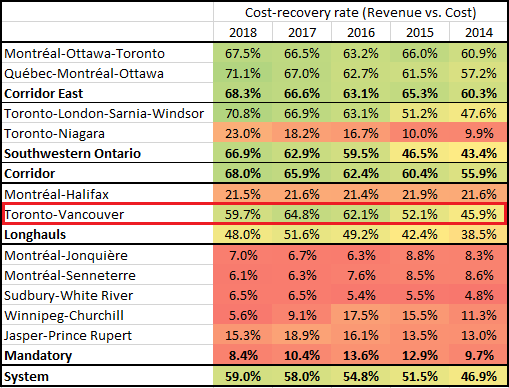
The only thing which surprises me here is that you make this claim less than 24 hours after I've posted a table which clearly shows that you should have listened to your intuition, as the Canadian lost in 2018 (latest annual data available) $0.68 for every $1 in revenues, which is virtually identical to the losses it incurred on its entire network and one-third higher than the $0.47 it lost for every $1 in revenues on the Corridor:What surprised me was that the Canadian is not in the red. So, maybe adding more trains per week is in order.
Repost (with red box added) from previous post
Therefore, adding more trains might not be in order, but more about that in point #9 further below.
#7 About finding viable intercity corridors outside the Quebec-Windsor Corridor
Glad to hear!I want to be clear that I greatly appreciate the thoughtful detail in your posts.
Congratulations, virtually every newspaper article which reports about the newest Maglev or Hyperloop route which is "under construction" or "will open in 3 years from now" fails to understand this distinction!I am willing to consider the speed rail should be capable of (non HSR, just conventional rolling stock); understanding that peak-speed is certainly not average speed.
No, there is nothing wrong: these are just rail corridors which were built entirely around a business model in which Canadian Pacific would operate recruiting offices in Europe to attract settlers-to-be, which would then travel as third-class passengers on its steamships and as "Colonist" class travellers on its railways, before getting sold a lot of CP-owned land to which CP would ship all necessary supplies and from which it would ship the produce of said land. As you can see, speed was an absolutely secondary consideration when surveying potential alignments and choosing a circuitous did not only maximise the subsidies paid by the government (as a fixed-sum per mile), but also the land granted by the government around any new tracks laid. Fast forward 150 years and a freight railroad may not feel tempted to upgrade its tracks to track class 4 (which would allow 80 mph or 129 km/h for passenger trains), if it deems track class 3 (which limits passenger trains to 60 mph or 96 km/h) to be sufficient for the volume (and time-sensitivity) of the freight it transports.When I see a 700km trip showing a time worse than car travel, I'm persuaded something is wrong.
One doesn't require complete grade separation to hit peak-speeds of 177km/ph or even, subject to equipment and regulatory approvals, 200km/ph.
Why should a trip of that length average 100km/ph or less?
You see, you identified most of these reasons yourself, but fixing it will cost a lot of money and I don't see that the Canadian taxpayer would get a particularly bad deal with the current arrangement: Whereas taxpayers in Europe pay substantial subsidies for a network which transports passengers much more efficiently than goods, Canada gets the opposite (a network which transports goods much more efficiently than passengers - and also: than goods in Europe) for close to no cost. This sucks from a passenger's perspective, but you don't get less than what you paid for...There are obvious answers, delays/conflicts; too many stops, other speed restrictions (turning radii, track switch speeds etc.). or the limitations of current equipment.
Whatever the case, it is addressable.
You may have your own preferences, but the consensus for infrastructure projects in democratic-capitalist countries is that the costs and benefits of any project are assessed as increments over the status quo and that does not black out the infrastructure which already exists. I believe Greg Gormick has a point when he keeps quoting a former CP CEO lamenting that the completion of the Trans-Canada Highway turned the launch of "The Canadian" in April 1955 (and its luxurious stainless steel fleet which serves VIA's name-sake reliably until this day) into the most costly mistake in its corporate history and prompted CP to pursue its total exit out of the passenger business. Nevertheless, if the Trans-Canada Highway continues to pose a barrier to make passenger rail viable (again), then this is a fact we need to accept sooner or later...That does not mean everyone's railway-geek train list should come to fruition.
But it does mean routes shouldn't be dismissed out of hand, when their running conditions are seemingly, needlessly sub-optimal.
Certain routes (Say Edmonton-Calgary) as an example, deserve a fresh-look, with an open mind. Separate the one-time costs from the on-going costs and ask how much would it cost to raise average train speed by 40km/ph?
I'm being entirely arbitrary in that suggestion; and not pre-supposing a positive outcome.
But I don't see it as useful to compare rail running in sub-obtimal conditions with cars whose highways have been subsidized to ensure optimal speed operation.
***
Now to some new points:
#9 About expanding transcontinental VIA services
For those of you without a CN/CP timetable archive on their HDD, "The Dominion" was CP's flagship Montreal/Toronto-Vancouver train until the introduction of "The Canadian" in 1955 (which operates until this day under the same name and fleet, but on the route of the former "Super Continental") and continued operating as a more basic alternative to The Canadian with more stops and thus slower travel times until 1966 (shown below is the October 1965 timetable):
I would argue that Trudeau might do the reverse. He needs to pander to the ones that didn't vote for him so that he can go to the next election and say "See, I ddid things for you". This is the best time for western expansion of VIA. Something akin to The Dominion could return. If done right, they could alternate it and the Canadian such that every day, a train goes across the Prairies between Vancouver and Toronto.
Yes, sure, but the only things missing are the fleet, mandate, market and funding:
- Fleet: from Skylines over Diners to (Prestige) Park cars, there are unfortunately only enough cars to form four identical trainsets (which is only sufficient to operate 3 departures per week) and even if you would accept having on-board amenities which vary greatly from one departure to the next, you would simply spread the same (finite and constrained) number of coaches and sleepers over more trainsets...
- Mandate: given that the mandates touched by this train (transcontinental service and the regional service between Sudbury and White River) are already covered adequately by existing VIA services, I don't see how such a service expansion could be justified to Transport Canada and the federal taxpayers...
- Market: Given that the current state of the infrastructure (let alone: freight traffic volumes) don't allow for a travel time (let alone: punctuality) which would make it competitive against the car (nor an inter-provincial bus service, which could be reinstated by the federal and provincial governments at rather short notice), I don't see any market which would be adequately served by the service you described above...
- Funding: Without a mandate or obvious market which this service would serve, why would any federal government commit the necessary operational funding to operate such a service?
#10 About jumping from CP to CN between Woodstock and London
I actually looked at this question in one of my very first posts in this forum and my conclusion was that choosing the CP (Galt Sub) alignment between Woodstock and London over the CN (Dundas Sub) alignment would save an estimated 2:23 minutes with a design speed of 200 km/h, but only 11 seconds with a design speed of 160 km/h. We can of course start debating whether 143 seconds is enough of a time saving to build tracks between the Dundas and Galt Subs and then following the latter, but as I've argued in said post over 5 years ago, the distribution of population and the presence of transcontinental freight traffic favours the northern mainline (via Kitchener) over the Southern mainline (via Woodstock and Aldershot), so please feel free to refer to the detailed tables, figures and descriptions which I posted back then...What sort of speed does VIA do between Woodstock and London? Have been wondering what sort of time saving could be achieved if VIA was able to do 110-125 over a track parallel to the very straight CPR alignment, with access to the current station via a curve to CN Thorndale (the VIA route to Stratford/Kitchener) and a similar track leaving Woodstock to join the CP ROW
(assuming CP agreeable of course)
(I again reached the 10,000 character limit, so to be continued a different day)
Last edited:


