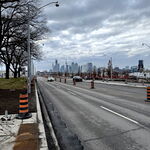
I made an edit earlier "[...]Dwell times are often longer and less consistent than metros due to bottlenecked boarding and alighting inherent in tram design."
We're not saying bunching occurs because someone fell asleep at the wheel and decided to idle at one stop for 4 minutes. We're saying bunching occurs due to cascading, compounding delays. For example, a driver that is just 1 minute slower at the halfway point, a green light that is missed by a few seconds leading to a 60 second red light, a handicapped passenger taking longer to board, a rowdy passenger refusing to pay their fare, a call from dispatch to hold 30 seconds longer at one stop, higher passenger traffic at one stop etc... etc...
In theory, the 510 Spadina shouldn't bunch with 7'45" headways on Saturday afternoons, but literally every time I'm on it at that time I see bunching. 506 Carlton had 9 minute headways today, and yet I could see two 506s within metres of each other going westbound near Yonge:
Longer headways only help prevent bunching in the same manner that excess schedule padding prevents bunching (see TTC schedules 24/7 365). It doesn't solve the underlying deficiencies inherent in design. Here's proof of Line 6 Finch West bunching, the train behind going eastbound is only 6 masts west of another train arriving at the Driftwood eastbound stop, or about 150 metres away:
How many times does it need to be explained on this forum that bunching will not occur on the surface section? Do you guys think the subway runs at uniform speeds all along its routes, or something?
When responding to this, I and many others took this to mean
"bunching will not occur on the surface section" period. It wasn't clear you were aware of any ways bunching could occur on a
regular basis.
Again, if someone can explain to me what is so special about the transition point on line 5 that it will cause bunching, but it doesn't happen at Bloor-Yonge or Eglinton West, I'm all ears.
Of course there being a transition from underground to surface in itself is not going to cause bunching. There being a manually operated surface section though,
will cause bunching. A subtle difference, but as
@nfitz said, it doesn't make much difference at the end of the day. How many people actually believe it's the transition from underground to surface that will cause bunching and not merely the surface section itself? There will be bunching.
@T3G I think you've misinterpreted at least some of us. When you hear hooves think horses not zebras. I'm not sure many are claiming the mathematically impossible here. I'm pretty sure they are claiming the inherent deficiencies of a surface ROW will lead to bunching, not the difference in average speeds between tunnel and surface. Maybe some others worded their posts ambiguously, sure. But the way you have replied to posts (Paris T9 etc.) it does seem like you were claiming surface tram lines
should not have bunching in general:
I mean, sure, you might get the odd slowpoke driver, but that's not going to be an appreciable factor. If it was going to be, we would have seen this on any other line with manual operations. Both subway lines, pre-ATC, were also operated manually, with varying station dwell times, segments with faster and slower top speeds, and drivers who had different driving styles, but it wasn't a common thing to see bunching anywhere - even at entrances to slow zones - except at the terminal stations, which were/are incapable of turning trains around as efficiently as the line frequencies call for.
As for delays at traffic lights for slightly different durations, sure, not every car is going to be delayed for exactly the same amount of time, but this applies to all cars and at all intersections. If one car gets held for a minute at Victoria Park and the next one for 30 seconds, they then might be held for 30 seconds and 1 minute respectively at Victoria Park, or any other number of different light/dwell time combos. It should all average out.
I believe you, but there's no reason this should be happening with a top frequency of 6 minutes - and especially not when there is no underground portion with higher top speeds, as has been commonly feared on here. I can only assume that either what you saw was residual delays from a service disruption, or another halfwitted operating procedure. That could easily be the case, on opening day I would have trains that serviced some of the stations for a full 1-2 minutes, for whatever reason. There's nothing in the physical design of either line that should cause this, at all.
From this post, it appears you're not aware of many contributing factors to bunching, and how frequently bunching happens on transit systems in general. Because the signal interaction duration variability often doesn't 'average out', that's why bunching can occur on Line 6, even with 12 minute headways.
This post as well:
For a surface tram, even one with strong TSP by the likes of Paris T9, bunching is still a real possibility. Dwell times are often longer and less consistent than metros due to bottlenecked boarding and alighting inherent in tram design.
Sorry, but isn't the top frequency of the Paris T9 4 minutes? While dwell times on trams are slower than metros, I have never been on a tram anywhere (except in Toronto downtown) where we've been stuck in one spot anywhere close to 4 minutes. Even on the busiest lines in Europe, it never took more than 30-40 seconds for all the boarding to be completed. I can't see how idling at one stop for 4 minutes would be anywhere close to a regular occurrence.
Dwell time variability is just
one of many contributors to bunching. It's not one excess dwell at one station that causes bunching, it's a confluence of small, cumulative deviations in dwell time, acceleration, signal interaction etc., as
@lastcommodore explains:
Theoretically over a long enough time, each LRV will hit the same number of reds and greens. However bunching occurs at a much smaller timeframe, thus it is totally possible for a single LRV to hit several unlucky red lights which now causes bunching. Effectively, bunching is caused by chance, and thus to reduce bunching you must reduce the variations of chance.
There is no reason to assume this will be a regular occurrence, though.
There are
countless reasons to know bunching will almost certainly be a regular occurrence. Seriously, have you ever been on a streetcar in Toronto besides the occasional visit downtown? Been on Line 6 besides day 1?
I didn't observe much by way of bunching on day 1 - if anything, the opposite problem existed, with the headways being stretched out far more than they should have been.
Ok, pack it up everyone.
@T3G didn't see bunching on day 1. Bunching has been solved. Case closed
 In all seriousness: for the headways to be stretched out on day 1, logically bunching would occur the moment they resumed regularly scheduled departures at the terminus, which is likely exactly what happened. There was a lot of bunching observed on day 1.
Hell, if this was remotely a reasonable concern, how come the 900 bus doesn't see bunching southbound at the 427 at Dundas, when they all slow way down? If Urban Toronto science applied here, you'd have the entire stock of the line running together in one big pack.
@T3G , there is
lots of bunching on a daily basis on surface bus routes in Toronto, including the 900. Virtually every time I touch a bus there is bunching. It's the degree of severity that is up for debate: are buses 5 minutes apart considered bunching for a route with 15 minute headways? Are 3 minute headways instead of the scheduled 10 minute headway considered bunching? When it's somewhere between two buses literally back-to-back and two buses exactly as scheduled it becomes very subjective.