
News   Dec 05, 2025
 268     0 
News   Dec 05, 2025
 1.3K     2 
News   Dec 05, 2025
 342     0 

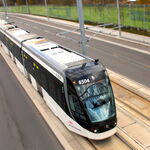
Toronto Eglinton Line 5 | ?m | ?s | Metrolinx | Arcadis

The QQ has been around shortly after 1919 when the road was built after the lake was fill in for commerical use and slips for ships with the QQ termilal been built in 1926 as a cold storage.

The two photos where shot from different locations with the 2nd one west of Bay and the 1st just west of Yonge.
 
I'm not aware of any such thing, either. I would assume the photo description was mislabeled.
A great many streets in Toronto had their names changed in the 20th century, and often the old name is now the name of another street nearby. Lakeshore Boulevard used to be the name of whatever street was closest to the lake, whether it was a main street or a small residential road, as long as they were all connected.
 
The two photos where shot from different locations with the 2nd one west of Bay and the 1st just west of Yonge.
They're in roughly the same spot, though the first photo is a couple of dozen feet west of Bay. The field of view is different. You can literally see the sign for Bay Street in the first photo on the left hand side.
 
Very cool!

So in the original picture it called it Lakeshore not Queens Quay. I was confused by that. Did they change the name at some point?
There was a Lakeshore Road that was displaced by the Gardiner in this area. There were also a lot of interim road configurations during the construction of the Gardiner in this area and something might have been renamed Lakeshore Road as a convenience at that time, but sometimes things stick around in people's memories a long time after they are officially changed (have you been to the SkyDome, lately?), also signage can stick around forever, like how there was that speed limit sign in M/PH on Disco Road until around 2008.

Anyway, I recall those tracks were still there until at least 2005, some paved over, some not, some paved over but the pavement worn away.

If you want another nearby example of this to lookup there was Ferguson Avenue in Hamilton and Hatt Street in Dundas, both of which I think were active until the early 1990's.

1760471140414.jpeg
 
Last edited:
A great many streets in Toronto had their names changed in the 20th century, and often the old name is now the name of another street nearby. Lakeshore Boulevard used to be the name of whatever street was closest to the lake, whether it was a main street or a small residential road, as long as they were all connected.
I know that streets get renamed, but I have not been able to find anything to suggest Queens Quay was ever called anything but that.
 
I loaded the picture into ChatGPT and got completely wrong information, but said with such authority and conviction. Hahaha.

That’s Toronto in the 1970s, and the train is running right down Bathurst Street, on what was known as the CP Galt Subdivision “Harbour Lead” or Toronto waterfront industrial spur.
  • Location: Bathurst Street, just south of Front Street West.
  • Direction: The train is heading south toward the waterfront, likely switching industries or warehouses west of Spadina Quay.
  • Locomotive: Canadian Pacific switcher #6584, a GMD SW1200RS, which worked local freight in downtown Toronto during that era.
  • Background landmarks: You can see the Toronto Star building (grey façade) near the left background, confirming this is near the base of Bathurst Street leading to Lakeshore and Queen’s Quay.

WRONG!
 
forgive my ignorance, but how do you build tall buildings on lake infill sites, I thought the fittings had to hit bedrock
 
forgive my ignorance, but how do you build tall buildings on lake infill sites, I thought the fittings had to hit bedrock

No worries. You learn by asking!

1) You don't have to build to bedrock strictly speaking, but for a tall building, most do. You do require a stable soil base.

2) Depth to bedrock varies across the City, but averages a bit over 30M below grade (something in the range of 10-12 storeys deep.

3) Bedrock is shallower near the Lake. (So closer to the surface).

4) The average depth of Lakefill isn't all that deep, in the range of 10-12M. Bedrock is generally located very close to the depth of the fill.

So in many cases even w/the fill, you have less than average depth to bedrock in the Lakefill areas.
 
With all the discussion about Queens Quay's freight trains, I can't believe that no one used the railway term for it, "street running". Any place where it still happens today is like a mecca for railfans.
Is there any freight street running in Canada?
 
I know that streets get renamed, but I have not been able to find anything to suggest Queens Quay was ever called anything but that.
Consider this: As already stated (and can be verified at Wikipedia), the road was built on or after 1919. It's extremely unlikely they would have named it after Queen Victoria 2 decades after her death. If it had been named for the monarch of the time, it would have been called King's Quay. It must have been named for Elizabeth II in the 1950s or later.

Many streets in Toronto changed their name in the 20th century. Usually the old name is no longer referenced, to avoid confusion. You can find old names on old maps, but it's rare to see them elsewhere, unless there's an interesting story behind the change.
 
Is there any freight street running in Canada?
When I was a kid in Toronto, trains ran on the streets all the time in a nearby factory area. When our family drove out to do grocery shopping, we often had to wait for street trains to pass. I live in a different neighbourhood now, but there is a warehouse area nearby, and old tracks can be seen everywhere. In the 25 years I've lived here, most of the tracks have been removed, along with train crossing signs and other old markers. I found it interesting enough to take photos of tracks when I first moved here, and used Google Maps to map out where all the rails went, so I have something to compare to the present. Trains on streets can be dangerous and noisy - as a kid, I'd hear them all night - and few active lines remain, if any.

Here is a map I made, and just a couple of photos as an example. On the map, red lines are active right of way rail lines, green lines are inactive street rails, numbers show places where I took photos. The 2 photos shown are at location points 5 and 9. This is southwest of Eglinton and Don Mills.
map2.jpg

IMG_0718.JPG

IMG_0726.JPG
 

Back
Top