




jordanmkasla2009
Active Member
Personally I'm biased towards the signals used by ION in Waterloo Region. No need for a "Transit Signal" sign with these...
Proceed
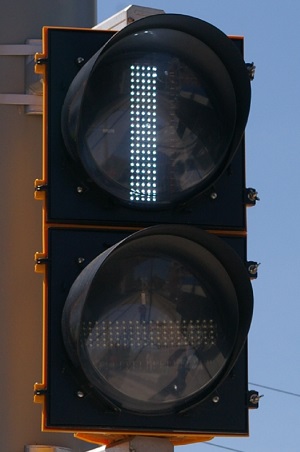
Stop
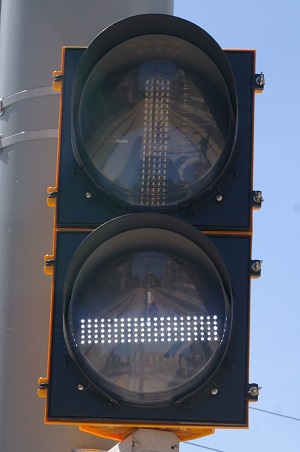
Proceed
Stop
|
|
|
Monarch is referring to the fact that Ontario doesn't allow the use of european style transit signals, which are shape based and cannot at all be confused with automobile signals. Instead the MTO thinks that standard (ok they are black) signal heads with a nearby "transit signal" sign work well enough that they don't even allow you the choice.

Personally I'm biased towards the signals used by ION in Waterloo Region. No need for a "Transit Signal" sign with these...
Proceed
Stop

They used them under some sort of exception as a trial, the details of which I am not familiar with. It was then not adopted into the standard MTO OTM on lights and signage, which is why Metrolinx or TTC have not used them on any of their projects.Ontario has allowed for other signals to be used for transit. KW has a completely different signal for their LRT so its certainly possible to get a different signal design in use. It's impossible to confuse KWs signal for a traffic light.
Have you seen the vast majority of ontario drivers? Driver knowledge and skill level is a known and relatively static data point, we could sit around and complain about it... or we could implement a known, proven, well used solution.Call me odd, but if you cannot figure out which traffic signal is for your lane, you should not have a drivers license.
In some jurisdictions, they position the traffic signals OVER the traffic lane they allegedly control.Call me odd, but if you cannot figure out which traffic signal is for your lane, you should not have a drivers license.
Drove to New York last month and Rochester was full of these. While it may make directions easier, it's a lot of visual clutter. The city looks like junk with all the hanging wires and long poles.In some jurisdictions, they position the traffic signals OVER the traffic lane they allegedly control.
It means having a very long arm over the roadway, however.View attachment 673796
Drove to New York last month and Rochester was full of these. While it may make directions easier, it's a lot of visual clutter. The city looks like junk with all the hanging wires and long poles.
I do not mean over the lane.I mean if you look at the lights and cannot figure out which ones to follow,you should not be driving. I have driven in most provinces and a good number of states, and even biked in other countries. Not hard to know which lights I need to follow. For example, if I am not a transit operator, I should not be following the 'transit' signals..I have always thought once your license comes up for renewal, all drivers must do a written and road test. It may weed out the really bad ones so that stupid accidents stop happening.In some jurisdictions, they position the traffic signals OVER the traffic lane they allegedly control.
It means having a very long arm over the roadway, however.View attachment 673796
For starters, how many of those other provinces and states have transit signals that have a red, yellow and green light just like the vehicle signals? Because they all seem to set up their lights quite differently from Ontario. For all I know, the lights for the Edmonton LRT don't use circular red or yellow lights either.I do not mean over the lane.I mean if you look at the lights and cannot figure out which ones to follow,you should not be driving. I have driven in most provinces and a good number of states, and even biked in other countries. Not hard to know which lights I need to follow. For example, if I am not a transit operator, I should not be following the 'transit' signals..I have always thought once your license comes up for renewal, all drivers must do a written and road test. It may weed out the really bad ones so that stupid accidents stop happening.

If you move from the current Flexity fleet to a 35-42m LRV, you have an old MU car from the past. The current fleet is not that far off from the days of 2 PPC that were mu together with one driver doing all the work will the other collected fares and issue transfers. Don't know if the drivers change position on each run back then.Here's a random fact that dawned on me. When the EC opens it will be the first time the TTC has operated Light-Rail Multiple Units in revenue service since 1977. The TTC used to operate MU's on the streetcar network back in the day on various tripper routes as well as the YONGE, BLOOR, and QUEEN streetcars as these had the highest ridership. While they carried more passengers the argument could be made that it wasn't efficient from a personnel stand point as each MU needed two employees on board; one up front to operate the MU while another was in the rear car to collect the fares. This practice is still alive and well in Boston, although with the advent of payment systems like Presto you now only need 1 employee on board as we'll see on the EC and FW lines. MU service on the streetcar network ended on February 1, 1977 due to both declining ridership and increased vehicular traffic on the QUEEN Streetcar. That said they would be the catalyst for the creation of the ALRV as it offered a compromise of carrying more passengers then a CLRV without taking up as much space on the road as two CLRV's operating as an MU. We'll probably never see MU's on the streetcar network anymore due to automotive traffic as well as most of our turnback loops aren't large enough to handle a Flexity Streetcar MU (in fact Neville Park Loop had to be redesigned in the 70's to handle the PCC MU's), but the Crosstown and Finch Lines we'll bring them back to the city after a 48 year absence (assuming the EC opens this year).
Would a good driver follow a light labeled "Transit Signal"? The colours or shapes or anything else is irrelevant, especially with that sign there. Regardless, an immediate solution is police patrols,warnings and tickets.For starters, how many of those other provinces and states have transit signals that have a red, yellow and green light just like the vehicle signals? Because they all seem to set up their lights quite differently from Ontario. For all I know, the lights for the Edmonton LRT don't use circular red or yellow lights either.
Wanting retesting to come with license renewal isn't a good reason to keep using standard red-yellow-green signal lenses for every signal head. Worded signs take longer for people to process than symbols and add extra clutter to roads. Maybe back when transit and right turn signals were rare and virtually every signal setup that had dedicated signals for a different movement looked like this, this worked fine. But now, transit signals and dedicated right turn signals are popping up all over the place. And are people getting them mixed up?
It seems like in London, that was actually a problem when the BRT opened. And you know that the King St setup is a whole other monster. My point is that regardless of anything else, if you need to a bunch of signs to distinguish each signal, that is flawed design. This isn't an argument against retesting BTW, it's an argument to allow better transit signals and red arrows in Ontario.
And how many drivers ignore other signs? Such as "no turning" signs.Would a good driver follow a light labeled "Transit Signal"? The colours or shapes or anything else is irrelevant, especially with that sign there. Regardless, an immediate solution is police patrols,warnings and tickets.