News   Dec 08, 2025
 1.3K     3 
News   Dec 08, 2025
 360     0 
News   Dec 08, 2025
 243     0 

Toronto Eglinton Line 5 | ?m | ?s | Metrolinx | Arcadis

Yes, certainly stops east of Renforth! The context recall was "They have already dropped the stops at The East Mall and one other stop ( I can't remember ), but I don't think the western extention needs too many stops either."

I was only discussing the extension west of East Mall ... particularly west of Renforth. The city's SmartTrack LRT was only planned to Renforth. I assume you were talking about the extension west of there which would be outside of the city's remit.

There's only 2 proposed stops between Renforth Stn and Pearson (Convair and Silver Dart) and Silver Dart seems utterly useless to have. I'd rather they stretch out the alignment a bit to serve a stop at Carlingview and Dixon considering the cluster of hotels and convention centres nearby if we must have 2 intermediate stops en route to the airport.
 
I had the pleasure of going on a tunnel tour this morning with Metrolinx! These show the tunnel structure just west of Caledonia Station. Please enjoy.

THE TUNNELS BENEATH OUR FEET

I

DSC_2649-2-2.jpg


II

DSC_2532-2.jpg


III

DSC_2535-2.jpg


IV

DSC_2561-2.jpg


V

DSC_2605-2.jpg


VI

DSC_2683-2.jpg


VII

DSC_2466.jpg


VIII

DSC_2499-3.jpg


IX

DSC_2712-2.jpg


The tunnels are way larger than I expected. The pictures don't really give a good sense of perspective. I'm almost 6'2 and the tunnels are close to 3 times my height.
 

Attachments

  • DSC_2499.jpg
    DSC_2499.jpg
    148 KB · Views: 316
The westbound tunnel had tracks fully laid between Caledonia station and Fairbank station. I was told they go as far as Oakwood (but not in the stations yet; they need to be further advanced.). Eastbound was further behind; it was in the process of having rails pulled and installed as shown in the pictures. I don't think it will take them long. All the welded rail and ties were there and the holes were drilled. No catenary has been installed. The plan is to test trains in this section (Mt Dennis - Oakwood) first.
 
Have you ever heard of streetcar suburbs?
I believe @sixrings has a very dry sense of humour, but yes, many US cities historically had 'streetcar suburbs' as well as 'interurban' ones, Chicago probably being one of the best examples of remnants still functioning.

But in modern terms, nothing in North Am is more illustrative than San Diego's Trolley.

Here's from July 2, 1981 WashPost: (It's grown a long way since then, connecting even more suburban cities into SD downtown and to each other. It's owned by Sandag (San Diego Area Governments)
This city has built a mass transit system without a nickel from the federal government.

Known here as the "Tijuana Trolley," the system is to begin operating in late July, on time and on budget, serving a 16-mile route between downtown San Diego and the Mexican border. Local officials are so pleased that they are talking of building a line that would connect downtown and the city's eastern suburbs.

The $86 million light-rail project was funded by the state gasoline tax, with some help from a .25 percent local sales tax.

It is the first trolley system built in the United States in a generation and the country's cheapest mass transit system, in terms of dollars per mile, in 40 years. It cost only a little more than $5 million for San Francisco's Bay Area Rapid Transit system and $43 million for Washington's Metro.

The basic fare is $1, although those using the trolley in the downtown area alone will pay just 25 cents.

The city already owned 14.2 miles of track that once belonged to the San Diego's biggest factories, through its southern suburbs and stopping 200 feet from the Mexican border, provides the bulk of the trolley line.

To complete the line, the transit development board had to install 1.7 miles of traditional track along city streets. An overhead electric wire will provide power.

The two-car trains will make the trip in 33 minutes. The bus takes 77.

The cars, with a starter fleet of 14, were built by Siemens-DuWag of Dusseldorf, at $8000,000 apiece.
https://www.washingtonpost.com/arch...a08-ac3a-6cf16b30b2ef/?utm_term=.2070a51f5dc5

A lot has changed since then, Siemens obviously having set up shop in California.

There's some question as to whether Edmonton predated the SD Trolley. It did in deed, but not necessarily in connecting cities together.
It cost only a little more than $5 million for San Francisco's Bay Area Rapid Transit system
Is a typo error. That should be $50M, and Bart has currently gone through the roof:

Bay Area subway and rail costs: Why are they among the highest in the world?
13
The process of designing, bidding, and building mega-projects is a costly one, but it doesn’t have to be this way
By Andy Bosselman@andybosselman Jun 18, 2018, 11:30am PDT
[...]
To make smarter investments in future construction, Levy agrees with local transportation advocates who have been “banging their heads against the wall” as they call for transit agencies to coordinate regional planning.

In many countries, including France, Germany, and Switzerland, regional planning organizations are charged with creating well-coordinated network that offers a seamless experience between different transit agencies. They design rail, subways, tram, and buses lines to work together.

In Paris, a single planning organization, the RATP, dictates routes and spending for new infrastructure. Individual transit agencies operate trains and buses, they do not plan or construct their own expansions.
[...]
https://sf.curbed.com/2018/6/18/17464616/bay-area-subway-train-rail-costs-price-bart-muni

Lessons to be learned!
 
Last edited:
Have you ever heard of streetcar suburbs?
As much as I love streetcar suburbs (I really do, I would live along the 506 if I could afford it), Eglinton (At least the current line as is) is not suitable for that type of development. While the crosstown is an LRT, it will still bring development, but a suburban mixed-use type development, which isn't bad for the corridor, but it will likely lead to capacity constraints in the future. Eglinton was not ripe for LRT, it should have been heavy rail.
 
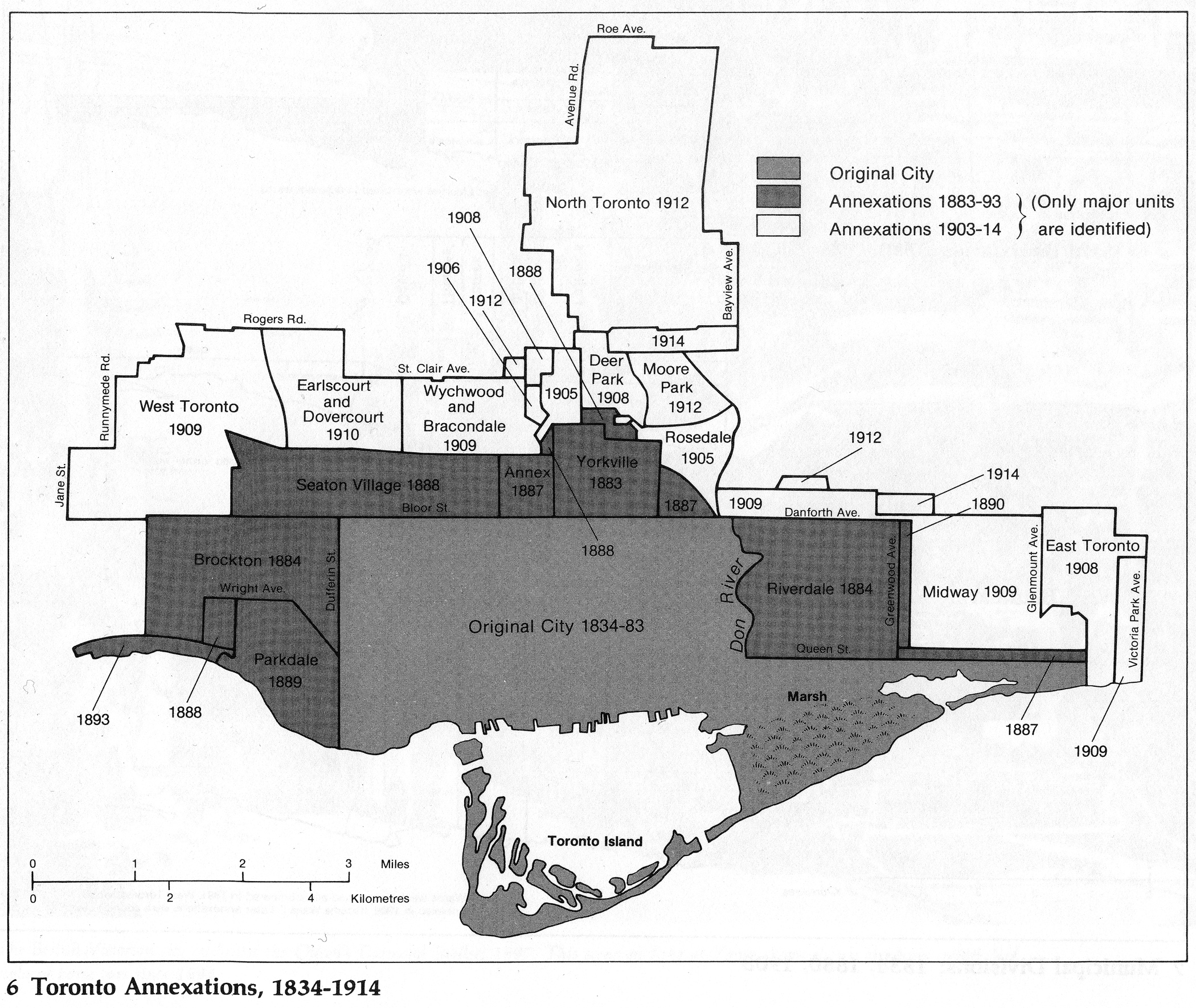
Before 1954, the Toronto Transportation Commission ran streetcars within the old city of Toronto.

tor%20annexations%201834-1914.jpg

From link.

The streetcars ran in the old city, and served them well.

toronto-32_1024x1024@2x.png


From link.

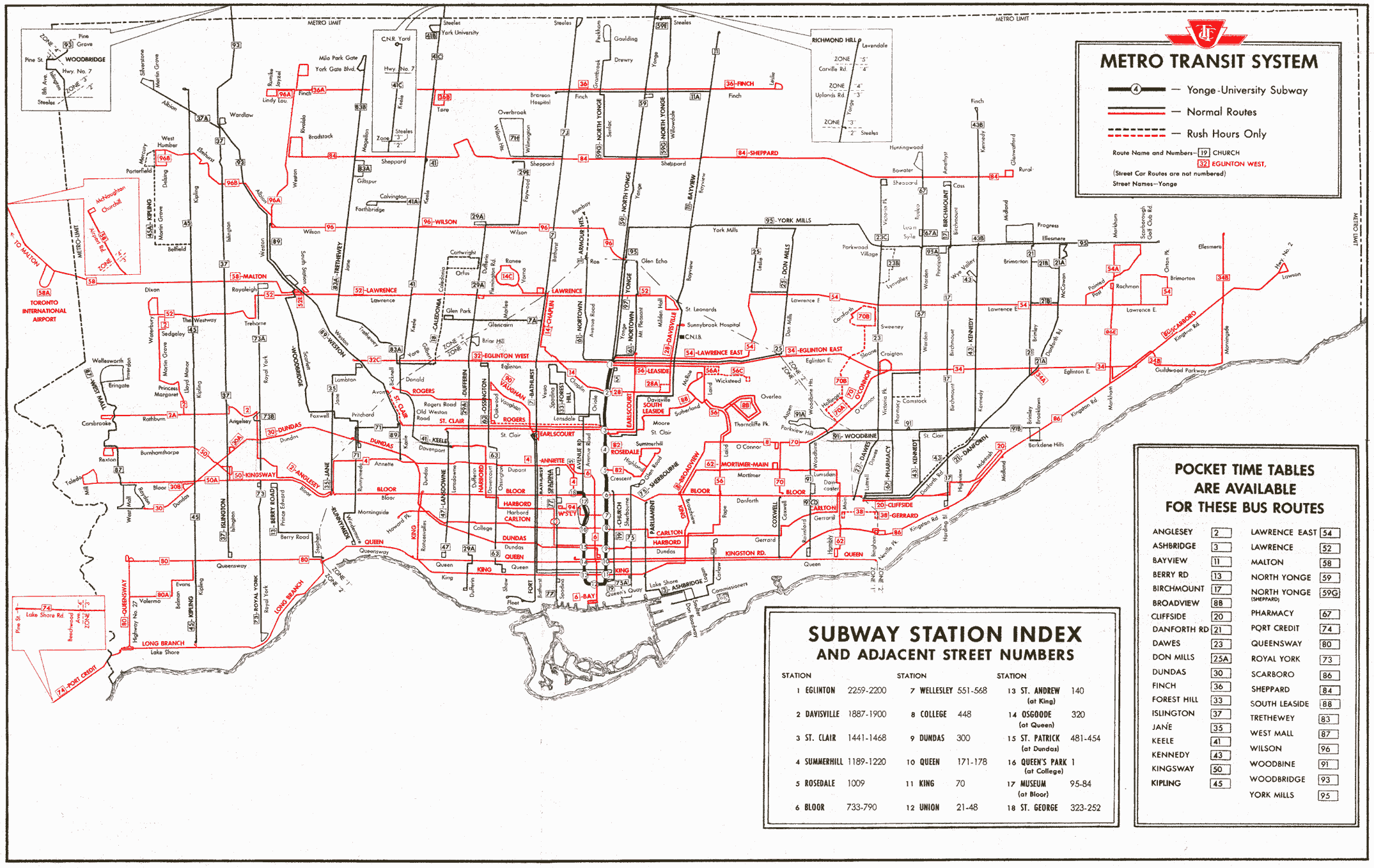
Then in 1954, the Toronto Transit Commission took over the old city and transit in the other 12 municipalities of Metropolitan Toronto.

guide1954f.gif

guide1965.gif


From link.

Unfortunately, the spell of the propaganda machines put forth by the bus and petroleum companies was working. In the newly emerging suburban subdivisions, instead of putting in streetcars, they went with buses. With wide open spaces, they could have put in streetcar right-of-ways, but went with very wide traffic lanes and genuflected before the automobile gods with buses, instead. Public transit, of any kind, was an afterthought.
 
This history lesson has nothing to do with the subject of this thread, Crosstown LRT, even though the posts just before yours just mentioned streetcars.

In the 1950's, they would have been called: streetcars, trolleys, interurbans, radials, or trams. Today, the suburban rails would be called light rail transit.

Today, we're building a subway, tube, metro, light metro, or underground light rail under part of Eglinton Avenue, that should have been with some sort of rail from the start.
 
Eglinton was not ripe for LRT, it should have been heavy rail.
I agree, as that is how Brussels and other cities do it. Build it to "Metro" size, and then run it with streetcar/LRT until such time as it can be or is upgraded to full heavy rail.
[...]
The Brussels Metro (French: Métro de Bruxelles, Dutch: Brusselse metro) is a rapid transit system serving a large part of the Brussels-Capital Region of Belgium. It consists of four conventional metro lines and three premetro lines. The metro-grade lines are M1, M2, M5, and M6[1] with some shared sections, covering a total of 39.9 kilometres (24.8 mi),[1] with 59[citation needed] metro-only stations. The premetro network consists of three tram lines (T3, T4, and T7) that partly travel over underground sections that were intended to be eventually converted into metro lines.[5]Underground stations in the premetro network use the same design as metro stations. A few short underground tramway sections exist, so there is a total of 52.0 kilometres (32.3 mi) of underground metro and tram network.[1]There are a total of 69 metro and premetro stations as of 2011.[1]

Most of the common section of the first two metro lines (between De Brouckère metro station and Schuman station) was inaugurated on 17 December 1969 as premetro[6] tramways, converted in 1976 to the first two lines of the metro, then considered as one line with two branches, between De Brouckère and Tomberg and De Brouckère and Beaulieu.[3] The metro is administered by STIB/MIVB (French: Société des Transports Intercommunaux de Bruxelles, Dutch: Maatschappij voor het Intercommunaal Vervoer te Brussel). In 2011, the metro was used for 125.8 million journeys,[7] and it was used for 138.3 million journeys in 2012.[2] The metro is an important means of transport, connecting with six railway stations of the National Railway Company of Belgium, and many tram and bus stops operated by STIB/MIVB, and with Flemish De Lijn and Walloon TEC bus stops.

[...]
Premetro
Line 3 and Line 4 are tram lines using the North-South Axis tunnel which crosses the city center from Brussels-North railway station to Brussels-South railway stationand Albert premetro station. Line 3 runs from Churchill in the south to Esplanade in the north. Line 4 runs from Brussels-North railway station to the Stalle car park in the south.

Line 7 is the main line of the greater ring, replacing Tram 23 and Tram 24 as of 14 March 2011. It services the Heysel/Heizel, runs under the Laeken Parc and then via the greater ring to the terminus of Line 3 to terminate one stop later at Vanderkindere for connections to tram lines 3, 4 and 92.
[...]
1549685844637.png

Map of the Metro Network of the Belgian capital Brussels. The so called PREMETRO sections, which are shown by blue, thinner lines, are underground sections of the tram network and continue further above ground, which is not shown on the map. There are two more PREMETRO-sections which cover only one station each, so I decided not to display them for a clearer view. Stations with two names have different names in the French and Dutch language. The French name is always shown above the Dutch one. Stations with only one name don't have an expression in the other language or both names are the same.
https://en.wikipedia.org/wiki/Brussels_Metro#/media/File:Metro_Brussels.svg
 
From link.

Unfortunately, the spell of the propaganda machines put forth by the bus and petroleum companies was working. In the newly emerging suburban subdivisions, instead of putting in streetcars, they went with buses. With wide open spaces, they could have put in streetcar right-of-ways, but went with very wide traffic lanes and genuflected before the automobile gods with buses, instead. Public transit, of any kind, was an afterthought.
Off topic, but something's caught my eyes on that second last map: proof that Oriole station was at York Mills Road.
 

Back
Top