News   Dec 23, 2025
 887     3 
News   Dec 23, 2025
 2.3K     1 
News   Dec 23, 2025
 3.1K     1 

Toronto Eglinton Line 5 | ?m | ?s | Metrolinx | Arcadis

Still don't know if the Crosstown LRT will have screen platform doors or not, since they were considered "gravy" in the Ford administration days.
No, but the structures are being built to support them in the future if someone decides they should be added.
 
Depends,

If West of Kennedy can handle the loads, it should be run through.
If you want to relive the transit debates of the past 6 years with forced transfer, go ahead and make it separate.

If the separate is pushed, maybe we will end up with another B-D subway extension - this a branch along Eglinton to UTSC

It absolutely doesn't depend.

The ridership numbers, current and future, are far less east of Kennedy Station than they are to the west. Ergo, the headways will be quite a bit different - and thus may not blend well. As well, where are those people from the east of Eglinton heading to? Probably two-thirds are currently heading down the B-D - assuming that that ratio stays fairly similar to that in the future, they won't benefit from a through-running line in any case. And finally, longer transit lines have more problems with headway adherence - so why make the line any longer than you have to when the benefits are so minimal?

Dan
Toronto, Ont.
 
Probably two-thirds are currently heading down the B-D - assuming that that ratio stays fairly similar to that in the future, they won't benefit from a through-running line in any case.
That is an assumption that has never actually been studied.

When Transit City was being studied, they assumed SMLRT to be its own line. Crosstown East report hasn't produced numbers on number of transfers at Kennedy, or the downstream affects on the Crosstown heading towards Yonge.
 
It absolutely doesn't depend.

The ridership numbers, current and future, are far less east of Kennedy Station than they are to the west.

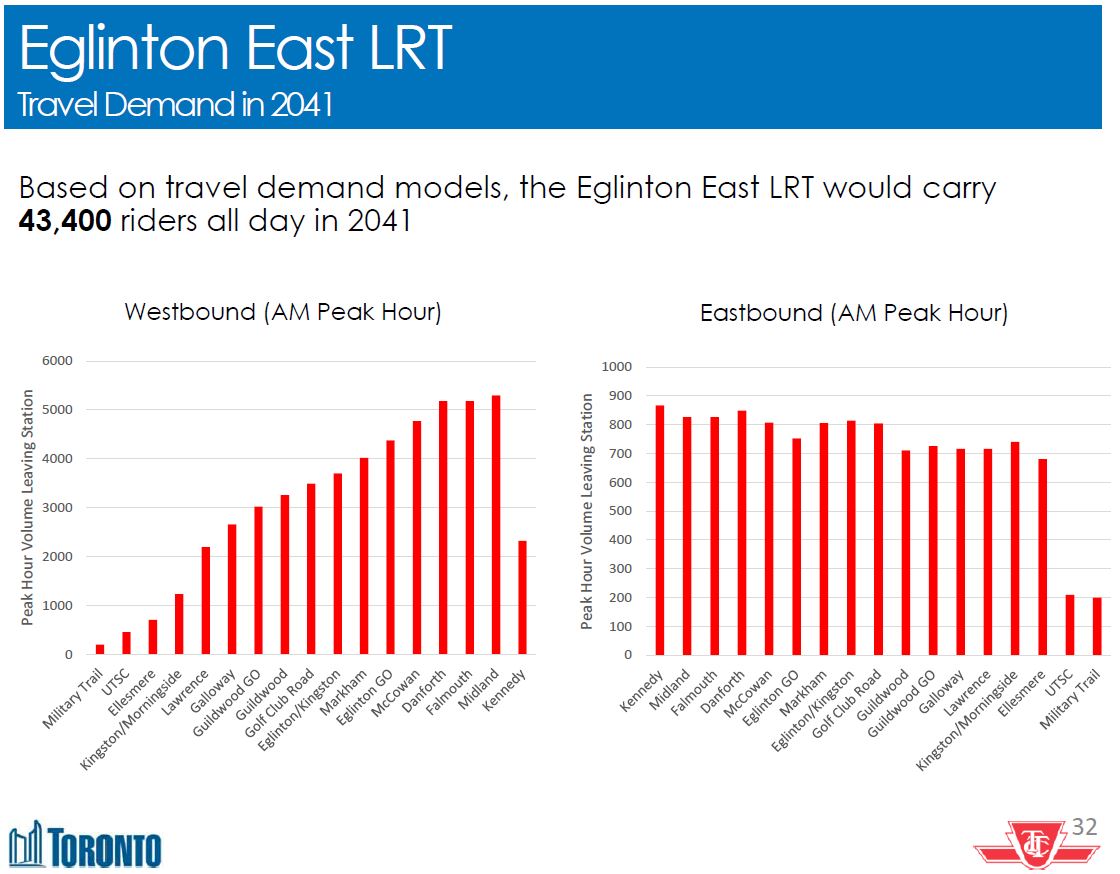
201605_egleastdemandrev.jpg


Westbound into Kennedy ridership is projected to be around 5,250 pphpd. The westbound peak ridership of the Crosstown LRT is westbound into Yonge Station at 5,400 PPHPD. Both ridership projections are essentially equal.

The only place on the LRT network that will have significantly higher peak ridership is eastbound into Eglinton West Station, with its ridership expected to be around 7,000 pphpd.

The impact of Crosstown West on the ridership of the central Crosstown hasn't yet been evaluated. But let's say 3,000 of the 5,250 Crosstown West westbound peak hour trips continue to Yonge Street. In that case, the peak ridership of Crosstown West would be 5,250 westbound into Kennedy and the peak hour of the central Crosstown will be 8,400 pphpd westbound into Yonge Street. Those ridership aren't equal, but it's not such a great imbalance that I believe it would cause issues.

It's also worth noting that City Planning wants the Relief Line northern extension under construction within the next 15 years. It is yet to be seen how this will impact the Crosstown. My hunch is that, because the Scarborough to Downtown trip is faster on the Crosstown + Relief Line than it is on the Crosstown + Yonge line, we'd have significantly greater westbound ridership east of Don Mills Station than west of it.

 
Last edited:
@TheTigerMaster What is that drop off between Midland and Kennedy supposed to reflect? Did they actually calculate transfers at Kennedy station?

If I read that correctly, would that suggest that 2,250 pphd is traveling westbound after Kennedy station? (Indicating 3000pphd transferring to Line 2?)
 
@TheTigerMaster What is that drop off between Midland and Kennedy supposed to reflect? Did they actually calculate transfers at Kennedy station?

If I read that correctly, would that suggest that 2,250 pphd is traveling westbound after Kennedy station? (Indicating 3000pphd transferring to Line 2?)

Looks like you're right about that. 5,250 pphpd travel west into Kennedy. 3,000 of them transfer to other services. 2,250 continue west on the Crosstown.

However it's not clear to me if the 2,250 riders that continue West past Kennedy Station includes boardings at Kennedy Station. But ridership evaluations for the Crosstown LRT (not including west or east extensions) expected that 2,500 people would board at Kennedy. This suggests that the westbound ridership projections for the Crosstown East LRT did not include westbound boarding at Kennedy (otherwise ridership westbound ridership at Kennedy would be significantly higher than 2,500 pphpd).In that case, if there are 2,500 westbound boardings at Kennedy and 2,250 Crosstown East riders continuing westbound past Kennedy, ridership immediately west of Kennedy would be 4,750 pphpd. Thus the westbound ridership immediately east and immediately west of Kennedy are approximately equal.
 
That is an assumption that has never actually been studied.

When Transit City was being studied, they assumed SMLRT to be its own line. Crosstown East report hasn't produced numbers on number of transfers at Kennedy, or the downstream affects on the Crosstown heading towards Yonge.
And what happens if DRL to Eglinton happens? Do 2\3 of passengers carry on?
I agree it hasn't been studied, but it is quite easy to visualize the number of riders being high west of Kennedy unless the lines are run to force people a certain way - and that would be a repeat of the SRT forced transfer that bogged down transit planning for a decade.
 
It absolutely doesn't depend.

The ridership numbers, current and future, are far less east of Kennedy Station than they are to the west. Ergo, the headways will be quite a bit different - and thus may not blend well. As well, where are those people from the east of Eglinton heading to? Probably two-thirds are currently heading down the B-D - assuming that that ratio stays fairly similar to that in the future, they won't benefit from a through-running line in any case. And finally, longer transit lines have more problems with headway adherence - so why make the line any longer than you have to when the benefits are so minimal?
.

I pondered this point of view recently as I stood at Humber Loop in a cold wind, kicking the slush off my boots, looking at the 501 car I had just got off and wondering when the 501 car I needed to carry me onwards would turn up.

It makes perfect sense unless you are the commuter stuck out in the weather.

Shouldn't we be trying to solve the scheduling and operating problems instead of allowing them to drive the design to lowest-possible service standards?

- Paul
 
And what happens if DRL to Eglinton happens? Do 2\3 of passengers carry on?
I agree it hasn't been studied, but it is quite easy to visualize the number of riders being high west of Kennedy unless the lines are run to force people a certain way - and that would be a repeat of the SRT forced transfer that bogged down transit planning for a decade.
It depends on their destinations. I imagine most people heading to financial district area would transfer at Don Mills and Eglinton. Those heading to Bloor-Yonge or Eglinton-Yonge would contine to Eglinton.

It is too early to say with certainty IMO because commuting patterns will change greatly. For instance, a number of people might end up choosing to bypass Yonge and head to Eglinton West to transfer to Spadina line instead.

My take on your second question is this: The Eglinton Crosstown should be faster to reaching Yonge Street than the Bloor-Danforth line from Kennedy Station. Yonge-Eglinton Station should also be less crowded than Bloor-Yonge Station, both the platform and the train itself, making it an easier transfer point for people. Therefore, people who intend to transfer on the Yonge line should be motivated to stay in their seats at Kennedy rather than to transfer to Line 2. (And these people might be intercepted by the Relief Line if it were extended to Eglinton.)
 
No one will transfer twice. Scarborough to
Financial = SRT\Eg to DRL
Union = SRT/Eg to Yonge south.
Hospital Row = SRT\Eg to Spadina line south.
Y-B = SRT to B-D
York U = SRT/Eg to Spadina line north
Y-E or YYZ = stay on SRT/Eg.
 
It absolutely doesn't depend.

The ridership numbers, current and future, are far less east of Kennedy Station than they are to the west. Ergo, the headways will be quite a bit different - and thus may not blend well. As well, where are those people from the east of Eglinton heading to? Probably two-thirds are currently heading down the B-D - assuming that that ratio stays fairly similar to that in the future, they won't benefit from a through-running line in any case. And finally, longer transit lines have more problems with headway adherence - so why make the line any longer than you have to when the benefits are so minimal?

Dan
Toronto, Ont.

That is an assumption that has never actually been studied.

When Transit City was being studied, they assumed SMLRT to be its own line. Crosstown East report hasn't produced numbers on number of transfers at Kennedy, or the downstream affects on the Crosstown heading towards Yonge.

201605_egleastdemandrev.jpg


Westbound into Kennedy ridership is projected to be around 5,250 pphpd. The westbound peak ridership of the Crosstown LRT is westbound into Yonge Station at 5,400 PPHPD. Both ridership projections are essentially equal.

The only place on the LRT network that will have significantly higher peak ridership is eastbound into Eglinton West Station, with its ridership expected to be around 7,000 pphpd.

The impact of Crosstown West on the ridership of the central Crosstown hasn't yet been evaluated. But let's say 3,000 of the 5,250 Crosstown West westbound peak hour trips continue to Yonge Street. In that case, the peak ridership of Crosstown West would be 5,250 westbound into Kennedy and the peak hour of the central Crosstown will be 8,400 pphpd westbound into Yonge Street. Those ridership aren't equal, but it's not such a great imbalance that I believe it would cause issues.

It's also worth noting that City Planning wants the Relief Line northern extension under construction within the next 15 years. It is yet to be seen how this will impact the Crosstown. My hunch is that, because the Scarborough to Downtown trip is faster on the Crosstown + Relief Line than it is on the Crosstown + Yonge line, we'd have significantly greater westbound ridership east of Don Mills Station than west of it.

Looks like you're right about that. 5,250 pphpd travel west into Kennedy. 3,000 of them transfer to other services. 2,250 continue west on the Crosstown.

However it's not clear to me if the 2,250 riders that continue West past Kennedy Station includes boardings at Kennedy Station. But ridership evaluations for the Crosstown LRT (not including west or east extensions) expected that 2,500 people would board at Kennedy. This suggests that the westbound ridership projections for the Crosstown East LRT did not include westbound boarding at Kennedy (otherwise ridership westbound ridership at Kennedy would be significantly higher than 2,500 pphpd).In that case, if there are 2,500 westbound boardings at Kennedy and 2,250 Crosstown East riders continuing westbound past Kennedy, ridership immediately west of Kennedy would be 4,750 pphpd. Thus the westbound ridership immediately east and immediately west of Kennedy are approximately equal.

And what happens if DRL to Eglinton happens? Do 2\3 of passengers carry on?
I agree it hasn't been studied, but it is quite easy to visualize the number of riders being high west of Kennedy unless the lines are run to force people a certain way - and that would be a repeat of the SRT forced transfer that bogged down transit planning for a decade.

It depends on their destinations. I imagine most people heading to financial district area would transfer at Don Mills and Eglinton. Those heading to Bloor-Yonge or Eglinton-Yonge would contine to Eglinton.

It is too early to say with certainty IMO because commuting patterns will change greatly. For instance, a number of people might end up choosing to bypass Yonge and head to Eglinton West to transfer to Spadina line instead.

My take on your second question is this: The Eglinton Crosstown should be faster to reaching Yonge Street than the Bloor-Danforth line from Kennedy Station. Yonge-Eglinton Station should also be less crowded than Bloor-Yonge Station, both the platform and the train itself, making it an easier transfer point for people. Therefore, people who intend to transfer on the Yonge line should be motivated to stay in their seats at Kennedy rather than to transfer to Line 2. (And these people might be intercepted by the Relief Line if it were extended to Eglinton.)

I pondered this point of view recently as I stood at Humber Loop in a cold wind, kicking the slush off my boots, looking at the 501 car I had just got off and wondering when the 501 car I needed to carry me onwards would turn up.

It makes perfect sense unless you are the commuter stuck out in the weather.

Shouldn't we be trying to solve the scheduling and operating problems instead of allowing them to drive the design to lowest-possible service standards?

- Paul

I have to go with everyone else Dan. The transfer, has bad political implications. Yes the line is long, but I would rather that then another political battle 15 years from now.

No one will transfer twice. Scarborough to
Financial = SRT\Eg to DRL
Union = SRT/Eg to Yonge south.
Hospital Row = SRT\Eg to Spadina line south.
Y-B = SRT to B-D
York U = SRT/Eg to Spadina line north
Y-E or YYZ = stay on SRT/Eg.
Agreed. I would think as many people would use the DRL long as possible.
 
And what happens if DRL to Eglinton happens? Do 2\3 of passengers carry on?
I agree it hasn't been studied, but it is quite easy to visualize the number of riders being high west of Kennedy unless the lines are run to force people a certain way - and that would be a repeat of the SRT forced transfer that bogged down transit planning for a decade.

In a completely unrealistic scenario where 100% of westbound Crosstown West users stay on the Crosstown past Kennedy, ridership west of Kennedy would be 7,750 and ridership east of Kennedy would be 4,250. That's not such a large imbalance that I'd imagine it causing operational issues.

Could some trains short turn at Kennedy? Sure. But all modes of transit short turn. Even the SSE will be short turning 50% of trains at Kennedy.
 
Last edited:
I've been looking at the update renderings for the stations and they all look pretty good except for one thing: the "T" signage on the outside of the stations. Could they not have come up with some more original than stealing it from Boston's MBTA sign? :eek:

mbta-2.png


cab-driver-khairullozhon-matanov-frequently-waited-for-fares-outside-picture-id471366518


What's the best way to call out Metrolinx on another fumble? Better yet, maybe it would be fun to reach out to MBTA and ask how much Metrolinx is paying them to operate the Crosstown ;)
 
I've been looking at the update renderings for the stations and they all look pretty good except for one thing: the "T" signage on the outside of the stations. Could they not have come up with some more original than stealing it from Boston's MBTA sign? :eek:

mbta-2.png


cab-driver-khairullozhon-matanov-frequently-waited-for-fares-outside-picture-id471366518


What's the best way to call out Metrolinx on another fumble? Better yet, maybe it would be fun to reach out to MBTA and ask how much Metrolinx is paying them to operate the Crosstown ;)
The state of Massachusetts (under MBTA's name) might end up purchasing Metrolinx from the Ontario government. The state of Massachusetts may end up running Toronto's Line 5.

Yep, a government agency of another jurisdiction would run a part of our transit system. Line 5 could be called the Boston line.
 
I've been looking at the update renderings for the stations and they all look pretty good except for one thing: the "T" signage on the outside of the stations. Could they not have come up with some more original than stealing it from Boston's MBTA sign? :eek:

mbta-2.png


cab-driver-khairullozhon-matanov-frequently-waited-for-fares-outside-picture-id471366518


What's the best way to call out Metrolinx on another fumble? Better yet, maybe it would be fun to reach out to MBTA and ask how much Metrolinx is paying them to operate the Crosstown ;)

Pretty sure it's a placeholder graphic.
 

Back
Top