


News   Dec 23, 2025
 557     3 
News   Dec 23, 2025
 1.3K     1 
News   Dec 23, 2025
 2.1K     1 

Terrible Road signage (for wayfinding)

Hipster Duck

Senior Member
Member Bio
Joined
Apr 24, 2007
Messages
3,558
Reaction score
10
Does anyone else find directional road signage in Toronto (and NA, in general) to be severely lacking?

For example, picture yourself as an out-of-towner trying to navigate yourself out of downtown Toronto. There are tiny wayfinder signs that direct you to the Gardiner and DVP - but there is nothing to suggest that these are freeways that lead you out of town. Also, the small, badge-shaped signs are difficult to read.

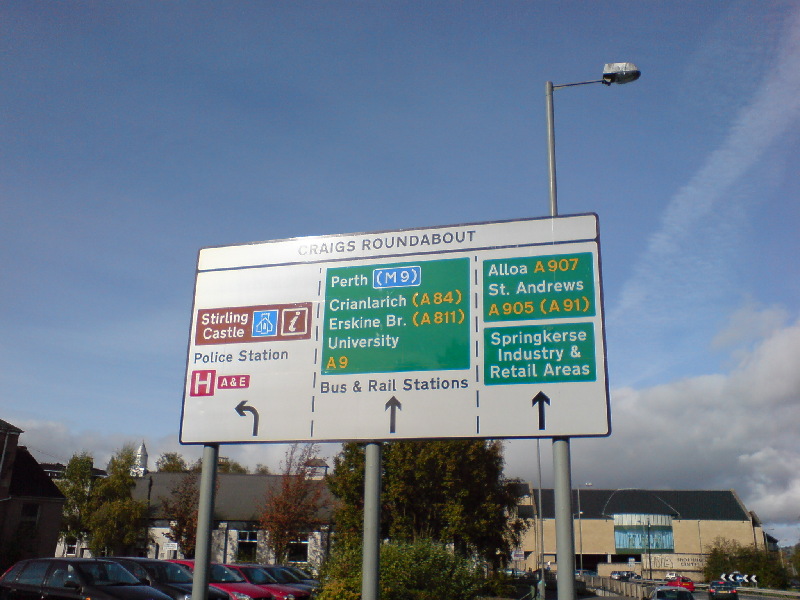
This is an example of decent signage out of the UK:
Signs3_w.jpg


It lists points of interest, important landmarks and destinations on one clear board and lets you know which roads to follow and which way to turn.

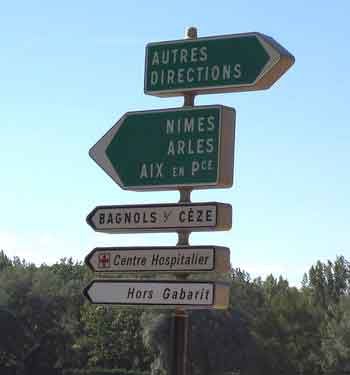
This French one is even better. You want to go to Nimes, Arles, Aix or some local landmarks? Turn left. If you want to go everywhere else, make a right. Straightforward.
FSP-French-road-signs.jpg


And this is what we have to deal with:


Gard-trailblazer.jpg


First of all, if you're from out of town, you're forgiven if you drive down Yonge street and barely see a trailblazer no bigger than a "No Parking" sign, affixed to some random post that looks like a Scout's badge. Even if you read it, what the hell is the Gardiner Expressway? Is Yonge street the Gardiner expressway? It sure looks like a highway route marker. In short, there is nothing to let you know that this is the main route out of a major metropolitan downtown. It doesn't let you know where the Gardiner leads, either.
 
I just drove in France, and their signs are terrible. Frequently, the signs were arranged on a very slight angle where several roads met, and in some way you were supposed to derive, from the angle, which of the routes to follow (we got better at that as time went on). More importantly, you'll note the French example, that they have no highway numbers, meaning that when you arrived at a place where you had to change highways, you had to guess at which town might be advertised as the next up the road. I was always saying something like "We're looking for the A44, so it might say "Chapellie-sur-Mars" or "De Quesnelle D'Antenours" or perhaps "Chamberiere". Little did we know it was "Rotin", which was under the fold of my highway map, and was smaller and farther away than Chamberiere anyways. Horrible, horrible, horrible, signage, of which the example you provide is quite useful. Just another instance of where web browsing in the absence of actual experience is misleading at best.

The British signage looks nice though.

And you do realize you are comparing rural highway signs with city signs, don't you? The context is entirely different.

Though, frankly, you do have a point with the Gardiner signs, which are a tad small. The ones that kill me are "Bay Street Throughway" (or whatever) signs that have no readily apparent meaning (I know what they mean - but who would) and which are even tinier than the example you provide.
 
Horrible, horrible, horrible, signage, of which the example you provide is quite useful. Just another instance of where web browsing in the absence of actual experience is misleading at best.

Archivist, I have traveled extensively by road in Europe, including in France, and more often than not I was navigating from the passenger seat. From my experience, the road signage in Europe was much more clear and functionally organized than in North America, despite the confusing road patterns. The lack of highway numbers - in Germany, where I have the most experience, anything other than the national road system (Bundesstrasse) aren't numbered - doesn't seem overly perplexing to me because you navigate by driving from town-to-town. Long distance travel is done on the freeway and there is always a sign directing you there, as well. I should also add that a numbering system is only useful if you know which direction you are going, and across Ontario I have discovered that the signage consistently fails to tell you even that. And let's not even get started on the senseless renumbering of roads that were downloaded by the Harris government...

And you do realize you are comparing rural highway signs with city signs, don't you? The context is entirely different.

The British example strikes me as an urban, or at least suburban example. Frankly, the road signage in rural North America is just as bad as it is in the cities. Typically, they feature the same small highway shield and a tiny directional arrow pointing you in a certain direction. No mention is made of what the next town is, or what direction you're traveling.

Traveling within an urban environment in Europe, I've found there are often signs that lead you to a major road that has been designated as the principal route out of the city (or at least to a major highway intersection that will lead you out of the city). In downtown Toronto, for example, if you are traveling on a major north-south road that crosses Adelaide, a sign about the size of a dinner table should appear at the intersection reading "To: DVP/404: Newmarket /401 East: Oshawa" or something like that.
 
Travelling in the States, the signage there is pretty good. There are always 3-4 signs before exits, a sign with the route number every mile or so, etc. When I'm travelling from Ontario into New York or Pennsylvania, I'm always suprised by the amount of signage, which is good.
 
Hipster, I guess we'll have to disagree, because the signage in France was horrible and they are welcome to it. We were avoiding expressways and driving on smaller roads, had really good maps, I am excellent at navigating (or so I hope) and the signage was just completely awful. I think the absence of the highway numbers was a terrible move.

So, whatever. I'd so much rather have our signs than those in France. To each his own.
 
California is the Gold Standard for highway signage for North America, at all levels of jurisdiction, I found. Michigan is quite good as well, as is most of the Midwest.

I found New England to be hit-and-miss. Boston's signage was horrible, though New York is okay, Rhode Island really bad, but Vermont not too bad. New Hampshire was bad as well (in a place like Hanover, NH, there's no signs telling one how to get to either of the adjacent interstates - 89 or 91 - anywhere!)

Ontario's MTO signs aren't too bad, but in urban regions, there's not enough empthasis on using control cities on MTO roads. The bigger problems are the horrible results of downloading so many of those highways.
 
In downtown Toronto, for example, if you are traveling on a major north-south road that crosses Adelaide, a sign about the size of a dinner table should appear at the intersection reading "To: DVP/404: Newmarket /401 East: Oshawa" or something like that.

If such signs were posted, can you imagine the hue and cry that would accompany them Many people, presumably most of this forum, would be up in arms about the perceived 'ugliness', 'uselessness', 'car-centricness', etc., etc.

In my expereience, I've found driving in the UK to be quite a pleasure. Typically well signed, and with just about every road numbered, you can locate yourself on a map quickly and easily.
 
Freeway signage in Ontario is pretty good, it's when you get to the 2-lane highways that it's hit or miss. Signs for intersecting roads show the road number with the name of the road at the top. Control cities are secondary and often aren't there at all. A sign might say "3 Parkhill Road" with no indication of where Parkhill Road goes.

I don't know about France but in the Czech Republic control cities are first and foremost on the signs, even if the road only goes to a tiny village. The highway number is next, but it's always there so you can always follow a road without worrying about which town is next. It's a good system, if only the signs were a little bigger.
 
The UK system on signs and maps of the Yellow-on-Green control cities or places is an excellent system. It ensures the maps and the road signs sync perfectly.

Mexico has horrible directional signage.
 
I would agree that California is the gold standard. I found navigating in a car in LA to be extremely easy, with helpful signs posted when you needed them most. I find Ontario's signs just fine, though.

Another thing about Ontario's signage that is better than France - we have roadsigns posted every few kilometres just to indicate what highway you are on, and frequently these are posted just after intersections, as a reminder that you are on a particular route. No such thing in France, often we waited for an intersection and looked out the side of the car in hope that a route number might be posted. ("Do you think we're on A44? I hope this is A44." Ten kilometres later: "Cripes, we're coming into Chantilly-des-deux-Magots-sur-Baconville, which means we're on the B563. How did that happen?".
 
I agree that the 400-series highways are signs are excellent. The mileage-based exit numbering system, clearly-marked control cities, and letting you know how many interchanges a city has are all nice gestures. It's once you get off the freeways that it gets bad - and spectacularly bad, at that.

California is the Gold Standard for highway signage for North America, at all levels of jurisdiction, I found.

No doubt about it. Highway administration is to California what the LCBO is to Ontario, or Toronto Public Libraries is to Toronto (or what the TTC used to be). The sort of diamond in the crown of government services.

Mind you, one of the few times I got royally lost was in Culver City, near LA, trying to get back onto the 405. I'm embarassed to say this but it was late at night and I seemed to lack any innate sense of direction that evening. I ended up at Marina del Rey - about ten kilometers away, and in the completely opposite direction that I had intended to go. The road signage was pretty lousy there, to say the least!

If such signs were posted, can you imagine the hue and cry that would accompany them Many people, presumably most of this forum, would be up in arms about the perceived 'ugliness', 'uselessness', 'car-centricness', etc., etc.

Ha ha. I hear you. Urbanists do have the tendency to get up in arms about anything that makes driving a little easier - even if it has no effect on transit or pedestrians. For example, many people were offended when Toronto unveiled those big blue street signs above traffic lights. I think their visibility is highly useful as a pedestrian or transit rider. Especially before transit stops were called on an automated announcement, I relied on these large signs when I was taking a bus through an unfamiliar suburban area.

As for the "ugliness" or "visual clutter" of road signs, well, that would be just a bit ironic given that we live in Toronto ;)
 
The MTO, I could make a case for, the gold standard for highway construction standards (parclos, tall-wall concrete barriers, long acceleration lanes and good traffic channelization), but Caltrans seems to be following the MTO in several areas, such as their enthusiastic uptake of the parclo interchange.

Overall, California and Ontario do very well.
 
With this high standard of highway construction, it's odd that our highways in Ontario don't have shoulder rumble strips or reflectors mounted on the lane markers on unlit stretches.
 
Most 400 series highway segments have rumble strips now.

I think the lack of reflectors are due to their uselessness in winter, and the issue of being picked up by snow plows. If Ontario had no snow, I would expect the MTO to pick up the use of Botts Dots.
 
Most 400 series highway segments have rumble strips now.

I think the lack of reflectors are due to their uselessness in winter, and the issue of being picked up by snow plows. If Ontario had no snow, I would expect the MTO to pick up the use of Botts Dots.

Yeah, you're right about the rumble strips. I recalled sections of the QEW and 401 with no strips or strips on only one side and I must have thought that it added up to a lot of segments when writing that. A lot of it must have been recent. That's also some interesting information about the Botts Dots that I unaware of.
 

Back
Top