


News   Mar 09, 2026
 239     0 
News   Mar 09, 2026
 342     0 
News   Mar 06, 2026
 1.9K     7 

Russian-Ukrainian War (2022- )

Great analysis from RUSI, as usual. My take on it, as a report from a Western military think tank made for consumption by Western militaries, it has a clear message in mind: don't fall into the trap of underestimating your enemy.

And while I agree with the importance of that sort of messaging, I would still argue that Russian Aerospace Force (VKS) is still not a significant threat to NATO. In other words, I agree that VKS is no longer the paper tiger it was back in 2022, but it is still not a real tiger either. As of 2026, it is a cardboard tiger.

They don't need to win a war in Europe to do substantial damage. They won't win in Ukraine. And look at the state of that country. Our Quality of Life rests very much on peace and stability. The mere threat of war can bring economic troubles. Actual war would bring economic ruin that could take more than a generation to recover from.

1. VKS is incapable of penetration operations into contested airspace.

2. Russian glide bomb threat is real, but it can be countered.

3. NATO forces have the capability to establish air supremacy (in time).

See above to understand why we think this is a threat. Sure, the VKS will eventually lose. But they can still do far more damage than we'd like till they are pushed back. And the surest way to deter them from even trying in the first place is to make the overmatch substantial enough that it scares them. This is the threat of complacency on our part.

So yes, if Canada wants to participate in the penetration missions against Russia, that's when F-35s will come in handy for RCAF.

Uggh. I really wish people would understand the physics here and stop acting like Low Observability is exclusively about strike missions. One of the ways we use F-22s and F-35s in DCA (Defensive Counter Air) and SEAD (Suppression of Enemy Air Defences) is as forward spotters who can get closer to Red Air and/or Red AD. Then the Eagles, Typhoons and Gripens at the back can unleash BVRAAMs and ARMs that are guided almost to termination over datalink. A recent example of this is what the Pakistanis did to the Indians in May 2025. And doing SEAD is not just an offensive function. It's necessary as part of defence because the Russians move their GBAD up with their fighters.

them being able to flip a software kill-switch on any F-35 at any time they'd like

This misinformation has to stop. There's no kill switch.

I also wouldn't mind having some Grippens too (or any other advanced 4th gen multi-role aircraft).

Unless it's an imposed political solution, the RCAF isn't interested. If compelled to go second fleet, the preferred solution is actually an expanded light fighter based on the lead in fighter trainer. Something like the FA-50 paired with the TA-50. This has actually been briefed internally. The public is too ignorant to discuss nuances on this. Especially against Saab marketing. But this has been the only public article I have seen actually discuss what has been talked about inside the RCAF:

 
This misinformation has to stop. There's no kill switch.
No kill switch, but the aircraft is the tip of a supply chain spear. You won't be operating F35s for long without continued US permission for parts and support.
 
No kill switch, but the aircraft is the tip of a supply chain spear. You won't be operating F35s for long without continued US permission for parts and support.

Sure. But this ridiculous kill switch nonsense needs to go away.

And the supply chain restrictions are true for literally every ITAR's parts including the Gripen's engine, most of its weapons and half the avionics and sensor components. If sovereignty is a priority there's only one real solution: Rafale.

But let's all remember this Gripen talk was never about sovereignty (this is something the public has glommed on to). The discussion was largely about jobs and in retaliation to American trade threats. Had basically nothing to do with defence considerations itself.
 
I really wish people would understand the physics here and stop acting like Low Observability is exclusively about strike missions. One of the ways we use F-22s and F-35s in DCA (Defensive Counter Air) and SEAD (Suppression of Enemy Air Defences) is as forward spotters who can get closer to Red Air and/or Red AD. Then the Eagles, Typhoons and Gripens at the back can unleash BVRAAMs and ARMs that are guided almost to termination over datalink. A recent example of this is what the Pakistanis did to the Indians in May 2025. And doing SEAD is not just an offensive function. It's necessary as part of defence because the Russians move their GBAD up with their fighters.
Sure, my post was too long already, so I didn't go into such detail. Thanks for doing it for me. Still, you need low observability enablers at the tip of your SEAD spear, whether that a penetration mission into the Russian airspace or against their forward-deployed GBAD.

There's no kill switch.
But this ridiculous kill switch nonsense needs to go away.
My bad for presenting is as a fact without any context in a post that was too long anyway. But the US maintains an worrying level of control over F-35 software. They install it, they update it, they even manage the analysis and distribution of mission-critical files. It's all done under under the guise of maintaining interoperability and centralized control over security. "We're all allies, we're in it together" Until one day we're not.
In a hypothetical situation that I don't even want to think about, how does a RCAF F-35 defend Canadian airspace against unfriendly US jets if they are in control of its datalink? It's not a kill switch per se, but is it not functionally the same?
And that's just the software concerns, which may be overblown. The supply chain control is also a problem, as already discussed.
 
My bad for presenting is as a fact without any context in a post that was too long anyway. But the US maintains an worrying level of control over F-35 software. They install it, they update it, they even manage the analysis and distribution of mission-critical files. It's all done under under the guise of maintaining interoperability and centralized control over security. "We're all allies, we're in it together" Until one day we're not.
In a hypothetical situation that I don't even want to think about, how does a RCAF F-35 defend Canadian airspace against unfriendly US jets if they are in control of its datalink? It's not a kill switch per se, but is it not functionally the same?
And that's just the software concerns, which may be overblown.

This is also how our C-130J, C-17, CH-147 fleets work. We have some ability to program defensive systems on board but they rely substantially on US technical intelligence. It's this context that has most RCAF pers thinking all this concern over the F-35 is BS. Most fleets these days are purchased under the Global Fleet Concept. Everybody uses the same baseline hardware and software configuration that way engineering costs for updates are kept low. It's amazing how this become a sovereignty concern for the F-35 and not every single other weapons system, crypto for comms, and other platforms in the CAF inventory. Like what do people think happens to any aircraft or weapon if you lost secure comms and secure GPS?

Sure, my post was too long already, so I didn't go into such detail. Thanks for doing it for me. Still, you need low observability enablers at the tip of your SEAD spear, whether that a penetration mission into the Russian airspace or against their forward-deployed GBAD.

My point here was that people need to stop treating this as entirely an offensive use case. The philosophy of low-observability came about from the development of survivability as an engineering doctrine. That wasn't just for offensive employment. It was to improve the chance the system and crew survived in every situation. It's not random stuff that Americans came up with to just enable deep strikes. I literally did a chunk of one of my Master's degrees using this, and the author's protege was my second reader. I say this not to toot my own horn. I want people to understand this is far more than random design choices. Decades of intellectual work and research has gone into how to bring home crews. A lot of this grew out of WWII and Vietnam. It's a philosophy now applied to everything from ships to airplanes to satellites. And it's a big part of what separates us from say the Russians who put a magazine under the crew compartment of their tanks.


ntegrated-Survivability-onion.png
 
Last edited:
This is also how our C-130J, C-17, CH-147 fleets work. We have some ability to program defensive systems on board but they rely substantially on US technical intelligence. It's this context that has most RCAF pers thinking all this concern over the F-35 is BS.
Point taken. As I said, the concern is merely hypothetical for when US becomes hostile. But if/when that happens, we have bigger problems than figuring out how do we operate our integrated platforms. And a tiny fleet of F-35 is not going to save us, even if they were somehow 100% functional against a US foe.

Good ol' onion diagram, love them! Though I prefer the dumbed down versions of the same complexity level as the "suck-squeeze-bang-blow" 4-stroke engine operation:
1768323518015.png

image source

But this has been the only public article I have seen actually discuss what has been talked about inside the RCAF:
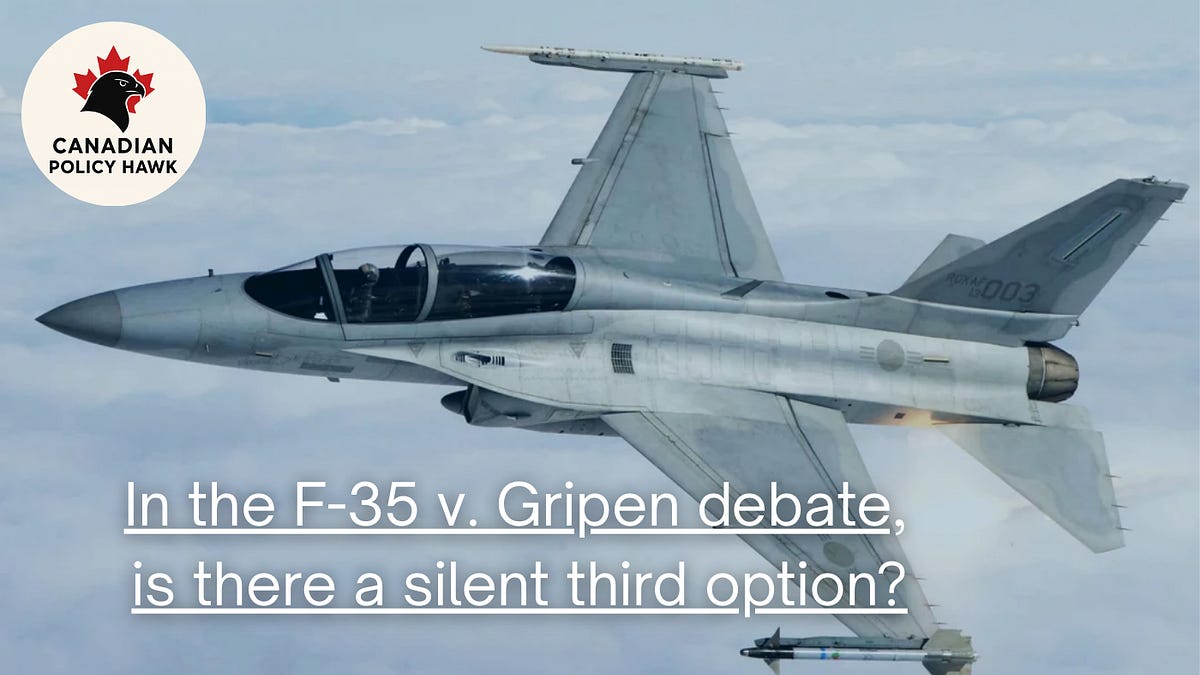

Good read. Good argument for the case of a combat capable trainer. Here's some something I have a question about though:
The core of the argument was that Canada has so few fighter pilots and technicians - and especially few of those experienced enough to form an initial cadre of trainers and leaders needed for a successful transition to a new type - that to remove two such groups out of existing CF-18 squadrons could easily cripple the CF-18s’ ability to operate effectively during the years before a new fleet takes over.
If the staffing is such a concern, are there plans to expand the pool of pilots and and techs?
 
If the staffing is such a concern, are there plans to expand the pool of pilots and and techs?

There are. And a split fighter fleet would set that effort back by half a decade (and probably closer to a decade). That's why the RCAF is so resistant to the idea. It's also why the only split fleet idea that works is using a light fighter based on the fighter-trainer. It's practically the same airframe for techs. And it smooths the transition for pilots from training to line ops on the F-35 by creating an intermediate step where they learn Fifth gen basics like AESA radars, datalinks, helmet mounted displays and HOBS missiles, before they go to the F-35.

Good ol' onion diagram, love them! Though I prefer the dumbed down versions of the same complexity level as the "suck-squeeze-bang-blow" 4-stroke engine operation:

The dumbed down versions miss out on the key terms: susceptibility, vulnerability, recoverability. Those are all terms that are literally turned into mathematical probabilities during design and then used by staff when campaign planning.
 
The dumbed down versions miss out on the key terms: susceptibility, vulnerability, recoverability. Those are all terms that are literally turned into mathematical probabilities during design and then use by staff when campaign planning.
Just like the dumbed down "suck, squeeze, bang, blow" is missing all sorts of details like ignition source, compression ratios, air-fuel mixture and caloric equations related to fuel energy density. But you have to admit, the concepts of succeptability, vulnerability and recoverability are not as intuitive and memorable as "don't get penetrated". :)

But on a more serious note, I understand the point that low observability is just another layer of protection for a weapons platform and is not solely used for offensive capability. It improves weapons platform survivability in whatever combat role you chose to use that platform in. It's just that the discussion started around the hypothetical conflict between Russia and NATO in the European theatre, and focused more specifically on degrading VKS and Russian air defenses. So in that particular instance stealth comes in handy for running offensive penetration missions into Russian airspace. It doesn't mean that it's not useful for all sorts of other mission types.
 
So in that particular instance stealth comes in handy for running offensive penetration missions into Russian airspace.

More than that. More specifically it allows the (LO) aircraft to put the adversary aircraft or launcher much more into its own Weapons Employment Zone (increasing probability of kill) while remaining outside the effective WEZ of the adversary (increasing probability of survival) since its low observability will prevent a lock from adversary weapons. The F-35 would not be detected until weapons release, by which point it's already notching or turning and burning. Its adversary would have to be really lucky to get a shot off before immediately starting to defend. Something like this. But that red cone would be smaller than the blue cone if real life radar lock ranges are considered.

DfbQMigW4AAgjAr


Better graphic to explain::

605294001_1428635265287178_8055161497252233240_n.jpg
 
Last edited:
The F-35 would not be detected until weapons release [...} Its adversary would have to be really lucky to get a shot off before immediately starting to defend.

I was always curious about this exact scenario. Not sure if there are any first-hand accounts of such engagement. But my understanding of the scenario is as such:
- In order to get into its WEZ, F-35 has to close to within a certain distance from a bogey
- Ideally, F-35s low observability still puts it outside of bogey's radar detection zone for a stealth aircraft
- Weapons release on F-35 means opening up the internal weapons bay and firing off a missile
- When F-35 opens up the weapons bay, its radar cross-section drastically increases, potentially putting it into bogey's radar detection range and WEZ. This is when they can lock on an hypothetically get a shot off too.

Here's where my curiosity is at with this exact scenario: does it actually introduce a serious threat to a stealth fighter?

Here's footage of the Norwegian air force going through a missile firing exercise:

The weapons bay of the F-35 stays open for about 4 seconds at most in that particular case. So is 4 seconds even enough for the bogey to get a weapons lock-on? Assuming that it is and the pilot actually manages to get that lock-on and fire off a shot, wouldn't they just lose the lock-on right after the F-35's weapons bay closes?
 
The weapons bay of the F-35 stays open for about 4 seconds at most in that particular case. So is 4 seconds even enough for the bogey to get a weapons lock-on? Assuming that it is and the pilot actually manages to get that lock-on and fire off a shot, wouldn't they just lose the lock-on right after the F-35's weapons bay closes?

Lots of complexities. Yes. 4s is enough to get a lock. Especially with an AESA. But maintaining the lock is the challenge. There's various techniques for that. But suffice to say they are all harder on an F-35. At minimum it forces an immediate choice. Even wasting a few seconds firing back could mean certain death for that adversary.
 
And the surest way to deter them from even trying in the first place is to make the overmatch substantial enough that it scares them. This is the threat of complacency on our part.
Canada's biggest concern right now should be to deter terrorists from even trying (they've already tried multiple times in the past couple years alone, and it's naive to think they'd give up and not try again). In the meantime, I'm gonna keep looking over my shoulder and avoiding crowded public spaces/events.
 
Hungary is much better off being closer to the EU than it is to Russia.

I have been going there since 1996 and I have seen both sides of the spectrum. I saw when it was pullng itself out of Communism, when it joined the EU and now when that jackass ruined it.

They were doing much better in the 90s and early 2000s when they joined NATO and the EU. They were getting closer to Europe and truly becoming integrated.

Unfortunately, the PM was a complete tool and got caught on tape lying in 2008. That scandal damn near led to the government being forcibly overthrown by protestors who were seconds away from breaking down the doors of the parliament building.

When that whole situation happened, the socialist opposition collapsed and Orban picked up the pieces. He then jury rigged the system to keep winning.

I personally detest Orban and would love to see a return to the left leaning politics from years ago.
Thoughts on April 2026 and possible Ukraine War implications?

 
Canada's biggest concern right now should be to deter terrorists from even trying (they've already tried multiple times in the past couple years alone, and it's naive to think they'd give up and not try again). In the meantime, I'm gonna keep looking over my shoulder and avoiding crowded public spaces/events.

The likelihood of you getting hit by a car or by lightning is higher than dying in a terrorist attack in Canada. It's okay to admit that you're to scared to leave home.
 
Thoughts on April 2026 and possible Ukraine War implications?


I am voting for the Tisza Party and I do think it will help bring Hungary closer to Europe.

Hungarians do not like Orban as much as the western media makes it out to be the case. They see him in their news but have grown tired of him.

Orban knows that the Tisza Party is a threat to his governance and actively tries to portray them as being close to Brussels (which is in his mind a bad thing). He also ties them to Volodymyr Zelenskyy claiming that they will support the war in Ukraine.

While the Hungarian people don't neccessarily want to be involved in the Ukraine War, they know it is on their doorstep. Having that change in governance might be the catalyst to start heading away from Russia and towards the EU so take that as you will.

I don't see Viktor Orban remaining as PM through April and quite honestly that's a good thing. Hungary was much better in and around 2006 when it was joining the EU. They are a small country but they need to become more integrated with Europe if they want to flourish.
 

Back
Top