




afransen
Senior Member
PP's appeal was entirely fatigue with Trudeau.Looking at poll numbers, the approval ratings for PP went down after Trudeau announced his resignation back in January of 2025.
|
|
|
PP's appeal was entirely fatigue with Trudeau.Looking at poll numbers, the approval ratings for PP went down after Trudeau announced his resignation back in January of 2025.
Gen Z men are increasingly diverging from women in having more socially conservative attitudes towards gender equality, LGBT issues, immigration, etc.It's not social conservatism driving young adults to be oddly more conservative at the polls than older generations
Citation needed. The housing bubble continued to inflate under Harper.He ensured that the number of homes needed due to immigration match the number built by the private sector.
Change of topic and whataboutisms...How many homes did Harper build?
Housing stock-to-population ratio actually increased under Harper, only to decrease under Trudeau almost immediately. [housing prices grew a lot under both admins, but the self-inflicted declining ratio contributed to rising costs under Trudeau]
you can't put food on your table because housing costs are so high.
I find it funny that noone is pointing out the obvious, that the 08 financial crisis led to income growth flatlining in that chart...Although I recall this chart from Ottawa citizen that shows the wealthy did the best under Chretien/Martin, whereas Harper improved the lot of everyone equally.
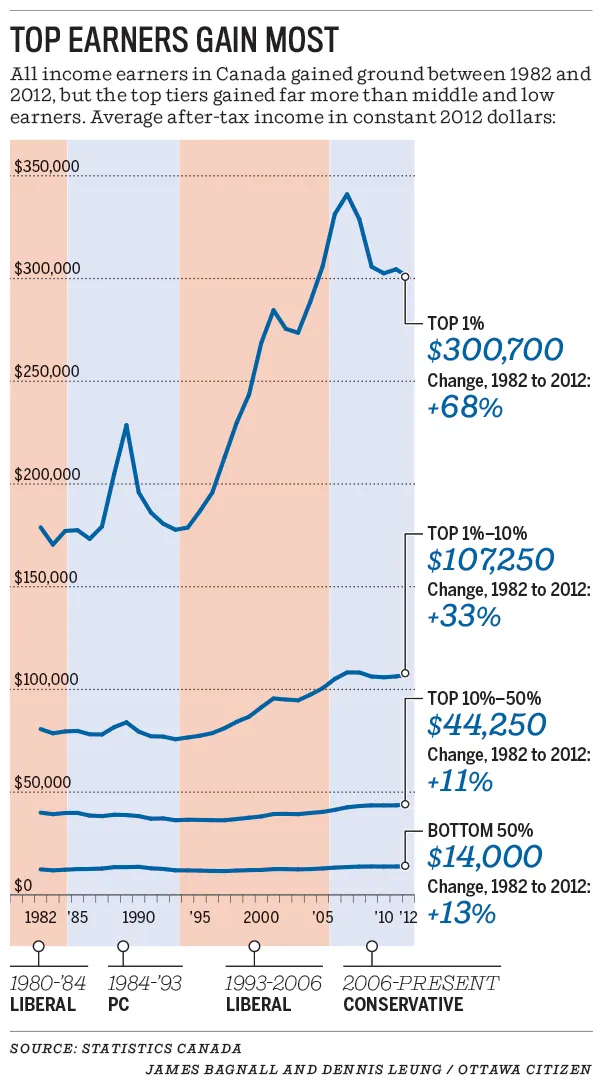
The same sentiment rings true when Chinese leadership said this:Purchasing a place to live should be about obtaining a home, not about building wealth.

And some part of that divergence is due to socioeconomic decline. Although I strongly disagree with the notion that American-style social conservatism is as prevalent in Canada as UT perceives. If that were the case, PP would've won and not clutched defeat from the jaws of victory. Something like 1/4 to 1/3 of Americans are evangelical Protestants, compared to less than 10% of Canadians. And religious affiliation is declining faster in Canada.Gen Z men are increasingly diverging from women in having more socially conservative attitudes towards gender equality, LGBT issues, immigration, etc.
He ensured that the number of homes needed due to immigration match the number built by the private sector.
Both of your claims are true enough. As I said before, housing stock-to-population ratio consistently increased under Harper, but that did not prevent housing costs from rising faster than inflation. There were other factors at play.Citation needed. The housing bubble continued to inflate under Harper.
True; that's what enabled him to be fatally framed in terms of Trump. However, when PP was leading by a landslide in the polls, Trump wasn't (back) in office yet.The problem is that PP is beholden to the significant percentage of the CPC vote and even more significant percentage of the party faithful and donors that are Maple MAGA. PP would have a hard time standing up to Trump when 30-50% of the people he needs to beg for money from think Trump is the best thing to happen to the US. And yes, these people walk among us.

Harper increased the use of Mandatory Minimums in new offences and this lead to courts in Canada being overburdened. The Tyee has done an article about it.Change of topic and whataboutisms...
I'll refer you to this from earlier:
Yes, Trudeau was more socially progressive in some ways. This is not mutually exclusive with what I am claiming. Many social conditions worsened under Trudeau. Often a result of high population growth, which lead to housing and public services not keeping up, which later contributed to increased crime. This then ties into Trudeau's poor record on filling judicial vacancies to ensure timely prosecution of alleged criminals.
I think progressive minded people know a decline in socioeconomic conditions is correlated with higher crime.
View attachment 730555
https://www150.statcan.gc.ca/n1/daily-quotidien/250722/cg-a001-eng.htm
"National homicide rate increases for fourth consecutive year [...] The homicide rate increased 8% from 2.08 homicides per 100,000 population in 2021 to 2.25 homicides per 100,000 population in 2022. This was the highest rate since 1992."
https://www150.statcan.gc.ca/n1/daily-quotidien/230727/dq230727b-eng.htm
When comparing eras, sexual assault against women stats show a similar depressing trend.
---------------------------------------------------------
I am not defending Harper the person. I am pointing out that despite Trudeau's progressive image and rhetoric, on many social items that matter to ordinary Canadians---housing unaffordability, food insecurity, wealth inequality, violent crime, to name a few---got worse under his admin. So while Harper may not have presented himself as progressive, many social conditions happened to be better during his administration.
That's not to say I give 0 credit to the Trudeau admin, $10 a day childcare is great, but even that only benefits less than half of the population:
"In 2024, 51.5% of Canadian women aged 20 to 49 years were not yet mothers."
https://www150.statcan.gc.ca/n1/daily-quotidien/260126/dq260126a-eng.htm
Federal immigration-driven population growth was the primary driver of declining per capita access to public services, while provincial underfunding (relative to inflation) was a secondary aggravating factor. The sentiment I am getting is that Ford came in and made deep cuts to every public facing department. That's not true. And any relative decline in spending did not lead to the smoldering ruin of public institutions overnight, as some are perceiving....
Even if I wholeheartedly disagree with Ford's attitudes and policies on healthcare, education, etc.
"The federal government’s revised immigration policy is beginning to pay dividends in returning balance to a stretched social infrastructure."
----------------------------------------
Is the Dial-Back of Immigration Having the Intended Impact in Canada?
Is the Dial-Back of Immigration Having the Intended Impact in Canada?economics.td.com
If we are not allowed to fault Trudeau's admin for policy failures leading to socioeconomic backsliding (oil prices and covid scapegoat), then we similarly cannot credit Harper's admin for generally not worsening things despite the great recession.
When Carney recently said, "more substance" less "showboating", you wonder who the previous showboater-in-chief was...
I find it funny that noone is pointing out the obvious, that the 08 financial crisis led to income growth flatlining in that chart...
The same sentiment rings true when Chinese leadership said this:
Houses are for living, not for speculation - Wikipedia
en.wikipedia.org
I agree with this ideal. Wealth should not be the primary goal of housing, but a happy by-product.
However, in virtually every country, the quality of life, wealth, socioeconomic mobility for homeowners tends to be better. $1 of net worth is still $1 of wealth. High rents prevent you from accumulating any form of savings. Low rents tend to lead to homeownership. Our ideals will not change the fact that wealth tends to accumulate among the homeowner class.
There is also a reason why ostensibly socialistic countries pursue de facto homeownership for their residents. China for reference has 90+% homeownership rate (with Reuters reporting 96%), compared to less than 66% in Canada and declining.
The point is, people are dismissing the benefits that homeownership can bring. As if it's no big deal that 70% of adults under age 30 are priced out, forced to pay exorbitant rents or live with their parents, as long as other social ideals are met, like a 50/50 gender ratio in the Cabinet.
"Nationally, renters report lower quality of life than homeowners"
https://www150.statcan.gc.ca/n1/daily-quotidien/240219/dq240219b-eng.htm
And some part of that divergence is due to socioeconomic decline. Although I strongly disagree with the notion that American-style social conservatism is as prevalent in Canada as UT perceives. If that were the case, PP would've won and not clutched defeat from the jaws of victory. Something like 1/4 to 1/3 of Americans are evangelical Protestants, compared to less than 10% of Canadians. And religious affiliation is declining faster in Canada.
Both of your claims are true enough. As I said before, housing stock-to-population ratio consistently increased under Harper, but that did not prevent housing costs from rising faster than inflation. There were other factors at play.

Harper increased the use of Mandatory Minimums in new offences and this lead to courts in Canada being overburdened. The Tyee has done an article about it.

To be fair, white people benefited from racial discounts as well. For starters, we whites are less likely to be stopped and searched by police, more likely to have police let us off with a warning or have lessor charges applied, more likely to have good legal representation and obtain more lenient sentencing. There's a reason Chris Rock recommend black drivers have a white friend. Perhaps Trudeau was just trying to even the playing field."racial discounts" didn't come in until Trudeau.
Meanwhile...
These are the Ontario postal codes losing door-to-door Canada Post delivery
Except that it has come out in evidence in a number of cases, certainly not anywhere close to a majority, that the crime was committed by or on the behest of a family member because the victim brought shame on the family or otherwise was believed to have violated some cultural norm. It's not a captured statistic because the motive for a crime is not a fact-in-issue in Canadian law (with very few exception).

Anyone could do it regardless of culture, but some cultures condemn it, while others encourage it.Is the killing of a woman at the hands of a jealous/angry/mentally ill man different in some way because of the culture they come from?
Undeniably a big problem in the EU, and the problem is definitely not that there are "too many Finns in Finland"The problem to me is that you're conflating too many people and too many people of a particular demographic
Undeniably a big problem in the EU, and the problem is definitely not that there are "too many Finns in Finland"


 www.ctvnews.ca
To be fair, white people benefited from racial discounts as well. For starters, we whites are less likely to be stopped and searched by police, more likely to have police let us off with a warning or have lessor charges applied, more likely to have good legal representation and obtain more lenient sentencing. There's a reason Chris Rock recommend black drivers have a white friend. Perhaps Trudeau was just trying to even the playing field.

"The committee will serve as a forum for expertise and strategy on all aspects of the Canada-U.S. economic relationship" Hmm. Expert and economics? Guess that leaves out Pierre Poilievre, but could include Mark Carney who knows a lot about economics.New Canada-U.S. advisory council includes former premiers, ex-Conservative leader
Prime Minister Mark Carney has unveiled a new Canada-U.S. advisory council ahead of a formal CUSMA review process this summer.
New Canada-U.S. advisory council includes former premiers, ex-Conservative leader
Prime Minister Mark Carney has unveiled a new Canada-U.S. advisory council ahead of a formal CUSMA review process this summer.
The council is made up of some members from the previous council while adding former Conservative leader Erin O’Toole, former Conservative cabinet minister Lisa Raitt, former premiers P.J. Akeeagok and Jean Charest, as well as former Canadian High Commissioner to the United Kingdom Ralph Goodale.
The new advisory committee on Canada-U.S. Economic Relations will be chaired by the President of the King’s Privy Council for Canada and Minister responsible for Canada-U.S. Trade, Intergovernmental Affairs, Internal Trade and One Canadian Economy, Dominic LeBlanc.
LeBlanc told reporters on Tuesday, that the council will have its first meeting next week and insisted the group will “help lead our negotiations.”
“(The group is) very much focused on businesses that obviously have important relations with American customers, American business partners,” LeBlanc added.
According to a press release from the Prime Minister’s Office Tuesday, “The committee will serve as a forum for expertise and strategy on all aspects of the Canada-U.S. economic relationship.”
“This new Advisory Committee ensures that government is drawing on the best advice and the broadest perspectives to advance Canada’s economic interests. Our goal is a strong economic partnership with the United States that creates greater certainty, security, and prosperity for all,” said Carney in a statement.
The original council was set up by then-prime minister Justin Trudeau in January of 2025, following the launch of Donald Trump’s trade war. It was populated by former politicians like Rachel Notley and Jean Charest, then-ambassador Kirsten Hillman and former ambassador David MacNaughton, former national security advisor Jody Thomas, as well as labour and industry stakeholders.
Other members of the new council include Aluminium Association of Canada CEO Jean Simard, Automotive Parts Manufacturers’ Association president Flavio Volpe and Canadian Chamber of Commerce president and CEO Candace Laing.
Carney has also added Bank of Montreal CEO Darryl White, Canadian National Railway president and CEO Tracy Robinson, ArcelorMittal Dofasco CEO Ron Bédard CEO, Nutrien president and CEO Ken Seitz president and TC Energy president and CEO Francois Poirier.
“It’s a diverse group. Leaders in from the union movement, experts in industry and CEOs in finance and across the economy,” Carney told reporters before a cabinet meeting.
In a statement, O’Toole underlined how honoured he was to serve on the committee while emphasizing the importance of a cross-partisan approach to getting a “fair deal” with the U.S.
“I will approach this work constructively because it is bigger than politics,” said O’Toole. “I have great respect for Americans. I have served alongside them in uniform and worked with them in board rooms as well as on Capitol Hill. I know we can work together to build a new version of an alliance that has been the envy of the world for generations.”
Raitt served as a cabinet minister under former prime minister Stephen Harper but more recently has been managing director and Vice-Chair of global investment banking at CIBC Capital Markets.
In an interview on Newstalk 1010 AM radio, Raitt said she accepted a seat on the council role because of how important it is to serve the country at this time.
“I love my country, I want us to do well,” Raitt said. “Quite frankly, I can sit on the sidelines and complain and moan and say nasty things, or I can roll up my sleeves and be part of a solution.”
More than a dozen members of the previous version of the council have been left off this latest iteration. They include former Canadian ambassadors to the U.S., David MacNaughton and Kirsten Hillman, former chief negotiator of the CUSMA Steve Verheul, entrepreneurs and investors on the TV show Wes Hall and Arlene Dickinson.
“There are sure to be folks that wish that they were on it or wish that their specific industries or organizations had a seat at the table,” said Diamond Isinger, former Canada U.S. policy advisor to prime minister Trudeau. “I think that this is probably the closest thing to a perfect balance that government can achieve right now, given what they have their priorities set out to be, which is making sure that affected sectors are protected, making sure that they’re hearing from relevant folks.”
It comes two days after the prime minister released a 10-minute-long video speaking directly to Canadians about how the U.S. has fundamentally changed its approach on trade, citing the punishing tariffs levied against the steel, aluminum, copper, lumber and automotive industries in this country.
“Many of our former strengths, based on our close ties to America, have become our weaknesses; weaknesses that we must correct,” Carney said in the video. “The U.S. has changed and we must respond.”
Conservative leader Pierre Poilievre had a lukewarm reaction to the new council, saying Carney was elected on a promise to “negotiate a win” with the Americans.
“The only talks that Mark Carney is doing are YouTube videos where he’s comparing himself to Sir Isaac Brock and holding up little figurines in his office,” Poilievre said. “So he told all of you the other day that with his new majority, he was going to stop showboating, and then a few days later, he put out a showboating YouTube video”.
Poilievre has pitched a plan to implement a tariff-free auto pact with the U.S. as a way of repairing relations between the two countries.
“I’ve laid out an extremely detailed plan to counter American tariffs and to fight for US trade. My position is clear. Build up leverage,” Poilievre said. “Use that leverage to get rid of American tariffs on aluminum, steel, autos and lumber”.
United States Trade Representative Jamieson Greer has said it’s unlikely the U.S. will resolve all its trade issues with Canada and Mexico before the July 1 deadline to renegotiation the Canada-U.S.-Mexico Agreement or CUSMA. In mid-March, Greer also told Fox Business that Canada was behind Mexico on trade discussions.
On Monday, Greer met with Mexican President Claudia Sheinbaum for a bilateral discussion on trade and economic relations ahead of the CUSMA review deadline.
According to a readout from Greer’s office, the trade representative thanked Sheinbaum for her strong leadership in expanding U.S.-Mexico bilateral co-operation.
Greer and Mexican Secretary of Economy Marcelo Ebrard concluded their meeting by agreeing to schedule a first official bilateral negotiating round for the CUSMA review on the week of May 25, in Mexico City. No such meeting has been scheduled between Canada and the U.S.