
News   Dec 23, 2025
 326     3 
News   Dec 23, 2025
 733     1 
News   Dec 23, 2025
 1.3K     0 

New Orleans - a lost accent?

Brandon716

Senior Member
Member Bio
Joined
May 12, 2007
Messages
1,428
Reaction score
0
Location
Niagara Region
I recently ran across an NPR piece about 3 years old now, just after Katrina hit, and really it was interesting to think about. Is a cherished accent gone forever? New Orleans really didn't have a southern accent, nor did it have an accent that fit anywhere else. It was its own thing.

Take a listen at this link and if you ever visit the city again, wonder if its lost.

http://www.npr.org/templates/story/story.php?storyId=4961257

http://en.wikipedia.org/wiki/Yat_(New_Orleans)

The majority of french acadian culture in Louisiana historically was not in the City of New Orleans, but a hundred miles west in Lafayette and its environs. That is where cajuns and cajun french is still found in schools. It too is different from anything in New Orleans, which was more creole and italian based.

Luckily the culture in central LA hasn't been destroyed.

Both Quebec and Louisiana are the only two governments in North America that operate on French civil code law and are semi-bilingual, obviously Quebec retaining a far larger french population as Louisiana is only 4.5 million and only a fraction of that is french or creole.

If you're interested in a map of the true Acadian culture still found today, where French is still spoken by locals, here is a map and its not quite New Orleans.

http://en.wikipedia.org/wiki/Acadiana
 
Interesting. I find it strange, though, that in the sound clip they dwell on the accent being non-rhotic (missing the consonant 'r', particularly at the ends of words). Many American accents are non-rhotic, particularly along the east coast.
 
True enough about the dropped R accents throughout the US. I do wonder if some of New Orleans won't be lost forever.

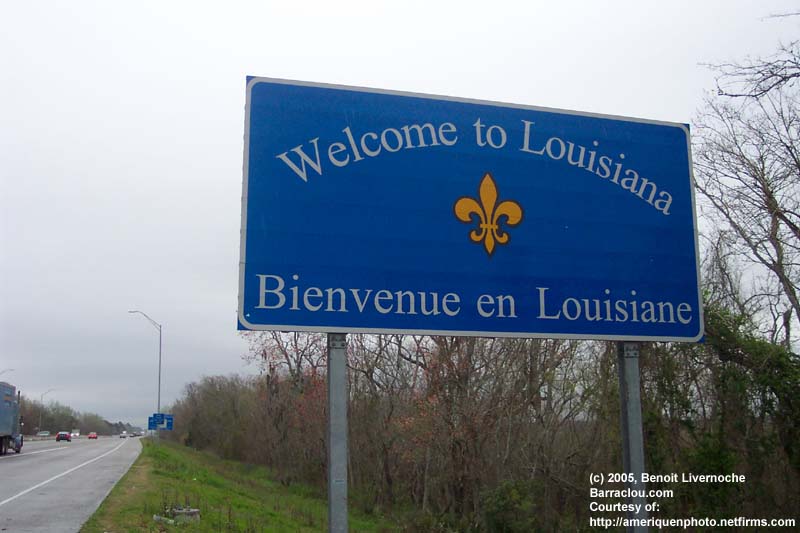
welcome_louisiana.jpg


The next time someone see's this sign, I doubt the accents in the NPR piece probably won't be in the city like they once were.
 
That sign makes me wonder why French died in the US while it survived in Canada.

Its not entirely dead in south central Louisiana, but its very small. That's why it "died" because the French culture of Louisiana relative to the US as a whole doesn't hold a candle to how large Quebec is in relation to Canada.

Remember, Louisiana is only a state of 4.5 million in a nation of 300 million, and only a small portion of that 4.5 million has a genuine French background.

Quebec is millions larger, and in Canada its the second largest province.

That relativity makes all the difference.

Louisiana for all intents and purposes is still very French based. The governments aren't broken down by counties, but rather by parishes due to the tradition, and the state - just like Quebec - is the only government in North America (besides Quebec) to operate on French Civil Code instead of English Common Law. And state laws recognize French as a language, remember the US government officially doesn't have an official language, that is left up to the states. Only 20 some states have solidified English as the official language.

Besides, Cajun French schools still operate in the vicinity of Lafayette, LA. New Orleans hasn't had genuine French for decades.

BTW, for the record, there are plenty historic sites west of the Appalachian mountains that recognize New France's role in American history, not just for Canadian history. Where I grew up in Tennessee, there is a historic marker just a few miles away of a French dignitary visit in the 1700's and declaring the land of New France before the American Revolution.

If you notice, there is a huge naming scheme difference between the division of the highlands of the appalachains. Every small town in Tennessee ends in -ville, in North Carolina there are more common endings of -boro/borough, burg/burgh in a more English tradition.

This difference can be seen in many areas that were considered New France before the Revolution.

Of course these are just historic traditions, not significant french culture. If you ask the average Tennessean of today, they are rather bitter typical-southern american anti-french attitude types... Little do they know their own history or that France was substantial help against the British in the Civil War or that the history of naming towns west of the Appalachains was decidedly French based. Nor do many Americans recognize France's gift to the US in the name of Lady Liberty as her light shines upon New York Harbor. :)

And unfortunately even if a few schools still teach in French in south central Louisiana, none of the governments or anything operate in French, so yea its unfortunately a dying culture.
 
Southern Louisiana Cajun accents-are they disappearing?

Brandon: Good topic on Louisiana and "N'AWLINS" - I visited southern Louisiana twice in the 80s and the cajun accent fascinated me-it IS a distinct Southern dialect unique to that region-the Wikipedia map is correct.

Accents fascinate me-I did not get to understand that people had accents in North America until I traveled off Long Island as a teenager in the 70s. Some people definitely noticed my distinct then-strong "Lawn Guyland" accent which stood out in places like Chicago,Southern Ontario and the Deep Southern USA.

I hope that the New Orleans dialect did not become another Katrina tragedy-another unique distinction of that region perhaps is lost forever.
My thoughts here-LI MIKE
 
Besides, Cajun French schools still operate in the vicinity of Lafayette, LA. New Orleans hasn't had genuine French for decades.

"Cajun French" is no less "genuine" than any other dialect. It's just different.

Accents fascinate me-I did not get to understand that people had accents in North America until I traveled off Long Island as a teenager in the 70s.

Accents are a relative phenomenon, so everyone has an accent. You just don't notice it until you venture outside your language community, or a visitor remarks on it.
 
I didn't say cajun french wasn't genuine, but rather that New Orleans hasn't had a serious french culture in many, many decades. When I visited pre-Katrina, I didn't find any real french speakers anywhere throughout the old city.

And the irony of New Orleans is that much of the old city wasn't destroyed from the French Quarter to the downtown area and down through the Garden District. These areas didn't feel the brunt of the floods.

Also, the ironic thing about the Katrina affair is that it practically destroyed the eastern part of the metropolitan area and much of the city, but the western and southwestern communities fared well. The levies mostly held up in Jefferson Parish, and from Marerro to Metarie there really wasn't substantial damage. New Orleans metropolitan area still has just over 1 million residents as of today, but the city has lost over 250,000 people due to the destruction.
 

Back
Top