

News   Apr 06, 2026
 603     1 
News   Apr 06, 2026
 455     0 
News   Apr 06, 2026
 435     0 

GO Transit: Service thread (including extensions)

My apologies, @reaperexpress for the late reply, but this was quite a busy week, having to entertain both kids at home while they are the last ones at their small daycare who have yet to catch the virus!

When I suggested that the London trip/extension would be a likely target for a cut, I was simply looking at the trips which carry the fewest passengers per staff-hour. Hardly a deeply-entranched belief or conspiracy theory...
Agreed, but it would still be an extremely misguided and counter-productive business practice (and was part of the reasons which made me look for new professional adventures at the midst of the pandemic...). Rather than looking solely at what services carry the least passengers, you should focus on wherever you can cut services with the least impact on your passengers.


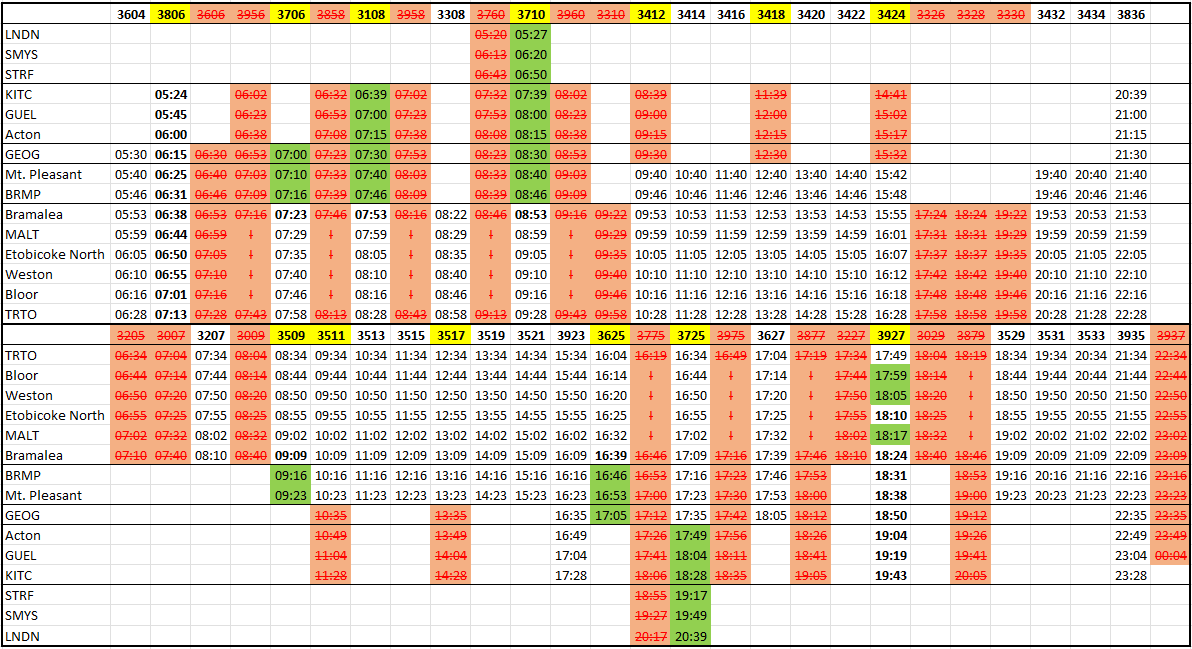
Let's have a look at the changes which took effect this week:
1642225353512.png


Now let's break down the 10 train pairs which were cut this Monday and how they impacted travelers:
  • Express services (all 4-5 train pairs cut): With the primary reason for having Express trains having been over-crowding, there is hardly a justification at this moment to operate Toronto-Bramalea and Toronto-Kitchener as two separate services. For some passengers that will mean a 8 minute long ride, whereas others will save 7 minutes and 1 transfer at Bramalea.
  • Counter-peak services (3 out of 4 train pairs cut): With only one Bramalea-Toronto peak service left (#3308), you can only run one off-peak service (#3207) in the opposite direction. Trains are replaced by busses, which offer comparable travel times and save quite a few passengers (e.g. Guelph-Union) a transfer). Same goes for the lost mid-day service to Kitchener, though in this case causing (rather than: removing) a transfer at Bramalea or Mount Dennis.
  • Some peak services (another 2 out of originally 12 train pairs cut): as is the case with the Express trains, the main justification for frequent peak service is over-crowding, which is hardly an issue at this moment. Reduced peak service will cause little inconvenience beyond a slight reduction in the flexibility offered to commuters.
Conversely, removing the London extension would have left the (admittedly few) passengers relying on that train with no other alternatives to the car (which might not be available to some of them). There is a good reason why VIA didn't abandon its passengers on the Toronto-Sarnia route during the pandemic...

To operate the AM London-Kitchener component of the London service, the crew needs to drive (a car) 1.5h from Kitchener to London, set up the train (0.5h?) and drive 2.2h back to Kitchener. That's 4 hours of crew time to carry 30 passengers one-way. In that same time, they could operate 5 trips (2.5 round trips) from Union to Bramalea, each of which carries more than 30 passengers each way. The peak-direction components of those trips are not a huge loss given that ridership is currently very low and the former express trains are now operating local, but the counter-peak components of those trips were a big time saver for passengers connecting to other services at Bramalea (e.g. the Kitchener bus, 407 buses).
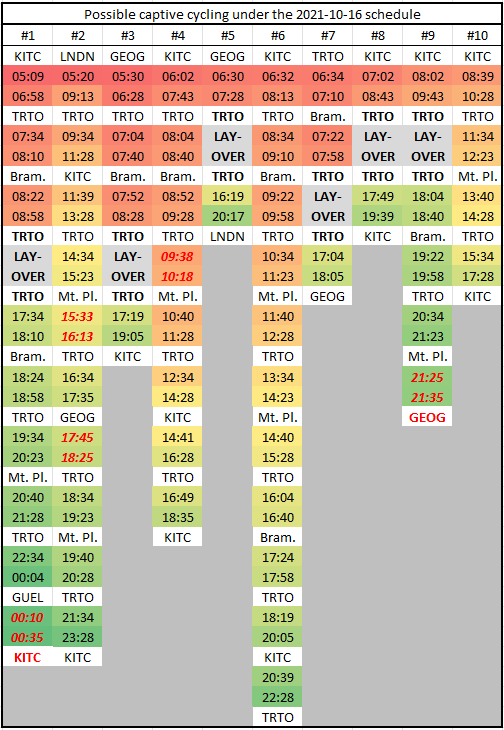
The most-constraining metric is not labor-hours, it's the number of shifts you have to staff and that becomes especially a problem with operating the traditional North American commuter-rail model. Under the previous schedule, out of the 10 trainsets required for the AM peak, only 4 are required past 10am:
1642230337396.png

Note: Timings in red are possible equipment positioning ("deadhead") trips, which help minimize the trainset requirements and rebalance the equipment at the end of the day.

Therefore, shaving off 4 hours from one single shift in the early morning does nothing to reduce the number of shifts you need to cover throughout the day.

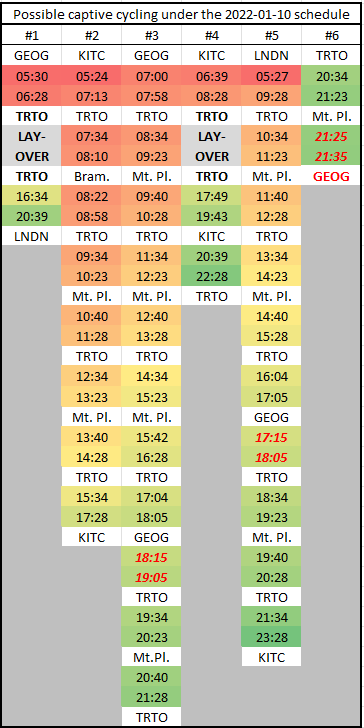
Conversely, the reduced schedule halves the number of trainsets required in the AM peak from 10 to 5, of which 3 trainsets (i.e. 60% rather than 40%) are also required mid-day:
1642231051932.png


***

In short, I'm not saying that that I can confirm that this schedule is the best-possible trade-off (between the conflicting objectives of minimizing staff requirements and the impacts on passengers), but I seriously struggle to come up with a better one...
 
Last edited:
My observation re London is that the requirement to deadhead from and to Kitchener to store the trains significantly increases the overhead component of the service, and unless the ridership has significantly improved since launch, is well worth scrutinizing when crew hours are at a premium.
 
My observation re London is that the requirement to deadhead from and to Kitchener to store the trains significantly increases the overhead component of the service, and unless the ridership has significantly improved since launch, is well worth scrutinizing when crew hours are at a premium.
Again: the metric which causes the crewing challenges is not "crew hours", it's the number of shifts which need to be crewed. Each of the 4 (out of 7) morning peak departures out of Kitchener which were withdrawn last Monday eliminated an entire shift. Conversely, canceling only the London-Kitchener segment does not change your crewing requirements. If you want to minimize the impact from cutting the number of shifts, you have to increase the average length of each shift. Removing just the London-Kitchener segment of any Kitchener-Toronto service would only make crewing even less efficient...

As a side note, I can't help the impression that the same people who accused Metrolinx of setting up the London service with the intention to cancel it again at the first occasion for doing so now criticize Metrolinx for not using the first occasion to kill it...
 
Last edited:
As a side note, I can't help the impression that the same people who accused Metrolinx of setting up the London service with the intention to cancel it again at the first occasion for doing so now criticize Metrolinx for not using the first occasion to kill it...
I would definitely say that the London service was implemented for political gain. But I have to think someone at Metrolinx is trying to make lemonade out of the lemons they were handed and pushing for the service to remain viable. The positives for Metrolinx are fairly clear if the service proves to be somewhat viable:
  1. Justification to purchase/improve the track from Kitchener to London
  2. Higher potential of funding for the Silver Grade Separation to enable frequent/faster service to Kitchener and London
  3. Higher potential for funding an improved transit terminal in Kitchener
  4. Opens up a potential expansion of GO bus routes to service SWO
 
I'm not disagreeing with your post, but why would train service to London be a prerequisite for opening up GO bus service to SWO? Waterloo/Wellington area warrant bus service to neighbouring areas now (Kitchener/Cambridge - Guelph, Guelph/Kitchener/Cambridge - Burlington/Hamilton notably), and yet GO continues to ignore those routes despite them being unserved, within their existing service area, and all those areas having existing GO Bus/Train service and bus yards in their vicinity.
 
My observation re London is that the requirement to deadhead from and to Kitchener to store the trains significantly increases the overhead component of the service, and unless the ridership has significantly improved since launch, is well worth scrutinizing when crew hours are at a premium.
The deadheading only happens on Friday evenings and Monday mornings. And the way it is built into those crews, over the course of the week they end up working about the same number of hours as a "regular" crew that has the same work 5 days a week.

Dan
 
My apologies, @reaperexpress for the late reply, but this was quite a busy week, having to entertain both kids at home while they are the last ones in their small daycare who have yet to catch the virus!


Agreed, but it would still be an extremely misguided and counter-productive business practice (and was part of the reasons which made me look for new professional adventures at the midst of the pandemic...). Rather than looking solely at what services carry the least passengers, you should focus on wherever you can cut services with the least impact on your passengers.


Let's have a look at the changes which took effect this week:
View attachment 374888


Now let's break down the 10 train pairs which were cut this Monday and how they impacted travelers:
  • Express services (all 4-5 train pairs cut): With the primary reason for having Express trains having been over-crowding, there is hardly a justification at this moment to operate Toronto-Bramalea and Toronto-Kitchener as two separate services. For some passengers that will mean a 8 minute long ride, whereas others will save 7 minutes and 1 transfer at Bramalea.
  • Counter-peak services (3 out of 4 train pairs cut): With only one Bramalea-Toronto peak service left (#3308), you can only run one off-peak service (#3207) in the opposite direction. Trains are replaced by busses, which offer comparable travel times and save quite a few passengers (e.g. Guelph-Union) a transfer). Same goes for the lost mid-day service to Kitchener, through causing in this case causing (rather than: saving) a transfer at Bramalea or Mount Dennis.
  • Some peak services (another 2 out of originally 12 train pairs cut): as is the case with the Express trains, the main justification for frequent peak service is over-crowding, which is hardly an issue at this moment. Reduced peak service will cause little inconvenience beyond a slight reduction in the flexibility offered to commuters.
Conversely, removing the London extension would have left the (admittedly few) passengers relying on that train with no other alternatives to the car (which might not be available to some of them). There is a good reason why VIA didn't abandon its passengers on the Toronto-Sarnia route during the pandemic...


The most-constraining metric is not labor-hours, it's the number of shifts you have to staff and that becomes especially a problem with operating the traditional North American commuter-rail model. Under the previous schedule, out of the 10 trainsets required for the AM peak, only 4 are required past 10am:
View attachment 374898
Note: Timings in red are possible equipment positioning ("deadhead") trips, which help minimize the trainset requirements and rebalance the equipment at the end of the day.

Therefore, shaving off 4 hours from one single shift in the early morning does nothing to reduce the number of shifts you need to cover throughout the day.

Conversely, the reduced schedule halves the number of trainsets required in the AM peak from 10 to 5, of which 3 trainsets (i.e. 60% rather than 40%) are also required mid-day:
View attachment 374899


***

In short, I'm not saying that that I can confirm that this schedule is the best-possible trade-off (between the conflicting objectives of minimizing staff requirements and the impacts on passengers), but I seriously struggle to come up with a better one...


The deadheading only happens on Friday evenings and Monday mornings. And the way it is built into those crews, over the course of the week they end up working about the same number of hours as a "regular" crew that has the same work 5 days a week.

Dan
So on the other days the train lays over at London Station?
 
So on the other days the train lays over at London Station?
Given that the scheduled runtime is over two hours between Kitchener and London and there is just 9 hours (now even slightly less) between the scheduled arrival of the afternoon and the scheduled departure of the morning train, deadheading the train to Kitchener also during the week would consume almost half of that downtime…
 
They didn't know that there was a subway in Vaughan. They usually drove to Kipling or Finch. I had to explain to them the other day how to use the GO Train and it was a mind blowing experience for them...

I'm starting to feel alot of people don't take transit because they don't even know it exists.
I can see finch being a draw due to the massive parking lot, even kipling. Downsview and Wilson didnt/don't really have the amount of parking that finch and kipling have. Finch I feel also resonated in Brampton because of the rte 77 service to finch. So for someone in Brampton for the last 30 years "going to the subway" generally meant finch. That being said I'm kind of surprised that they didn't know about yorkdale's parking. As my experience 20 odd years ago was that yorkdales was popular among the casual entertainment oriented trips from the west into the city. The garage was generally packed on days when the leafs/jays/raptors had games, especially on weekends.

Note I'm not including the recent subway extension to Vaughan as that only opened about 5 yrs ago and up was talking about a 20 yr time frame.
 
Last edited:
The deadheading only happens on Friday evenings and Monday mornings. And the way it is built into those crews, over the course of the week they end up working about the same number of hours as a "regular" crew that has the same work 5 days a week.

Dan
hi Dan, thanks for the clarification, I understood (clearly mistakenly) that it was deadheading daily, and the reason being that because London isn’t set up for 575v hotel power. Did that change or is GO idling the locomotive overnight?
 
hi Dan, thanks for the clarification, I understood (clearly mistakenly) that it was deadheading daily, and the reason being that because London isn’t set up for 575v hotel power. Did that change or is GO idling the locomotive overnight?
The original plan did have them deadheading back to Kitchener every night, but GO and VIA ended up coming to an agreement days before the service was scheduled to launch.

To the best of my knowledge they did not convert any of the wayside positions at London, and so one of the locos just leaves it's HEP genset on overnight.

Dan
 
hi Dan, thanks for the clarification, I understood (clearly mistakenly) that it was deadheading daily, and the reason being that because London isn’t set up for 575v hotel power. Did that change or is GO idling the locomotive overnight?
I thought that was an easy fix?
The original plan did have them deadheading back to Kitchener every night, but GO and VIA ended up coming to an agreement days before the service was scheduled to launch.

To the best of my knowledge they did not convert any of the wayside positions at London, and so one of the locos just leaves it's HEP genset on overnight.

Dan
What would it take for then to upgrade the wayside power?
 
The original plan did have them deadheading back to Kitchener every night, but GO and VIA ended up coming to an agreement days before the service was scheduled to launch.
What happens to the crew? I assume they are based in Kitchener.
 

Back
Top