

News   Apr 02, 2026
 332     0 
News   Apr 02, 2026
 331     0 
News   Apr 02, 2026
 362     1 

GO Transit: Service thread (including extensions)

I’m a little uncomfortable reading criticism directed at an individual, particularly offering speculation about why an individual may have left an employer. We spectators may be dissatisfied with ML’s output, but we are not in a position to know employment matters, and it is none of our business.

I can understand how, with a long term GO Expansion strategy and Business Case developed, approved, and moved from a blank sheet to an action plan, and a 25-year network plan developed and moved through a couple of 5-year iterations, ML’s strategic planning needs and challenges may have changed. That might change the potential fit and/or attractiveness of either the incumbent or the job, or both.

It’s a new era, let’s leave it at that. The products are certainly fair game for debate and criticism.

- Paul
If the shoe fit let it fit regardless of their position or who they are to get a better system. ML has been full of useless personal from top to bottom like TTC until real leadership was brought in from the outside.

If the products are certainly fair game for debate and criticism, so are the people who plan them and run them. Many good Project Management and personals have left ML because of interference from the person above them that lack the knowledge in the first place.

Far too many wrong decisions where made by ML and other systems by not having the right personal for the upper levels or override better ideas and plans that were better than theirs.

As I stated back in 2006 when ML was a bill and since then, unless ML was arm length from MTO and the Government of the day as well having the power to override various transit plans of the municipalities under it control, ML will be use for pet projects that have no rights to be built, let alone provide the quality of service to get people out of their cars.

We are so late in the Big Move delivery as well where it should go in ranking for quality of service. We have spent far too much money on things that should be at the bottom of the list, overdesign projects, allowing contractors be late on projects as well over billing them and the list goes on.

It taken longer than I hope when Phil Verster took over ML by showing Leslie Woo the door since she wasn't the right person for that position as well the Ex CEO and Chairman, but nice to see her gone as well of other ML personal. Until Phil Verster came along, Leslie Woo spoked on various issues at board level and she started to show up less and less to the point she wasn't seem at Board level meetings anymore once Phil Verster was in charge.

One can go back to 2008/2009(?) when the whole BOD including the CEO and Chair were replaced, as there wasn't anything in the ground to improve the quality of GO service that was supposed to taken place by then or on the horizon.

Until infrastructure is in place, quality of service can not meet the expectation of this board as elsewhere. It cost time and money to built infrastructure and doing it piecemeal doesn't help when you are trying to meet all areas of needs and lack funds to do it. A lot of things will not happen in the timeframe to get X built by various people since they lack the knowledge what has to take place in the first place and the order it must be done.

One needs to have a 25-50 plan what the system should look like at the end of the day, but also need 5-10 years plans to do it as well the funds for it that is updated yearly and review every 5 years. Thing can change over time due to unforeseen issues like the COVID-19 or government change of mind.
 
Last edited:
I’m a little uncomfortable reading criticism directed at an individual, particularly offering speculation about why an individual may have left an employer. We spectators may be dissatisfied with ML’s output, but we are not in a position to know employment matters, and it is none of our business.
Personally, I couldnt care less about the matters that involved why/how she left her position. That really doesnt matter to me, nor am i interested in investigating the matters. If the information leaks out (which i'm sure it will through the media eventually officially, or here on UT through insider information which we have some) then so be it. Metrolinx is accountable to the public, and as such there are certain liberties that individuals do not have while serving the public.

I was simply pointing out the fact that she is no longer Chief Planning Officer at Metrolinx, which as a result will do wonders for the organization (post-Doug Ford).
 
^I have always felt that ML produced castles in the sky..... very detailed and comprehensive strategies that had not one ounce of action plan attached to them. Sounded good, but when one asked when they would get on with them, one heard crickets. Or just more strategyspeak.

What one must realise is that Ml’s executives must have seen lots of preliminary drafts, and if they felt these were off the mark they had plenty of chance to redirect. So when they approved these ivory tower products, and presented them to the Ml Board for blessing, it was them as a team and not the author as an individual who was most complicit. And, when the ML Board applauded these products, they also became complicit. And then, when the pols, who control the money, promised to deliver, but didn’t get moving.... whose fault is that? Maybe the author was exactly the right fit for an organization that just wants to talk big, and not do anything that might test their effectiveness in delivering things.

The Big Move has always been a shopping catalogue.... far more proposed than Ontario could ever afford. If anyone thinks it will all happen, well that’s not ML’s fault.

As for RER, er, GO Expansion, I haven’t heard many people say that it’s wrongheaded and should be abandoned. We can argue fine details, but most of the complaint has been about the slow pace, the piecemeal execution and ML spinning its wheels with reinvented procurement models. The basic plan is a solid piece of work

Paul
 
As for RER, er, GO Expansion, I haven’t heard many people say that it’s wrongheaded and should be abandoned. We can argue fine details, but most of the complaint has been about the slow pace, the piecemeal execution and ML spinning its wheels with reinvented procurement models. The basic plan is a solid piece of work.

If RER had the drive, financing, and timeline of Montreal's REM, I don't think anyone would be complaining.

The primary issue with RER is that it lacks the political backing needed to, to borrow a phrase, make a Big Move. This has resulted in Metrolinx having to issue piecemeal contracts to upgrade specific sections of the network in order to incrementally boost capacity (see: Davenport Diamond grade separation, Stouffville Line double-tracking, etc). All of these projects will eventually get the GO network to a place where RER can be implemented by only having to electrify existing trackage, but it will take a hell of a long time. Metrolinx has just had to keep it under the radar to avoid it getting the "Ontario Line treatment" (i.e. made a pet project) from the current government.
 
If RER had the drive, financing, and timeline of Montreal's REM, I don't think anyone would be complaining.

The primary issue with RER is that it lacks the political backing needed to, to borrow a phrase, make a Big Move. This has resulted in Metrolinx having to issue piecemeal contracts to upgrade specific sections of the network in order to incrementally boost capacity (see: Davenport Diamond grade separation, Stouffville Line double-tracking, etc). All of these projects will eventually get the GO network to a place where RER can be implemented by only having to electrify existing trackage, but it will take a hell of a long time. Metrolinx has just had to keep it under the radar to avoid it getting the "Ontario Line treatment" (i.e. made a pet project) from the current government.

Funding is always the main issue.

But the other problem is that RER is upgrading a large existing service, which always is slower to refurbish than to build new.

yes, REM uses a lot of infrastructure that was already existing, but in a sort of blow away and rebuild from scratch kind of way.

But things could certainly move a lot faster, thats for sure.
 
If RER had the drive, financing, and timeline of Montreal's REM, I don't think anyone would be complaining.

The primary issue with RER is that it lacks the political backing needed to, to borrow a phrase, make a Big Move. This has resulted in Metrolinx having to issue piecemeal contracts to upgrade specific sections of the network in order to incrementally boost capacity (see: Davenport Diamond grade separation, Stouffville Line double-tracking, etc). All of these projects will eventually get the GO network to a place where RER can be implemented by only having to electrify existing trackage, but it will take a hell of a long time. Metrolinx has just had to keep it under the radar to avoid it getting the "Ontario Line treatment" (i.e. made a pet project) from the current government.

The lack of political will, or the curious political stance, is curious.

The last two Liberal leaders certainly made RER part of their brand... but only in name. Wynne and Del Duca talked big but put off providing funding. Producing plans is all they asked of Ml as that was all the self-aggrandizement they needed.

Under Ford, ML has gained traction. Ford is not afraid to cut, so the overall RER game plan must be seen by his government as needed and worthwhile. The total funding ask would certainly be known by his Finance Ministry. So yeah I would guess that ML is being advanced piecemeal/low key because Ford has enough voter blowback with his big ticket subway projects and any further spend would not sell well to his constituency ( and what politician wants to deliver the bad news that the GTA’s transit needs will need both and cost that much?)

We see new mini-projects emerging, likely to trim the cost of the all-in P3 procurement that Ml is still trying to get off the ground. That makes me more sure of my belief that ML is in a transition from high level planning to more concrete matters (deliberate word choice). Different competency requirement often brings new faces.

- Paul
 
Not only is the piecemeal approach time consuming, it is also a potential huge waste of money. What happens when Metrolinx finally has to make a decision about electrification and goes with catenary? All the lines and bridges that they have upgraded have to have the poles and infrastructure put in place. This is much like elevators on a subway line...............it is far less disruptive and costly to incorporate them into the original construction and design than have to go back and add them later.

This piecemeal {read refusal of Metrolinx to make an executive decision} has also resulted in a collective yawn by the public itself. The Ontario and Eglinton lines get all kinds of media attention even though construction has been ongoing on GO for a far longer amount of time and has the potential to be a FAR more transformative project. Even though shovels have been in the ground forever this piecemeal approach has logically led to Torontonians believing that this is being built on the never-never plan backed up by the fact that complete fare integration to make the system affordable and electrification to make the system fast and reliable are no where in sight.

Just mention GO expansion to the average Torontonian and you would get a collective yawn. Half the people probably don't even know what it is and the other half really couldn't care less. It's akin to telling someone that over the next decade your bus will begin to be more frequent with some new buses and then expect people to do cartwheels in response.
 
Last edited:
Not only is the piecemeal approach time consuming, it is also a potential huge waste of money. What happens when Metrolinx finally has to make a decision about electrification and goes with catenary? All the lines and bridges that they have upgraded have to have the poles and infrastructure put in place. This is much like elevators on a subway line...............it is far less disruptive and costly to incorporate them into the original construction and design than have to go back and add them later.

All procurement of works since about 2013 has always included the necessary provisions for electrification. For example: the UPX bridge has the concrete supports in place to add poles for catenary, etc. All new bridges and underpasses are built with electrification in mind.

There have been missteps; the Union station roof for example, but that work was completed prior to the announcement of RER
 
^ for the Union Station roof, aren't there current documents online suggesting they don't actually need to make any changes to the roof or vents above the tracks to accommodate electrification? Since (I believe) nothing needs to change it's not really a misstep up?
 
If RER had the drive, financing, and timeline of Montreal's REM, I don't think anyone would be complaining.

The primary issue with RER is that it lacks the political backing needed to, to borrow a phrase, make a Big Move. This has resulted in Metrolinx having to issue piecemeal contracts to upgrade specific sections of the network in order to incrementally boost capacity (see: Davenport Diamond grade separation, Stouffville Line double-tracking, etc). All of these projects will eventually get the GO network to a place where RER can be implemented by only having to electrify existing trackage, but it will take a hell of a long time. Metrolinx has just had to keep it under the radar to avoid it getting the "Ontario Line treatment" (i.e. made a pet project) from the current government.

If it were made a pet project, it might get more funding to get something more done.

Funding is always the main issue.

But the other problem is that RER is upgrading a large existing service, which always is slower to refurbish than to build new.

yes, REM uses a lot of infrastructure that was already existing, but in a sort of blow away and rebuild from scratch kind of way.

But things could certainly move a lot faster, thats for sure.

How do you eat an elephant?
One bite at a time.
Ideally, it is one big project all at once, and done within 5-10 years. However, if they started by adding a few stations and fixing existing running issues, it could one day open up without anyone knowing the work was done.

The lack of political will, or the curious political stance, is curious.

The last two Liberal leaders certainly made RER part of their brand... but only in name. Wynne and Del Duca talked big but put off providing funding. Producing plans is all they asked of Ml as that was all the self-aggrandizement they needed.

Under Ford, ML has gained traction. Ford is not afraid to cut, so the overall RER game plan must be seen by his government as needed and worthwhile. The total funding ask would certainly be known by his Finance Ministry. So yeah I would guess that ML is being advanced piecemeal/low key because Ford has enough voter blowback with his big ticket subway projects and any further spend would not sell well to his constituency ( and what politician wants to deliver the bad news that the GTA’s transit needs will need both and cost that much?)

We see new mini-projects emerging, likely to trim the cost of the all-in P3 procurement that Ml is still trying to get off the ground. That makes me more sure of my belief that ML is in a transition from high level planning to more concrete matters (deliberate word choice). Different competency requirement often brings new faces.

- Paul

It runs into the 905 area and that is his territory. He could use it as way to play to the voters on the fringes that might vote for him. Part of me wonders if he will announce it closer to the election to play to those voters.
 
^ for the Union Station roof, aren't there current documents online suggesting they don't actually need to make any changes to the roof or vents above the tracks to accommodate electrification? Since (I believe) nothing needs to change it's not really a misstep up?


Heres your answer:


https://www.metrolinxengage.com/sites/default/files/unionstation_ministers_consent_27nov20_0.pdf


"Within the trainshed, the OCS will be installed in the form of a Rigid Overhead Conductor Rail ("rigid rail"). The rigid rail was selected for the trainshed because of its low vertical clearance requirement. "


1608782480416.png
 
^ for the Union Station roof, aren't there current documents online suggesting they don't actually need to make any changes to the roof or vents above the tracks to accommodate electrification? Since (I believe) nothing needs to change it's not really a misstep up?

All of the physical changes required to be made to the trainshed were completed during the refurbishment process.

Dan
 
Here's my annual summary of Canadian commuter rail service:

Improvements since January 2020 in green, deteriorations in red.
ComRSum.JPG


Full writeup:
https://ontariotrafficman.wordpress.com/2020/12/27/canadian-commuter-rail-summary-2020/
Frequency
As you’d expect, every commuter rail line in the country has had its service reduced. For lines with frequent service, the cuts were drastic, typically eliminating half the service. On lines with less-frequent service, cuts were limited in order to maintain a functional base level of service. For the same reason, peak period service tended to be cut more severely than off-peak service. Lines which only had peak-period service therefore saw more significant reductions in service than lines with a similar number of trips spread throughout the day.


Speed
As commuter rail networks were cut back to their bare essentials, virtually all express service was cancelled. As a result, end-to-end travel times increased on the lines which previously had express service.

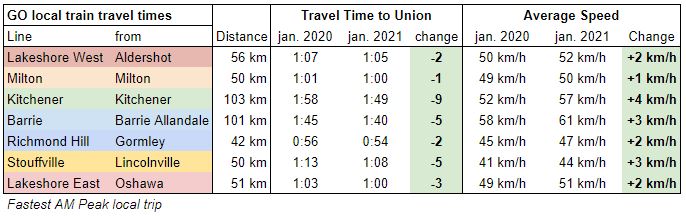
But the upside of drastically reduced ridership is that trains don’t need to dwell as long in stations. Furthermore, the reduced density of train traffic lowers the chance of delays spreading from one train to another. GO Transit has taken advantage of these conditions to shorten local train schedules by a few minutes on all lines.


The particularly large improvement on the Kitchener line is also due to ongoing railway upgrades between Kitchener and Georgetown.

Travel times along the Barrie line also were also helped by the closure of York University station.

Closure of the Deux-Montagnes line
In Montréal, the permanent closure of the Mont Royal tunnel to train traffic has reduced the Deux-Montagnes line to a shuttle service between Deux-Montagnes and Bois-Franc. Meanwhile, the Mascouche line now takes an enormous detour around the mountain, adding 40 minutes to the travel time. Although this technically increased line length considerably, I have not changed the length in the chart since it does not represent any increase in coverage.

On the 31st of December 2020, the rest of the Deux-Montagnes line will permanently close, to enable construction on the Réseau Électrique Métropolitain metro line which will replace it. The Deux-Montagnes line was the last remaining portion of the Canadian railway network to be electrified, so starting New Year’s day, Canada’s railway network will be 100% diesel-powered. This makes Canada the opposite of Switzerland, whose railway network is 100% electrified.

Metrolinx plans to electrify several railway lines in and around Toronto, so this situation should hopefully only last a few years.

Moving Forward
The current ridership slump is of course due to the stay-at-home measures which have eliminated the primary source of commuter rail ridership: travel between suburban houses and downtown offices, attractions and events. Once the pandemic is over, ridership will naturally increase again. The 2019 situation will represent a benchmark by which to measure the recovery over the next couple years.

But some travel patterns may never return to the way they were in 2019. Even prior to the pandemic, many office-based employers were cutting their real-estate expenditures by encouraging employees to work at least partially from home part time and reconfiguring offices to a co-working layout. Now that virtually all office workers have been set up to work from home, I would expect this trend to accelerate considerably, with many more people commuting 2 or 3 days per week.

If people commute less frequently, they will also be willing to live further from their workplace. So while the overall amount of commuter demand will almost certainly decrease, the amount of long-distance commuting may remain stable or even increase.

I also expect that off-peak ridership will become more important. Indeed GO Transit has reported that 61% of its ridership during the pandemic has been outside of rush hour, compared to only 39% in 2019. Of course travel pattern changes during the lockdown do not necessarily correspond to travel patterns in the future, but if my guesses are correct, this may represent an exaggerated picture of the travel pattern changes to come.

GO Transit is well-prepared for this likely shift in travel patterns. The GO Expansion program includes a heavy focus on off-peak and long-distance ridership. Of particular note is the plan for all-day express service from Toronto to destinations such as Hamilton and Kitchener, the former of which could begin as soon as next year.

The other two commuter rail operators have little to no off-peak service, and no comparable plans to introduce regular all-day service. They are therefore more vulnerable to changes in peak-period ridership.
 
Last edited:

Back
Top