





6ixGod
Active Member
I don't know if this is your YouTube, but "Transmania" is a quite a channel name... maybe I'll get a tuque!
It’s not mine, but it definitely caught my eye. He makes good content too.
|
|
|
I don't know if this is your YouTube, but "Transmania" is a quite a channel name... maybe I'll get a tuque!

Deeply unserious operating procedures. Why are driver changes happening at random stops on revenue service and not at terminals?The train I was on that had the driver change waited at Tobermory for 5 minutes
Even Jane Street would be a better place since its right next to the yard. Tobermory makes no sense at all for a crew change location.Why are driver changes happening at random stops on revenue service and not at terminals?
ION LRT got 15,000 boardings per day in 2024. The 36 Finch West bus got 39,000 boardings per day in 2024. But Kitchener-Waterloo is a unique case and arguably the Regional municipality had more discretionary spending room per capita than Toronto. Even then they only paid $800 million for 19 km of tram, versus $2.5 billion for 10 km of tram just a few years later.The Line 6 Finch West corridor is as dense as the iON LRT corridor and many said it didn't need an LRT either, yet the iON LRT is the most used transit route in KW now and is spurring further development along the corridor and the Region there is moving forward with it's stage 2 expansion down to Cambridge.
 www.grt.ca
 stevemunro.ca

Good question. I see this a lot on buses. There seem to be 2 ways to make a shift change:Why are driver changes happening at random stops on revenue service and not at terminals?
ION LRT got 15,000 boardings per day in 2024. The 36 Finch West bus got 39,000 boardings per day in 2024. But Kitchener-Waterloo is a unique case and arguably the Regional municipality had more discretionary spending room per capita than Toronto. Even then they only paid $800 million for 19 km of tram, versus $2.5 billion for 10 km of tram just a few years later.
Also, a corridor needing/being suitable for a tram is one thing. Having high ridership per km / per $ is another thing.
Performance measures
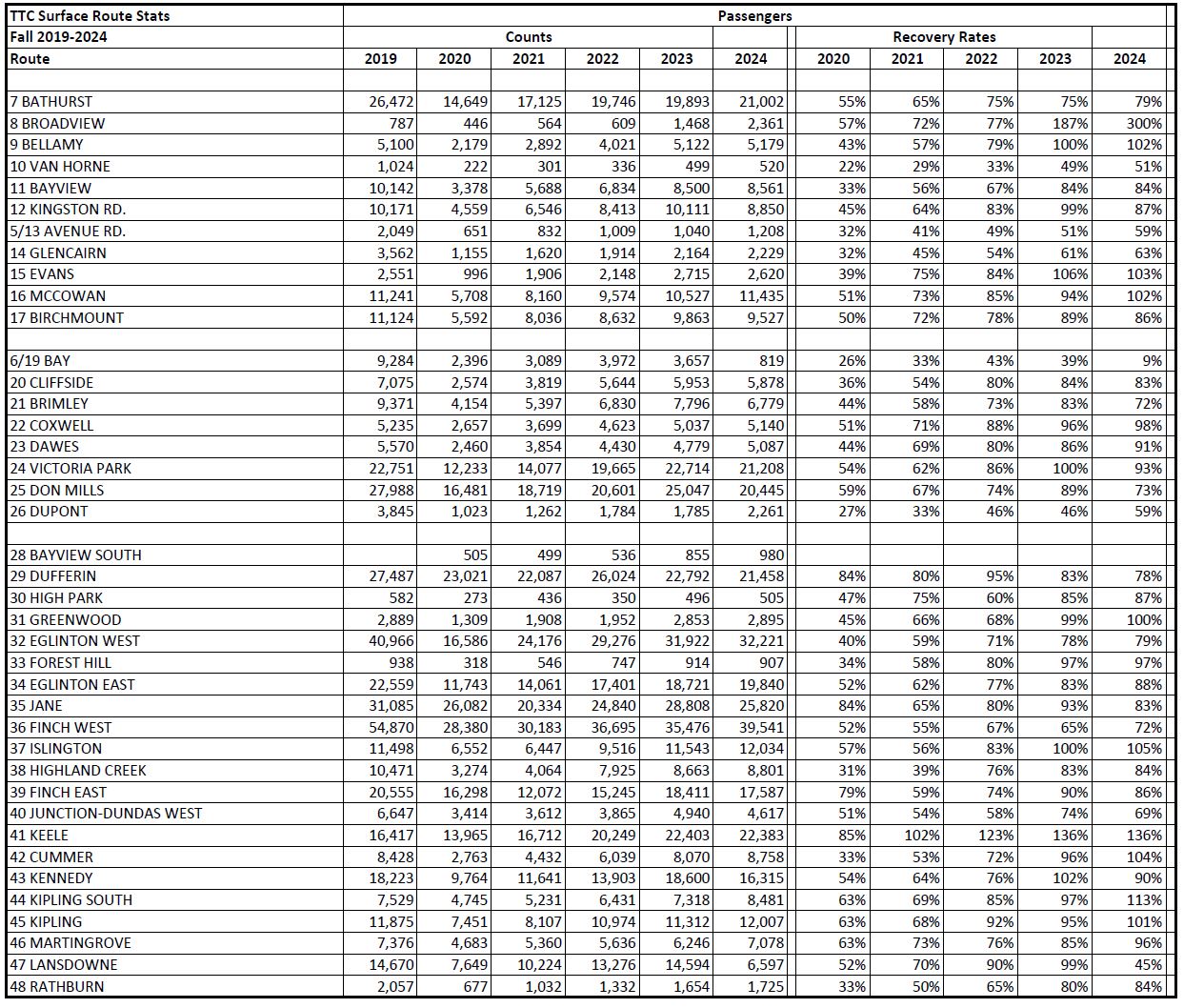
Ridership and on-time performance graphs for the past 12 months of service.TTC Surface Route Stats 2019-2024
The list of surface route operating statistics for 2024 recently appeared on the TTC’s Planning webpage. This article consolidates data for the years 2019 (the last pre-pandemic year) to 2024…
Because one (or both) of the drivers are running late and thus out of position in terms of where they are supposed to be during their shift.Deeply unserious operating procedures. Why are driver changes happening at random stops on revenue service and not at terminals?
It can and does happen on just about every single route if things go pear-shaped - even buses.I would joke about doing that on Line 1 during rush hour, but from the sheer amount of delays already present most probably wouldnt notice anyway

Normally, it's done at the closest intersection to the division from which the route is dispatched. For reasons that have never been entirely clear to me, every bus driver has to report first to the garage before they actually go relieve their bus on the street, and thus the changeoff point is usually chosen for its proximity to the division.At some obscure intersection. I've seen odd locations used for decades. Wait time is usually 5 mins, including time to adjust seat height and mirrors. My guess: A driver with seniority gets to have the shift change happen a short walk from his home.

Changes? Or two drivers swapping vehicles when they pass (which is common enough on streetcars).Why are driver changes happening at random stops on revenue service and not at terminals?

I timed 41 minutes from Finch West to Humber College earlier this month, though it does seem to be inconsistent.43 minutes from Humber College to Finch West - must be a new record
Pardon the nit pick on "cheap-bare bones stations". ION surface stops don't seem cheap at all when compared to Line 6, unless you think Line 6 has expensive bare-r bones stops... Is it justifiable that Waterloo paid less than 1/3rd for something that started major construction in 2014 instead of 2019, and got better surface stops? All that money was blown on overbuilding the terminus stations and much much more.Ion was done on the cheap- bare bones stations, and a route designed around existing rail corridors as much as around ridership potential. I'm not sure that it's accurate to say that the Region of Waterloo has more discretionary spending room. I don't think Ion Phase 1 would have been built at the time for $1.2 billion. We're going to see whether Ion Phase 2, 17 kilometres to Cambridge, gets built for an estimated $3.3 billion.
(I've mentioned this to you before but not on the forums so i'm repeating myself)Pardon the nit pick on "cheap-bare bones stations". ION surface stops don't seem cheap at all when compared to Line 6, unless you think Line 6 has expensive bare-r bones stops... Is it justifiable that Waterloo paid less than 1/3rd for something that started major construction in 2014 instead of 2019, and got better surface stops? All that money was blown on overbuilding the terminus stations and much much more.
View attachment 706250View attachment 706251
I was hoping you would chime in actually, I mentioned overbuilding... and much much more as a personal callback to you letting me know exactly how overbuilt Line 6 is. But I didn't want to just regurgitate what you told me and effectively take the credit.(I've mentioned this to you before but not on the forums so i'm repeating myself)
Unfortunately cost of a sheltered station is not a function of how useful the shelter is. In a smart world, yes, but consider the fact that the ION shelters are
- Far fewer- Generally one shelter on ION stops as opposed to up to EIGHT shelters per "station" on 6 FW- though the singular ION shelter is usually larger on footprint than a single 6FW shelter
- Far less material- just look at the sheer heft of those 6 FW stops versus. the ION walls and roof are much thinner than the 6FW, which are insanely overbuilt and hefty.
- Far shorter- For some reason they build the 6 FW shelters for giants? Every image I see of the shelters they look like thrice the height of a human... I'm genuinely interested in bringing a tape measure and trying to catch it on the roof to see how tall they are.
- Far smarter- MX is yet to be informed that four walls make a shelter, not one and two-halves. It is nearly comical to me how thick and overbuilt the roof and wall is, but the side glass panels are tiny and are miserably short.
In short: The 6FW shelters are not cheap, nor are they poorly built. They are horribly designed and overbuilt.
The horribly useless yet expensive terminal stations are the peak of this ideology, but even without them i'd say the stations are at bare minimum 3x more expensive on shelters than ION.
ION also only built the shelters on half the platform length at the start since the full length of the platform wouldn't be needed for trains until years later.(I've mentioned this to you before but not on the forums so i'm repeating myself)
Unfortunately cost of a sheltered station is not a function of how useful the shelter is. In a smart world, yes, but consider the fact that the ION shelters are
- Far fewer- Generally one shelter on ION stops as opposed to up to EIGHT shelters per "station" on 6 FW- though the singular ION shelter is usually larger on footprint than a single 6FW shelter
- Far less material- just look at the sheer heft of those 6 FW stops versus. the ION walls and roof are much thinner than the 6FW, which are insanely overbuilt and hefty.
- Far shorter- For some reason they build the 6 FW shelters for giants? Every image I see of the shelters they look like thrice the height of a human... I'm genuinely interested in bringing a tape measure and trying to catch it on the roof to see how tall they are.
- Far smarter- MX is yet to be informed that four walls make a shelter, not one and two-halves. It is nearly comical to me how thick and overbuilt the roof and wall is, but the side glass panels are tiny and are miserably short.
In short: The 6FW shelters are not cheap, nor are they poorly built. They are horribly designed and overbuilt.
The horribly useless yet expensive terminal stations are the peak of this ideology, but even without them i'd say the stations are at bare minimum 3x more expensive on shelters than ION.