




|
|
|
You are using an out of date browser. It may not display this or other websites correctly.
You should upgrade or use an alternative browser.
You should upgrade or use an alternative browser.
Finch West Line 6 LRT
- Thread starter Monarch Butterfly
- Start date
youngblood
Active Member

T3G
Senior Member
Just putting this reminder here before we get people attempting to discredit the chosen mode of transport again based on sketchy agency-level operating procedures.

And a demo of what we could also have if North American institutions didn't prize the illusion of safety over common sense:

And a demo of what we could also have if North American institutions didn't prize the illusion of safety over common sense:
Last edited:
urbanclient
Active Member
The marketing said 34 minutes end to end, for an average of 18 km/h. Now we're being told it could go as high as 46 minutes. JFC the hits keep on coming... 46 minutes implies an average speed of 13.4 km/h for a 10.3 km route. It is a farce that this is even on the TTC Subway map without a disclaimer.
The true subway speed is between 25-29km/h depending on Line and time of day (The service summary and navigation apps are not accurate).

nfitz
Superstar
That seems rather out of date.Just putting this reminder here before we get people attempting to discredit the chosen mode of transport again based on sketchy agency-level operating procedures.

Here's the one they posted yesterday (Thursday) morning.
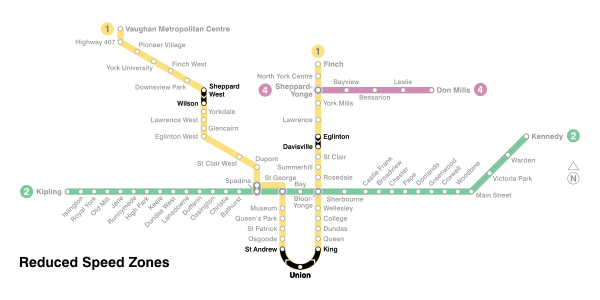
Gosh, the ones at Union are new. Looks like it will be there until early December westbound and mid-December eastbound.
T3G
Senior Member
Thanks, I wasn't aware that there was a page on the site for it with the up to date one.
Nonetheless, either map proves my point... if you have a bunch of circus clowns at the helm, being a subway instead of an LRT is no guarantee of speed or reliability. Nor are buses.
mikey7767
Active Member
It's called average speed. Also, even the slow zones have a higher average speed than any LRT, streetcar, or bus route.Thanks, I wasn't aware that there was a page on the site for it with the up to date one.
Nonetheless, either map proves my point... if you have a bunch of circus clowns at the helm, being a subway instead of an LRT is no guarantee of speed or reliability. Nor are buses.
Kyle Campbell
Senior Member
It seems excessively slow. That's much slower than ION, which travels almost double the distance in that same 46 minutes.The marketing said 34 minutes end to end, for an average of 18 km/h. Now we're being told it could go as high as 46 minutes. JFC the hits keep on coming... 46 minutes implies an average speed of 13.4 km/h for a 10.3 km route. It is a farce that this is even on the TTC Subway map without a disclaimer.
The true subway speed is between 25-29km/h depending on Line and time of day (The service summary and navigation apps are not accurate).
I know Finch is using the beloved Citadis which is so near and dear to our hearts in Ottawa, and maybe that they are afraid of it going off the rails, quite literally
Kyle Campbell
Senior Member
I don't know about that. That dreaded one they used to have near Sheppard West was the slowest I think I have ever moved on a subway or lrt anywhere I've beenIt's called average speed. Also, even the slow zones have a higher average speed than any LRT, streetcar, or bus route.
taylortbb
New Member
It seems excessively slow. That's much slower than ION, which travels almost double the distance in that same 46 minutes.
ION gets a higher level of signal priority, and half the route is in a separate right-of-way with heavy rail-style crossing gates.
LNahid2000
Senior Member
Lol we spent billions of dollars to make trips slower on Finch West (due to increased wait times and the line barely being faster than the bus). I hate this city.
toaster29
Active Member
When was the decision made to name the "stops" on this line "Stations" (and who approved it)? It's intentionally misleading. There is one new station on this line, not 18, but all the marketing from TTC is showing "18 new stations". Why don't we add every single streetcar stop onto the "rapid transit" maps and signage while we're at it? This is laughable. All previous copy had used the term "stop" to refer to every single "stop/station" on Line 6, other than Humber College Station (and the existing Finch West) - why did this change?
hw621
Senior Member
Time to jam the inbox of those councillors...Lol we spent billions of dollars to make trips slower on Finch West (due to increased wait times and the line barely being faster than the bus). I hate this city.
Coolibop
Active Member
A bit premature... As Steve posted, the 46min is just a placeholder at this stage. Let's wait til it opens and they can work out the kinks...Lol we spent billions of dollars to make trips slower on Finch West (due to increased wait times and the line barely being faster than the bus). I hate this city.
Then, I'm all for what @hw621 suggested if we don't see improvement...Time to jam the inbox of those councillors...
T3G
Senior Member
Congratulations on completely missing my point.It's called average speed.
The point is that if best practices aren't followed on a mode of transport - ANY mode of transport - delays and inefficiencies arise. When poor operational practices result in an LRT line running slower than it could, you're all out here clamouring to have subways subways subways built everywhere instead, but when the same thing happens on the subway, you're all weirdly silent.
Call a spade a spade - admit that the GTA is no better at subway or bus operations than LRTs - or admit that you're letting your own bias against LRT colour your own perception and arguments. The double standards here are ASTONISHING. World class cities don't have oodles of slow zones that take months to remove, that weren't discovered until an entire line was shut down due to deferred maintenance.
The fact that they've bungled the Finch implementation, and will no doubt do the same on Eglinton, is not a compelling argument to have subways on those corridors instead. It's a compelling argument to criticize the implementation and push for better practices, including traffic priority and higher allowed speeds. Especially Finch, which is perfectly suited for an LRT - if you told a European that you were proposing to build a subway on that corridor instead, they'd laugh in your face.
What a load of bunk! Have you ever ridden a bus in the suburbs? Or an LRT in Europe? With the sole exception of the Yorkdale-Lawrence West slow zone, all of the reduced speed zones have a maximum speed between 15 and 25 km/h, which buses and European LRTs routinely go faster than. Perhaps people would take your argument more seriously if you didn't make shit up in order to back your argument up.Also, even the slow zones have a higher average speed than any LRT, streetcar, or bus route.