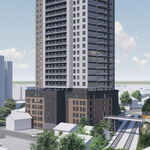
First of all, the targets are actually pretty low - leaving 60% of all residential growth to happen pretty much exactly how we are used to it happening - in spread-out, meandering, single-use suburbs, between the edges of the growth centres and the Greenbelt. 40% is not very far from what we know to be the status-quo in the region. Already intensification for the Greater Golden Horseshoe (the GGH) was estimated at 36% between 1991 and 2001, and the trend is for this percentage to increase. Likely, the actual intensification portion of projected residential building will occur in the form of tall towers, unless municipalities step in. The trend of ‘either flat or tall’, as I recently heard it described, is only likely to continue under the proposed plan.
The second problem with the intensification targets is that they are just too darn uniform. The GGH is a widely varied area and the identified growth centres are qualitatively different based upon their geography and their history. Intensification is already happening at very different rates in different places. According to Neptis, intensification in the City of Toronto between 1991-2001 was already at 96%. For the inner ring of suburbs, it was estimated at 28%, and the outer ring was intensifying at an average rate of 17%. So we can see that while 40% seems like a dramatic increase for places on the outside such as Simcoe County where only 8% of their residential growth was in the form of intensification over this period, it should probably be higher for a place like Niagara Region which is already at 33%. The Neptis report figures that outside of the City of Toronto the proposed intensification targets would only result in a total of 16% of all development units being transferred from rural sites to sites within urban boundaries.
But the primary problem with the province’s intensification targets is that, according to Neptis, they are measuring the wrong things. First of all, between 1991 and 2001, 50% of the intensification in the GGH occurred within half a kilometer of the urban edge, which the report refers to, reasonably, as a “particularly ineffective form of intensification.” In fact, development so close to the ‘urban edge’, which itself is a shakily defined thing, is hardly intensification at all! This sort of phenomenon is just not accounted for in the Plan.
As the Neptis report says, “The Growth Plan contains many policies, but few tools by which to measure progress toward their achievement.” Intensification targets should not be so focused on measuring residential growth. It ignores the very complicated nature of the planning problems. For one thing, the plan fails to recognize the difficulty of centering employment in urban growth areas when location decisions made by employers are often focused on property tax, parking availability and access to highways.