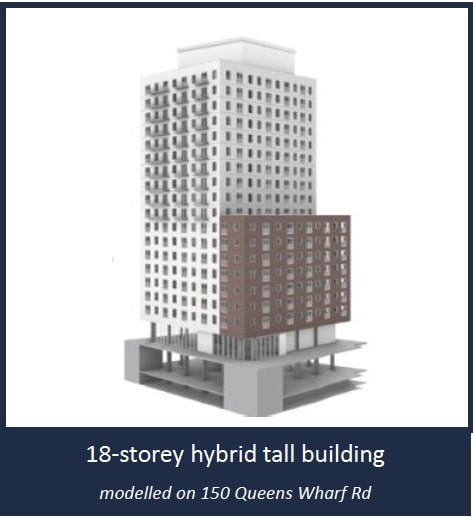
Toronto 150 Queens Wharf | 140.93m | 37s | TCHC/CreateTO | Karakusevic Carson + Teeple


These numbers are expected to further favour mass timber as time goes on. “As more and more [developers] take it up, there will be more supply,” Vic Gupta predicted, and this would mean “levelling out of pricing and more predictability of pricing.” Looking further into the future, the pilot program also examines the typology for a taller building made of mass timber, modelled on 150 Queens Wharf.

The next steps include advancing the rezoning for the subject site, as well as reporting on the business case in the first quarter of 2024. From there, the plan is to have an opportunity to advance a market offering for the building.

With mounting pressure to bring more residential units to market, and conventional construction costs still high even in this period of slow construction, Vic Gupta believes that the future is very bright for this type of build. The technology's environmental impacts, vastly reduced construction time, and ability to put more people into more homes are the compelling arguments put forth in the pilot program.
51866-155964.jpg
 
Some revisions here.............and people will be happy.

@HousingNowTO

@Paclo

Essentials first:

Design Architect: Karakusevic Carson

AoR: Teeple

Height: 37s (140.9m to top of MPH)

Old AIC Link:


Now the details:

1764938279270.png


1764938315684.png


Site Plan:

1764938422894.png


Ground Floor Plan:

1764938465179.png


Example of Tower layout: (look at the wonderful unit sizes!)

1764938547056.png


Stats:

1764938578489.png


Zero studios! Woohoo! But have a look at this, the smallest one bedroom is ~600ft2 and they range up to ~650ft2, 2 bdrm units start at over 815ft2 and run to 1,250ft2, and finally 3brms start at 1,250ft2 and run to 1,430ft2!!

Now this is how it should be!

On top of all that we have @ProjectEnd bonus, the elevator ratio: 4 elevators to 268 units, or 1.49 elevators per 100 units!!!

I'll put the description details from the Cover (planning) Letter below. But lets review, taller, but minimal shadows, fewer, larger units, higher ceilings, curves introduced, colour, building looks good and has less parking. We have a winner! Express lane please!

1764939053826.png

1764939082681.png

1764939107767.png
 
Quote : "Zero studios! Woohoo! But have a look at this, the smallest one bedroom is ~600ft2 and they range up to ~650ft2, 2 bdrm units start at over 815ft2 and run to 1,250ft2, and finally 3brms start at 1,250ft2 and run to 1,430ft2!!"

I cannot share your enthusiasm. Honestly, based on the above - I have no idea how the City expects to be able to build this newly proposed building design at any meaningful level of affordability...?

Everything that they are highlighting as "improvements" (eg. rounded shape, larger units, small floor-plate w/ 6-units per floor, etc) leads to a very expensive building in a very tight / constrained development location, that I cannot see CMHC being willing to fund via any of it's current programs.

Z_Block 36 North - Queens Wharf_CreateTO.png


The 3-bedrooms all look to be "Million-Dollar plus affordable housing apartments" from a design-build POV..?

The TOTAL APARTMENT numbers from above were not reflected in the most recent CreateTO "Housing Tracker" from November 2025 -- but they are saying that it is now = "To be delivered by Toronto Community Housing Corporation".

1764942179058.png


PDF - https://www.toronto.ca/legdocs/mmis/2025/ra/bgrd/backgroundfile-259780.pdf

This feels like a plan that is disconnected from reality.
 
You too can play in fantasy land of oversized units and overkill elevator ratios with fancy architecture when you are playing with public tax dollars! woo-wee!

Seriously. The city is wasting the ability to house probably an extra 100 families or so here by their little games with oversized units. Build proper 900sf 3-bed, 750sf 2-bed, and 550sf 1-beds and get on with it. Affordable housing should be affordable, not luxuriously more spacious than basically any market-rate unit. We don't need to go building micro units either.. though some micro-sized studios would actually be great for deeply affordable housing.. but 1,250sf 3-beds are just totally ridiculous.

Also @Northern Light - I always appreciate your postings! The link you posted does not work however - you may have to resort to the "new AIC" link.
 
You too can play in fantasy land of oversized units and overkill elevator ratios with fancy architecture when you are playing with public tax dollars! woo-wee!

Maybe. I don't have the numbers their using, but I might be tempted to read this as the Vienna model. Design a building to attract high-end of full market rent, use the extra $$ and high occupancy to subsidize the affordable units.

If Vienna can do it, so can we.

Also @Northern Light - I always appreciate your postings!

Thank you. Much appreciated.

The link you posted does not work however - you may have to resort to the "new AIC" link.

I know the link doesn't work directly, but this application isn't live in the new AIC yet.

I suppose I could just omit the link.
 
...this tower will be like holy water being flung around in a room full of spandrel'd vampires, goodness. 🙀
 
Quote : "Zero studios! Woohoo! But have a look at this, the smallest one bedroom is ~600ft2 and they range up to ~650ft2, 2 bdrm units start at over 815ft2 and run to 1,250ft2, and finally 3brms start at 1,250ft2 and run to 1,430ft2!!"

I cannot share your enthusiasm. Honestly, based on the above - I have no idea how the City expects to be able to build this newly proposed building design at any meaningful level of affordability...?

Everything that they are highlighting as "improvements" (eg. rounded shape, larger units, small floor-plate w/ 6-units per floor, etc) leads to a very expensive building in a very tight / constrained development location, that I cannot see CMHC being willing to fund via any of it's current programs.

View attachment 700705

The 3-bedrooms all look to be "Million-Dollar plus affordable housing apartments" from a design-build POV..?

The TOTAL APARTMENT numbers from above were not reflected in the most recent CreateTO "Housing Tracker" from November 2025 -- but they are saying that it is now = "To be delivered by Toronto Community Housing Corporation".

View attachment 700704

PDF - https://www.toronto.ca/legdocs/mmis/2025/ra/bgrd/backgroundfile-259780.pdf

This feels like a plan that is disconnected from reality.
The City needs to cap the unit count because the incoming pipes and outgoing sewers are already over capacity. When CityPlace was first dreamed up in the late 90s, certain densities were targeted and the deep infrastructure constructed at the time was intended to meet (exceed slightly, to be completely correct) those numbers. What actually got built out is at least 50% larger and denser than those original plans so here we are: the last block would not be able to reliably flush the toilets if constructed to 'market spec'.
You too can play in fantasy land of oversized units and overkill elevator ratios with fancy architecture when you are playing with public tax dollars! woo-wee!

Seriously. The city is wasting the ability to house probably an extra 100 families or so here by their little games with oversized units. Build proper 900sf 3-bed, 750sf 2-bed, and 550sf 1-beds and get on with it. Affordable housing should be affordable, not luxuriously more spacious than basically any market-rate unit. We don't need to go building micro units either.. though some micro-sized studios would actually be great for deeply affordable housing.. but 1,250sf 3-beds are just totally ridiculous.

Also @Northern Light - I always appreciate your postings! The link you posted does not work however - you may have to resort to the "new AIC" link.
I'm mixed on this. I see where you're coming from in terms of the 'math', but if the City wants private developers to work towards (and, gasp, embrace) things like the GuG, they have to lead by example. They can't tell developer X you need to follow these minimums, but we do not. I also think that having the City lower themselves to the basest capitalism of the worst class of people (real estate developers) is not the mission of a housing provider which should indeed try to rise the tide (and lift all boats) by providing stock that people might even find preferable to that offered by the private sector. That may be a bit too ideological, but again, like I said, I'm mixed on this.
 
The City needs to cap the unit count because the incoming pipes and outgoing sewers are already over capacity. When CityPlace was first dreamed up in the late 90s, certain densities were targeted and the deep infrastructure constructed at the time was intended to meet (exceed slightly, to be completely correct) those numbers. What actually got built out is at least 50% larger and denser than those original plans so here we are: the last block would not be able to reliably flush the toilets if constructed to 'market spec'.

I'm mixed on this. I see where you're coming from in terms of the 'math', but if the City wants private developers to work towards (and, gasp, embrace) things like the GuG, they have to lead by example. They can't tell developer X you need to follow these minimums, but we do not. I also think that having the City lower themselves to the basest capitalism of the worst class of people (real estate developers) is not the mission of a housing provider which should indeed try to rise the tide (and lift all boats) by providing stock that people might even find preferable to that offered by the private sector. That may be a bit too ideological, but again, like I said, I'm mixed on this.
I don't entirely disagree - as I said, I don't think the City needs to be running around building 700sf 3-beds and 400sf 1-beds like some industry builders do. They should be targeting functional, simple units without excess space - which tends to align closer to the numbers I quoted - 550-600sf 1-beds, 750-800sf 2-beds, and 900-1,000sf 3-beds. Those areas are functional unit sizes without being excessive.

Part of the problem with the GuGs is that the City's requested unit sizes were so far off market realities that they had no leverage to actually achieve them. The GuGs should have set targets of functional, useful unit layouts. Instead of pushing uselessly large units, they should have instead set targets of marginal improvements in unit layouts and larger acknowledgements of market realities. Even just encouraging developers to actively think about unit layouts during design processes goes a long way. Too often the design process in this city is to rush in a ZBA application to secure the maximum GFA possible with no thought about how that built form will function or what kinds of units it will produce.

Hearing about the capacity issues in this area is interesting and something I wasn't aware of. If that is the case then perhaps this is a good opportunity to provide a large number of 3-bed units, but again, at reasonable unit sizes. Do 1,000sf 3-beds and deliver a building full of them. We all know there is a massive shortage of family-sized units in this city and they are badly needed, but there is a shortage because families can't afford the 800-900sf 3-beds already on the market, yet alone 1,250sf units.
 
one more comment about this one - Open-air Type G loading? When has the city ever allowed that in the downtown? Definitely a great cost-cutting measure.
 

Back
Top