News   Jan 30, 2026
 3.1K     6 
News   Jan 30, 2026
 4.7K     1 
News   Jan 30, 2026
 533     0 

Alto - High Speed Rail (Toronto-Quebec City)

If I were VIA (and assuming the legacy services remain, at least for the decade of construction) I can't understand why Dorval is named as such and not Trudeau Airport. I don't have any data on who gets on/off at Dorval or how many transfer to the airport, but it just seems too sensible optically to enhance the appearance (and hopefully reality) of the transfer option.
Alto may or may not choose a route close to Trudeau, if they did, I would see such a station as a complete no-brainer, notwithstanding the intent to have very few local stations en route.

- Paul
Many people call YUL "Dorval airport" (at least here in Ottawa), and there seems to be pretty universal knowledge that Dorval station is near YUL
 
The maps I've seen all presume that the ALTO route will run along the north shore of the St. Lawrence and dip directly into Montreal from the Northwest via Laval. Adding a stop at Dorval would require a significant deviation, and may cut against the apparent intent of treating Laval as a secondary transfer station. (If all trains in and out of Montreal run through Laval, you can transfer between services there without going into the city, and you can also use Laval as a backup hub in the event that Gare Centrale is unavailable. If you want to run the trains all the way to Dorval, none of that works in a halfway-sensible way.)
 
It was especially myopic for the REM not to continue just that one last stop to Dorval Station for the VIA, Exo, and STM bus connections.
Maybe so, but at inception it would have been an expensive proposition to tack onto an otherwise reasonably priced project (extra 1-1.5km of tunnel depending where you excavate).

REM users from the north can reach Via from Gare Centrale. Airport users can reach Dorval from an airport shuttle bus. If you want to improve speed and capacity of the shuttle route, build a cheap, above-ground airport link like Pearson.

I get that there’s value to be added with the extension, but its exclusion is definitely justified.
 
Maybe so, but at inception it would have been an expensive proposition to tack onto an otherwise reasonably priced project (extra 1-1.5km of tunnel depending where you excavate).

REM users from the north can reach Via from Gare Centrale. Airport users can reach Dorval from an airport shuttle bus. If you want to improve speed and capacity of the shuttle route, build a cheap, above-ground airport link like Pearson.

I get that there’s value to be added with the extension, but its exclusion is definitely justified.
And in the next 15 years, who knows what expansions the REM may look at.
 
Maybe so, but at inception it would have been an expensive proposition to tack onto an otherwise reasonably priced project (extra 1-1.5km of tunnel depending where you excavate).
I'm not sure why you'd excavate under nothing much but parking lots - which stretch much of that 1.5 km.

REM users from the north can reach Via from Gare Centrale. Airport users can reach Dorval from an airport shuttle bus. If you want to improve speed and capacity of the shuttle route, build a cheap, above-ground airport link like Pearson.
VIA and the airport aren't the issue.

The issue is that the biggest transit hub in West Island was located at Dorval Station. Not connecting it to the light rail was a horrific decision. It would have solved many last mile issues, and made commuting easier and faster for many that live south of the 20.
 
Hard to interpret this sentence, are you suggesting cut and cover? The train is 35 metres below ground at the Airport so that doesn’t exactly save you any money/effort.
I was suggesting elevated, though cut-and-cover likely isn't too problematic, because there won't be much in the way of the usual services.

Wow that's deep. Is there a map showing where the station actually is? A crappy one I see on line, has the tail tracks heading due map south (perpendicular to the 20), ending half-way under the parking structure (which look triple the size last time I parked there - I normally taxi, or take the train). Are you saying the tail tracks under the parking structure are level, and don't start rising up?

Which only leaves about 900 metres to the current intermodal station at Dorval, and about 75 metres to the south end of the parking structure.

Which might preclude elevated - at least until they want to get over the railway tracks and Cardinal Avenue. What's the maximum incline for the REM and the Alstom Metropolis? Presumably at least the 8% the Flexity can handle (I'm not sure what the Flexity limit is either, other than the existing 8%). Which would take over 400 metres to get to a portal if the track is 35 metres deep!

That station sounds unusually overdesigned compared to all the other new stations. I wonder what drove it so deep; I don't think the 13 is that deep under the runways. Is there a nuclear fallout shelter under the terminal of something, when they first built it in the 1950s?

Hmm, is this the station excavation under MPETIA (!:)) parking structure? It does look deep on Google Maps:
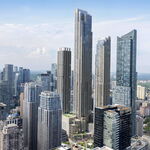
1769748930448.png
 
Last edited:
The maps I've seen all presume that the ALTO route will run along the north shore of the St. Lawrence and dip directly into Montreal from the Northwest via Laval. Adding a stop at Dorval would require a significant deviation, and may cut against the apparent intent of treating Laval as a secondary transfer station. (If all trains in and out of Montreal run through Laval, you can transfer between services there without going into the city, and you can also use Laval as a backup hub in the event that Gare Centrale is unavailable. If you want to run the trains all the way to Dorval, none of that works in a halfway-sensible way.)
Well yeah that's the whole point of the discussion. We're noting that selecting a Laval alignment instead of a Dorval alignment means that the line will not serve YUL, which is one of the main destinations for current train/bus trips in the Ottawa-Montreal corridor. It's also odd considering Air Canada is part of the consortium for Alto.

I'm not familiar enough with airline operations to really flesh it out myself, but I'm curious if there's any possibility that Air Canada would be interested in moving their hub to Mirabel if that airport gets high-speed links to Ottawa and downtown Montreal. YUL is notoriously cramped, so they might like the idea of consolidating their Ottawa and Montreal flights into a single airport.
 
I'm not familiar enough with airline operations to really flesh it out myself, but I'm curious if there's any possibility that Air Canada would be interested in moving their hub to Mirabel ...
After the previous dramatic epic, I think the answer is not in a million years would operations move to Tinkerbell.
 
After the previous dramatic epic, I think the answer is not in a million years would operations move to Tinkerbell.
Without wishing to derail the thread, could I get a *very brief* summary of that history?

I think there is a lot of potential for Alto to run along the Lachute sub not-so-far south of Mirabel Airport. It’s a very straight rail ROW stretching most of the way between Laval and Hawkesbury.
 
Without wishing to derail the thread, could I get a *very brief* summary of that history?

I think there is a lot of potential for Alto to run along the Lachute sub not-so-far south of Mirabel Airport. It’s a very straight rail ROW stretching most of the way between Laval and Hawkesbury.
Mirabel was supposed to replace Dorval, and ended up becoming a white elephant instead. Lots of companies and people got burned in the process. The experience is now gradually leaving institutional memory, but the history is still recent enough that any effort to relaunch Mirabel would attract significantly more opposition than you might otherwise expect.

The whole thing is also something of a sore point within Quebec: part of the reason this plan failed is that traffic into Montreal declined as the commercial centre of Canada shifted to Toronto. Mirabel was dreamed up in the Drapeau, sky's-the-limit era of Montreal and Quebec's potential, which is part of how it hung on for so long. Closing it down was tantamount to admitting that Toronto had won.

 
Mirabel was supposed to replace Dorval, and ended up becoming a white elephant instead. Lots of companies and people got burned in the process. The experience is now gradually leaving institutional memory, but the history is still recent enough that any effort to relaunch Mirabel would attract significantly more opposition than you might otherwise expect.

To add a further comment - while Mirabel exists as a runway and some facilities, the terminal facilities themselves are basically no longer extant. I don't have an idea of what it would cost to rebuild them, versus the cost of a Trudeau expansion, but I would bet money that expanding Trudeau would prove to be a better business case.

- Paul
 

Back
Top